
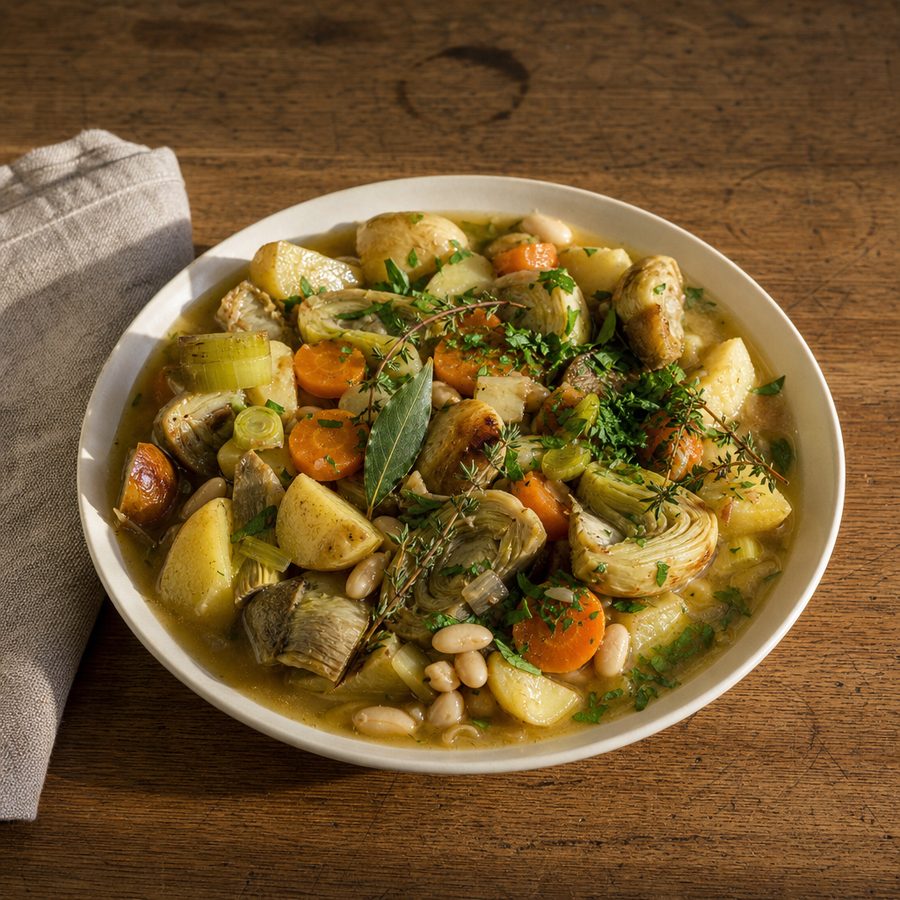
Artichokes Barigoule with Carrots, Leeks, and White Beans
Artichoke hearts braised in olive oil with carrots, leeks, potatoes, thyme, and bay until everything is tender, brightened with lemon and finished with white beans and a lot of parsley.
Why You'll Love This Recipe
Barigoule is a Provencal way with artichokes that dates back to a time when they were braised with wine, oil, and whatever root vegetables were in the cellar. The traditional version starts with fresh baby artichokes, which are wonderful and also a twenty minute job with a paring knife and a bowl of lemon water. I use good jarred or frozen hearts instead, rinsed well, and the dish loses very little. What you are really after is the broth, which turns cloudy and golden and tastes of thyme, bay, sweet allium, and lemon.
The order of the pan matters more than any single ingredient. Onion and leek go in first over gentle heat and cook until they are soft and sweet without browning, because browning would push this in a darker direction than it wants to go. Then carrots and potatoes, then garlic and herbs, then the liquid, and finally the artichokes, which need only ten minutes and turn stringy if you cook them from the start. The lid goes on and the pan does the rest while you set the table.
White beans go in at the end and turn what would be a side dish into dinner, softening at the edges in the hot broth and thickening it slightly as they do. Then the pan comes off the heat and gets a full half cup of chopped parsley and a good squeeze of lemon, both added late so they stay sharp. The artichoke hearts have already brought their own brine to the pot, so taste before you reach for the salt cellar and you may find it does not need any.
Ingredients
- 9 oz artichoke hearts, drained and rinsed well, halved through the stem
- 3 small Yukon Gold potatoes (about 12 oz), scrubbed and cut into 1-inch chunks
- 4 medium carrots, cut into thick diagonal coins
- 1 cup no-salt-added cannellini beans, drained and rinsed
- 1 large leek, white and pale green parts only, halved and sliced into half moons
- 1 large yellow onion, cut into thin wedges
- 3 1/2 tbsp extra-virgin olive oil, divided
- 2 tbsp lemon juice, plus wedges for the table
- 1/2 cup chopped flat-leaf parsley
- 4 garlic cloves, thinly sliced
- 6 sprigs fresh thyme
- 1 dried bay leaf
- 1/2 tsp freshly ground black pepper
Instructions
- Prepare everything first: This braise moves quickly once it starts, so cut the carrots into thick coins, the potatoes into 1-inch chunks, the onion into wedges, and the leek into half moons. Wash the leek slices in a bowl of water and lift them out, leaving the grit behind. Drain and rinse the artichoke hearts and halve them.
- Soften the alliums: Warm 2 1/2 tbsp of the olive oil in a wide braising pan over medium-low heat. Add the onion and leek and cook for eight minutes, stirring, until they are limp and translucent. You want no color at all here, so drop the heat if they start to catch.
- Add the roots and aromatics: Stir in the carrots and potatoes and cook for three minutes, turning them in the oil. Add the garlic, thyme sprigs, bay leaf, and black pepper and cook one minute more, until the thyme smells resinous and the garlic has softened without browning.
- Braise: Pour in 1 cup water and half the lemon juice, bring it to a simmer, cover, and cook over low heat for 15 minutes. The potatoes should be nearly tender at that point and the liquid should have gone slightly cloudy from the potato starch.
- Add the artichokes and beans: Tuck the artichoke halves and the cannellini beans in among the vegetables, cover again, and cook for 8 to 10 minutes, until the artichokes are heated through and silky and a knife goes into a potato with no resistance. Uncover for the last two minutes if there is more than a shallow pool of liquid left.
- Finish off the heat: Take the pan off the burner, pull out the thyme sprigs and bay leaf, and stir in the remaining olive oil and lemon juice. Fold in most of the parsley, scatter the rest over the top, and serve in shallow bowls with plenty of the broth and lemon wedges alongside.
Variations
- With fennel: Swap the leek for a bulb of fennel cut into wedges, which brings a sweet anise note that suits the artichokes.
- Spring version: Add a cup of shelled green peas and a handful of snap peas for the last three minutes, so they stay bright green.
- With mustard: Whisk a teaspoon of dijon mustard into the broth at the end for a sharper, more assertive finish.
- Over grains: Spoon it over cooked barley or farro and let the broth soak in, which turns the dish into something closer to a stew.
Storage & Leftovers
This keeps four days in a sealed container in the refrigerator. The artichokes soften a little further and the broth thickens as the potato starch settles, both of which are improvements. Add fresh parsley and a squeeze of lemon when you reheat, since the first round of both fades overnight.
Reheat gently in a covered pan over low heat with a splash of water, stirring as little as possible so the potatoes and artichokes stay whole. It is also good at room temperature, spooned over toast or eaten as a salad with an extra drizzle of olive oil.
I do not recommend freezing it. Potatoes turn grainy, artichokes go stringy, and the delicate broth that makes the dish is the first thing lost. It comes together in under an hour anyway, and it keeps most of a work week in the refrigerator.
Notes & Tips
- No browning at the start: This braise wants a pale, sweet base. Onions and leeks cooked slowly without color keep the broth clean tasting, while a browned base makes the whole pan taste like a different dish.
- Rinse jarred artichokes properly: Give them a full minute under cold running water and let them drain. They arrive carrying the flavor of whatever they were packed in, and rinsing lets the thyme and lemon come through instead.
- Add the artichokes late: Ten minutes in the covered pan is all they want. Cooked from the beginning they go stringy and lose the silky texture that makes the dish worth making.
- Wash leeks after slicing: Grit hides between the layers and no amount of rinsing the whole leek gets it out. Slice first, swirl the pieces in a bowl of water, then lift them out with your hands and leave the sand at the bottom.
- Taste before you season: The artichokes come out of the jar already carrying salt, and the broth reduces around them. Taste at the end and adjust then, rather than seasoning at the start out of habit.
Nutrition & Mindful Eating
- Artichokes, root vegetables, and white beans work as three layers here. The artichokes give the dish its character, the carrots and potatoes give it sweetness and body, and the cannellini beans bring the plant protein that lets a pan of vegetables serve as dinner.
- Artichokes are one of the more fiber-dense vegetables, and much of that fiber is inulin, a type that feeds the bacteria in your gut. They also carry folate and a faintly bitter, nutty flavor that no other vegetable quite matches.
- Carrots turn markedly sweeter in a covered pan, and cooking them in olive oil helps your body take up the beta-carotene that gives them their color. Cut thick, they keep enough bite to stand out against the softer things around them.
- Cannellini beans have a thin skin and a floury interior that turns creamy in the hot broth, and they bring folate, potassium, and a slow fiber along with their protein.
- Thyme, bay, garlic, lemon, and a half cup of parsley are the whole seasoning of this pan, and the parsley in particular is generous enough to count as a green, bringing vitamin K and a grassy sharpness that cuts the olive oil.
- As you eat, spoon up the cloudy broth at the bottom of the bowl along with the vegetables, and notice how much flavor came out of a pan that never once browned.
Frequently Asked Questions
Can I use fresh artichokes?
Yes, and they are the original. Use eight baby artichokes, trim away the outer leaves down to the pale heart, halve them, and hold them in lemon water so they do not darken. Add them with the potatoes rather than at the end, since fresh ones need about twenty minutes.
Frozen or jarred, which is better here?
Frozen hearts have the cleaner flavor and a firmer texture, and they go into the pan straight from the bag. Jarred ones are more convenient and already tender, though they carry the brine they were packed in, so rinse them under cold water and taste the broth before you season it.
What can I serve with it?
It stands on its own as written, since the potatoes and beans are both there. A piece of bread for the broth is the traditional companion, and a spoonful of farro or barley in the bottom of the bowl works just as well.
Mine tasted flat. What would you change?
More lemon and more parsley, in that order, both added after the heat is off. This is a pale, gentle braise with no browning in it, so the acid and the raw herb at the end are carrying the top notes and they are worth being generous with.