
Blackened Tilapia with Charred Broccoli and Lime
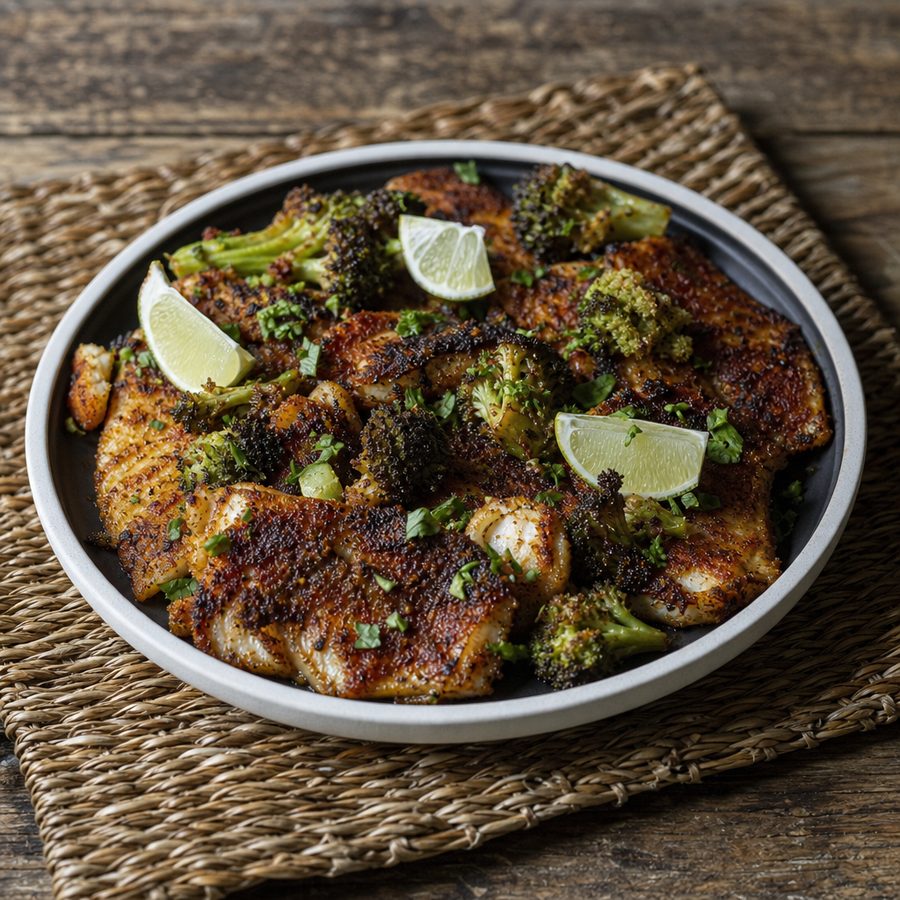
Tilapia fillets rubbed with paprika, oregano, and cayenne and seared dark in a hot skillet, with broccoli charred alongside and lime squeezed over everything.
Why You'll Love This Recipe
Blackening sounds like restaurant cooking and is really just a spice rub, a hot pan, and the nerve to leave a fillet alone until the crust is dark. Tilapia is the fish I use for it, partly because it is inexpensive and easy to find, and mostly because it is thin and mild enough that a heavy crust improves it rather than fighting it. This is a good lunch for a day full of calls, since the fish takes five minutes and the broccoli chars while you mix the rub. Open a window before you start, because a properly blackened fillet smokes.
Two details make or break it. The spice rub needs to go onto a dry fillet and be pressed in, not sprinkled over, so it forms a crust rather than a dusting that falls off into the pan. And the broccoli should go in first and come out before the fish, because the florets want six or seven minutes and the fillets want five, and a pan holding both at once will not have room to char either. Paprika burns if the heat is too high for too long, so medium-high is the target rather than the smoking heat you might use for steak.
A dark, warmly spiced crust sits over soft white fish, with broccoli blackened at the tips and stems still firm enough to bite, and lime cutting through both. The butter goes in at the end with the lime juice and turns the last of the spices stuck to the pan into a thin rust-colored sauce for the broccoli. Tilapia is mild and quick-cooking and carries enough protein to hold you through an afternoon of work. Leftovers flake into greens the next day, and the broccoli is honestly better cold with an extra squeeze of lime over it, which is the version I end up eating most often.
Ingredients
- 4 tilapia fillets, about 6 oz each
- 1 lb broccoli, cut into small florets, stems peeled and sliced
- 2 tbsp olive oil, divided
- 2 tbsp butter
- 1 tbsp paprika
- 2 tsp dried oregano
- 1/2 tsp cayenne
- 2 tbsp fresh lime juice, plus wedges for serving
- 3 tbsp chopped fresh parsley
- 3/4 tsp fine sea salt, divided
- 1 tsp black pepper
Instructions
- Mix the rub and cut the broccoli: Stir the paprika, oregano, cayenne, black pepper, and 1/2 teaspoon of the salt together in a small bowl. Cut the broccoli into small florets and peel and slice the stems. Pat the tilapia fillets very dry on both sides, then press the rub firmly onto both faces of each one.
- Char the broccoli: Heat 1 tablespoon of the olive oil in a large cast iron skillet over medium-high until it shimmers. Add the broccoli with the remaining 1/4 teaspoon salt in a single layer and cook undisturbed for 4 minutes, until the flat sides are dark. Toss and cook 2 to 3 minutes more, until the tips are blackened and the stems still have a bite. Move it to a plate.
- Blacken the fish: Add the remaining tablespoon of oil to the same pan. Lay the fillets in without crowding them and cook undisturbed for 3 minutes, until the crust is dark red-brown and lifts cleanly from the pan. Do not move them before that or the crust stays behind.
- Turn and finish: Flip the fillets and cook 2 minutes more, until the fish is opaque through and flakes when you press the thickest part. Thin tail ends may need only 90 seconds, so pull them early and keep them warm on the plate with the broccoli.
- Make the pan sauce: Take the skillet off the heat, add the butter and the lime juice, and swirl until the butter melts into the spices left in the pan and turns into a thin rust-colored sauce. Return the broccoli and toss it through.
- Serve: Divide the broccoli and its sauce among four plates, set a fillet on each, and scatter over the parsley. Serve with lime wedges and squeeze them over at the table rather than in the pan.
Variations
- Smoked paprika: Swap half the paprika for smoked paprika if you want the crust to taste like it came off a grill.
- Green beans in place of broccoli: Green beans blister in the same time and stay crisper, which suits the soft fish.
- Cilantro and extra lime: Use cilantro rather than parsley and double the lime for a brighter, more citrus-forward plate.
- Corn tortillas: Warm four corn tortillas in the pan first and break the fish into them with the broccoli and lime.
- Cool it down: A spoonful of skyr on the side gives you something cold and tangy to drag the hot crust through.
Storage & Leftovers
Leftovers keep in a sealed container in the refrigerator for up to 2 days. Store the fish and the broccoli side by side rather than stacked, since the crust softens where it sits against something wet and the broccoli keeps giving off a little moisture as it cools.
Reheat in a dry skillet over medium heat for about 3 minutes, which brings back some of the crust. A microwave turns a thin fillet like this rubbery in well under a minute, so if that is the only option, flake the fish cold into a salad and skip reheating it altogether.
Freezing cooked tilapia is not worth doing, since it thaws watery and the crust dissolves. The rub itself keeps for months in a jar, so mix a triple batch while you are at it and you have taken the only real prep step out of the next two lunches.
Notes & Tips
- Press the rub, do not sprinkle it: A pressed crust holds through the flip. A sprinkled one falls into the pan and burns while the fish stays pale.
- Dry the fillets first: Wet fish steams the spices rather than toasting them, and you get a muddy gray surface where the crust should be.
- Cast iron if you have it: It holds its heat when four cold fillets go in, which is exactly when a thinner pan drops temperature and gives up on browning.
- Medium-high, not maximum: Paprika scorches and turns bitter over a screaming pan. You want dark, not black smoke.
- Cook the broccoli first: It takes longer and the fish waits badly. Doing it in that order is what keeps this to one pan.
- Lime at the table: Squeezed over the crust just before eating, the juice stays sharp. Added to the hot pan and left there, it goes flat.
Nutrition & Mindful Eating
- The tilapia, the broccoli, and the spice rub carry this plate between them. The fish brings the protein and a soft texture, the broccoli brings bite and green sweetness, and the paprika crust and lime give both of them something to push against.
- Tilapia is mild, firm, and quick-cooking, a fish for people who do not much like fish, and a fillet this size carries a real amount of protein along with selenium and B12.
- Broccoli charred at the tips tastes nutty and faintly sweet rather than grassy, and those florets bring fiber along with a surprising amount of vitamin C for something you eat hot.
- Paprika, oregano, and cayenne pressed into a dry fillet toast in the pan and turn into an actual crust, and the capsaicin in the cayenne is what gives the warmth that builds slowly as you eat.
- Lime squeezed over at the table keeps its sharpness, and that fresh acid against a dark spice crust is what makes the plate taste finished with very little salt in it.
- As you eat, let the warmth of the cayenne build slowly rather than rushing past it, and notice how the lime resets your mouth between the crisp broccoli and the soft fish underneath.
Frequently Asked Questions
Can I use a different fish?
Yes. Catfish is the traditional choice and behaves identically. Cod and haddock work at the same weight but are thicker, so give them an extra minute per side. Salmon takes the rub well and needs about 4 minutes on the first side.
The crust stuck to the pan and came off the fish. Why?
The fillet was moved too early, the pan was not hot enough, or there was not enough oil under it. A crust releases itself when it is ready, so wait the full 3 minutes and let the fish tell you rather than lifting a corner to check.
How hot is this?
Warm rather than fiery. A half teaspoon of cayenne across four servings reads as a low background heat behind the paprika. Take it down to a quarter teaspoon for something gentler, or add a second half teaspoon if you want it to bite.
Does this work on a low-FODMAP plan?
It does. The rub is paprika, oregano, cayenne, black pepper, and salt, with no onion or garlic powder in it, which is where most commercial blackening blends cause trouble. Broccoli florets sit well at this portion, and lime is fine.