
Orange and Bay Braised Goat with Swiss Chard
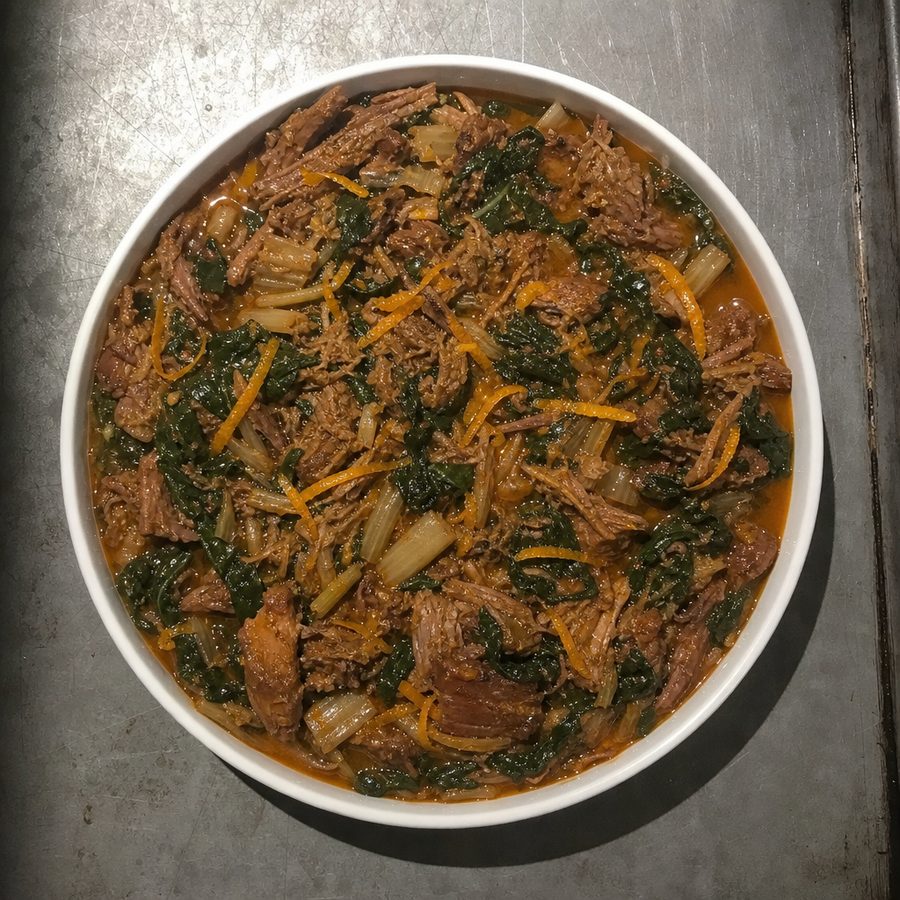
Goat shoulder braised for hours with onion, garlic, orange, and bay until it shreds, then folded back into the reduced juices with ribbons of swiss chard.
Why You'll Love This Recipe
Ask your butcher for goat shoulder and you will usually get a small speech about how nobody buys it, which is a shame, because it is the cheapest interesting meat in the case and it braises into something people remember. This is the dinner I make on a cold Saturday when the oven is already on and I want the house to smell like orange peel and browned meat for three hours. It is almost entirely unattended. Twenty minutes of work at the front, three hours of nothing, and then ten minutes of shredding and folding in greens at the end while everyone hovers.
Goat is close-grained and firm, so it needs both time and liquid, and it will punish you for hurrying it. Brown the chunks hard first, in batches, because the browned bits stuck to the bottom of the pot are where the depth of the sauce comes from. The orange juice and cider vinegar go in at the beginning rather than the end, so the acid has three hours to work its way into the meat, which is what keeps a long braise from tasting flat and heavy. If a fork still meets resistance at three hours, give it another half hour. It is ready when the meat gives up entirely.
The last ten minutes are what make this dinner rather than a pot of meat. You pull the goat apart with two forks, reduce the braising liquid until it turns glossy, and then wilt the chard straight into it so the leaves take on all that orange and garlic. The sliced stems go in first and keep a little crunch, and the leaves need barely a minute, which is the contrast a rich braise wants beside it. What you end up with is dark, savory, and citrus-bright, with enough protein in a bowl to make a real dinner and enough greens folded through that nothing else has to go on the table.
Ingredients
- 1 1/2 lb boneless goat shoulder, cut into 2-inch chunks
- 1 large bunch swiss chard (about 12 oz), stems sliced thin and leaves cut into ribbons
- 2 large yellow onions, sliced
- 8 cloves garlic, smashed
- 2 oranges, zest of 1 in wide strips and juice of both (about 2/3 cup)
- 2 cups chicken bone broth
- 2 tbsp apple cider vinegar
- 2 tbsp olive oil
- 2 tsp dried oregano
- 1 tsp ground turmeric
- 3 bay leaves
- 1 1/2 tsp fine sea salt, divided
Instructions
- Season and brown the goat: Heat the oven to 325°F (163°C). Pat the goat chunks dry, since a wet surface steams instead of browning, and season them with 1 teaspoon of the salt. Heat the olive oil in a large dutch oven over medium-high and brown the meat in a single layer, 6 to 7 minutes, turning until the pieces are deep brown on at least two sides. Move them to a plate.
- Soften the onions and garlic: Lower the heat to medium and add the onions with a pinch of salt. Cook for 7 to 8 minutes, scraping the browned bits off the bottom as they release, until the onions are soft and golden at the edges. Add the garlic, oregano, and turmeric and cook for 1 minute, until the pot smells warm and the turmeric darkens slightly.
- Build the braise: Pour in the orange juice and cider vinegar and let them bubble for 1 minute, then add the broth, the strips of orange zest, and the bay leaves. Return the goat and any juices from the plate. The liquid should come about three quarters of the way up the meat, because a chunk fully submerged boils rather than braises and the exposed top is where the color comes from.
- Braise until it gives way: Bring the pot to a bare simmer, cover tightly, and move it to the oven for 3 hours. Check once at the 2-hour mark and add a splash of water if the level has dropped below the meat. It is ready when a fork twists a chunk apart with no resistance at all, which may take up to 3 1/2 hours.
- Shred and reduce: Lift the meat into a bowl and shred it with two forks, discarding any gristle. Fish out the bay leaves and orange zest. Set the pot over medium-high heat and boil the liquid for 8 to 10 minutes, until it has reduced by about half and coats the back of a spoon, so it has body enough to hold onto the shredded meat.
- Fold in the greens and finish: Stir the chard stems into the reduced sauce and cook for 2 minutes, then add the leaves and cook 1 to 2 minutes more, just until they collapse and turn glossy dark green. Return the shredded goat, add the remaining 1/2 teaspoon salt, and warm everything through for 2 minutes. Taste for salt and acid, and add a squeeze more orange if it needs lifting.
Variations
- Lamb shoulder: Swap in 1 1/2 pounds of boneless lamb shoulder and start checking at 2 1/2 hours, since lamb gives way sooner than goat does.
- Warm spiced version: Add a cinnamon stick and a pinch of ground cloves with the bay for a deeper, more aromatic pot that suits winter.
- Sturdier greens: Collard greens or kale can take the place of the chard when you want leaves with more chew, and both want 4 to 5 minutes in the sauce rather than 2.
- Root vegetables in the pot: Add turnip or celeriac chunks for the final hour of braising if you want the dish to carry more of the plate on its own.
- Lime and mint: Finish with lime juice in place of the extra orange and a scattering of torn mint for a sharper, fresher bowl.
Storage & Leftovers
This keeps in a sealed container in the refrigerator for up to 4 days and genuinely improves by the second day, once the orange and garlic have settled into the meat. Store the goat under its sauce so the shredded strands stay moist, and cool it uncovered for 20 minutes before the lid goes on.
Reheat in a covered saucepan over low heat for 6 to 8 minutes with a spoonful of broth or water, since the sauce thickens considerably as it chills. The chard softens further on reheating and the stems give up their crunch, which is fine here. A grating of fresh orange zest at the end wakes the whole bowl back up.
Shredded goat freezes very well in its sauce for up to 3 months, portioned flat so it thaws quickly. Thaw overnight in the refrigerator and reheat gently. If you plan to freeze it, hold the greens back and wilt fresh ones into the sauce as it reheats, since they go slack after a spell in the freezer.
Notes & Tips
- Brown in batches, always: Three pounds of meat at once will steam in its own juices and stay gray. Two batches costs 7 extra minutes and is where most of the sauce flavor is made.
- Trim, but not too hard: Take off the heavy surface fat and leave the seams of connective tissue alone. Those seams melt into the sauce and give it body over three hours.
- Zest in strips, not gratings: Wide strips of peel give you fragrance you can fish out at the end. Fine zest simmered for hours turns bitter and there is no removing it.
- Acid goes in early: The orange juice and vinegar at the start have hours to move through the meat. Added at the end they sit on top of the sauce and taste raw.
- Judge by feel, not the clock: Goat varies more than most meat. A fork should twist a piece apart without any push behind it, and if it does not, the answer is always more time.
- Reduce before the greens go in: Boil the sauce down first, then wilt the chard. Greens added to thin liquid release more water and you end up chasing the sauce.
Nutrition & Mindful Eating
- The goat, the citrus, and the chard make this what it is. The meat gives the bowl its substance, the orange and vinegar keep something braised for hours from sitting heavy, and the greens folded in at the end mean there is a real serving of something dark and leafy in every spoonful.
- Goat is close-grained, faintly sweet, and firmer than most red meat, which is exactly why it wants a long wet braise. Cooked this way it shreds into soft strands and brings iron in the form the body absorbs most readily, along with zinc and B12.
- Swiss chard goes into the pot in two stages, the sliced stems first so they keep a little bite and the leaves after, since they need barely a minute to turn silky. Dark leaves like these carry vitamin K, magnesium, and fiber into a dish built around meat.
- Onions and garlic cooked down slowly at the start turn sweet and mellow, and they carry the kind of fiber the bacteria in your gut feed on. Hours in the pot break them down until they thicken the sauce on their own.
- Orange juice, cider vinegar, and bay are the backbone of the flavor here, and putting the acid in at the beginning rather than at the end is what makes a three-hour braise taste bright. Turmeric warms it from underneath and gives the sauce its color.
- As you eat, catch the orange peel and bay in the smell before the first bite, notice how completely the meat has given way after three hours, and let this be a meal you sit down for rather than one you eat with a pot lid in your hand.
Frequently Asked Questions
Where do I buy goat, and what if I cannot find it?
Halal and Caribbean markets almost always carry it, and many farmers markets do seasonally. If you cannot find any, lamb shoulder is the closest match and needs about 30 minutes less time. Beef chuck also works at roughly the same timing, though the result is richer and less delicate.
My goat was still tough after three hours. What went wrong?
Goat is firm and the timing varies with the age of the animal, so three hours is a starting point rather than a rule. Keep it covered, keep the oven at 325°F (163°C), and give it another 30 to 45 minutes. Tough goat is almost always undercooked goat, not overcooked.
Can I make this in a slow cooker?
Yes. Brown the meat and the onions on the stove first, since that step cannot be skipped, then transfer everything to the slow cooker and cook on low for 7 to 8 hours. Reduce the liquid in a saucepan on the stove at the end before you fold in the greens.
Does this fit an AIP elimination phase?
It does. There are no grains, legumes, dairy, eggs, nuts, seeds, or nightshades in it, and the seasoning is onion, garlic, oregano, turmeric, bay, orange, and vinegar. Check the label on your bone broth, since many boxed versions carry black pepper or paprika.