
Butter-Basted Beef Tenderloin Filets
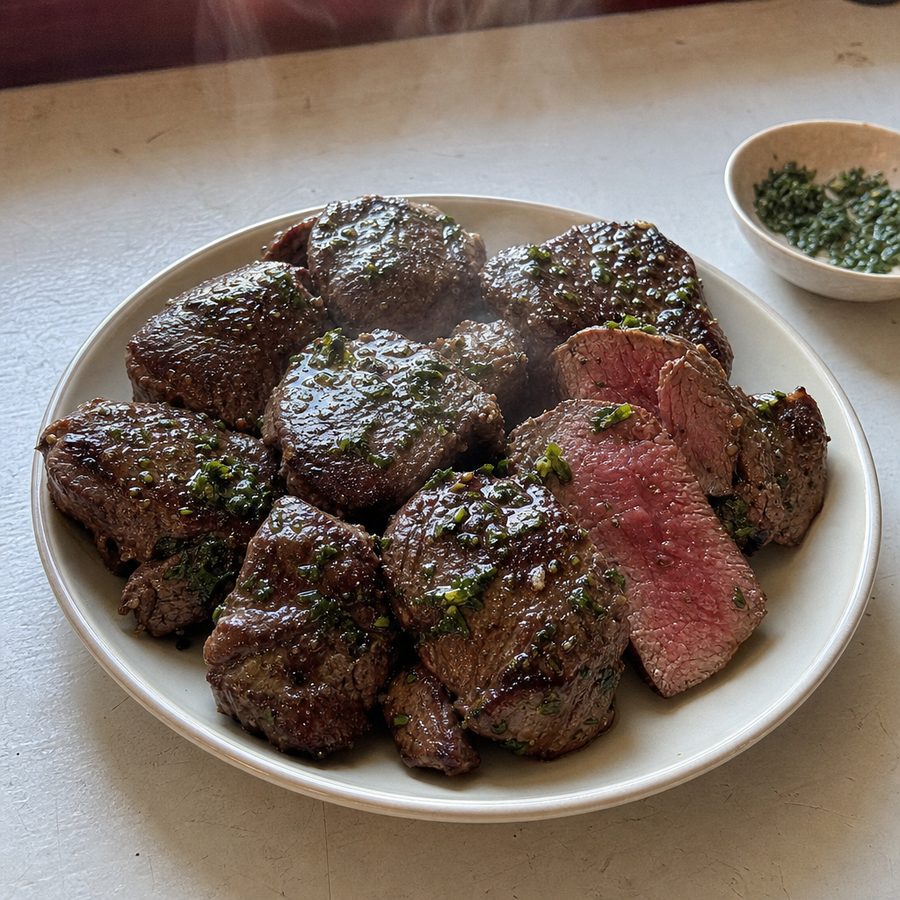
Thick, tender filets seared to a deep crust and spooned with foaming butter until medium-rare and juicy.
Why You'll Love This Recipe
Three ingredients and about fifteen minutes. Tenderloin is the least marbled cut on the animal, which is precisely why it wants butter spooned over it while it cooks: there is very little fat inside the meat, so the fat has to arrive from the pan. That is the whole idea of the recipe, and it is why the technique matters more here than in almost anything else we make.
Basting is the whole technique. Once the crust has set you tilt the pan, let the butter pool at the low edge, and spoon it over the top of each filet again and again. It cooks the surface gently while the center comes up to temperature, and it does something a hotter pan cannot: the butter carries heat without carrying the harshness of direct contact, so the outside stays where you left it while the inside catches up.
This is protein and fat and nothing else, which makes it unusually easy to plan a plate around: put whatever you like next to it and nothing will fight. A green vegetable and something starchy, or simply a sharp salad, and dinner is finished. It is also the cut to reach for when there are two of you and the evening is meant to feel like an occasion, since it cooks in under ten minutes. Or take the same approach with a different cut in our Bacon-Wrapped Pork Tenderloin.
Ingredients
- 1 3/4 lb beef tenderloin, cut into 4 filets
- 3 tbsp butter
- 3/4 tsp coarse salt
Instructions
- Dry them, salt them, let them sit: Pat the filets very dry on every face, sides included, season all over with the salt, and leave them on the counter for ten minutes. The drying is not fussiness: a wet surface has to boil dry before it can brown, and those lost seconds are the difference between a crust and a gray ring. The ten minutes takes the chill off so the center is not fighting the pan from the start.
- Get the pan properly hot first: Heat a heavy skillet until it is just short of smoking, which takes longer than most people give it, then lay the filets in away from you. Listen rather than watch: you want a hard steady sizzle the moment they land, not a gentle one. A pan that is merely hot will gray the outside of a tenderloin while you wait for color that never comes.
- Read the crust, not the clock: Three minutes a side is a guide, and your pan is not the pan this was written in. Lift the corner of one filet and look: you want an even, deep brown crust that releases from the metal on its own. If it sticks when you lift, it is not ready, and another thirty seconds there will do more for the finished steak than turning it early ever will.
- Baste while the butter foams: Drop in the butter, tilt the pan so it pools at the low edge, and spoon it over the filets again and again for a minute or two, until the center reads 130°F for medium-rare. The foaming is the water in the butter boiling off, and while it foams it is basting rather than burning. When the foam dies away and it starts to smell nutty, you are at the end of that window.
- Rest them five minutes: Move the filets to a warm plate and leave them five minutes before anybody cuts in. Heat is still traveling inward, so they come up a few degrees off the pan, and the juices driven toward the center need that time to settle back through the meat. Cut one open straight away and you lose them to the board instead.
Variations
- Skip the dairy: Baste with beef tallow or a good olive oil instead of butter. You lose the nutty browned-milk flavor but the technique works the same.
- Add more vegetables: Cook mushrooms or spinach in the pan after the filets come out to rest. They pick up the browned butter left behind.
- Add aromatics to the butter: Drop a smashed garlic clove and a sprig of thyme or rosemary in with the butter and spoon that over the filets instead.
- Make a pan sauce: With the filets resting, add a splash of red wine or broth to the hot skillet, scrape the browned bits loose, and swirl in a small pat of butter off the heat.
- Use a compound butter instead: Mash softened butter with parsley, garlic, and lemon zest, chill it, and melt a coin over each rested filet rather than basting in the pan.
Storage & Leftovers
Three to four days, with honest advice attached: do not plan on leftovers of this one. A filet cooked to medium-rare and then reheated is a filet cooked to medium-well, and tenderness is the thing you paid for. If you do have some left, slice it thin and eat it cold on a salad, which is genuinely good rather than a consolation.
If you must warm it, use a low oven, around 250°F for ten minutes, with the slices in a single layer, and accept that it will come up a stage in doneness. A skillet is too aggressive and a microwave is worse: both cook the outside of a slice long before the middle is warm.
This is not a recipe to portion into boxes for the week, and it would be dishonest to pretend otherwise. It is a fifteen minute dinner you cook on the night you want it. If you are cooking ahead, the braises and the tray bakes are the ones that reward it, and they are cheaper cuts besides.
Notes & Tips
- Give the filets room: Two at a time in a skillet, not four. A crowded pan drops in temperature and you get gray meat instead of a crust.
- Dry surface, real crust: Pat them very dry. If you have the time, salt them and leave them uncovered in the fridge for an hour first, which dries the surface further.
- Use a thermometer: Filets vary in thickness more than the clock does. Pull them at 130°F (54°C) for medium-rare and expect a few more degrees as they rest.
- Watch the butter foam: It should foam steadily, not smoke. When the milk solids go past golden, pull the pan off the heat for a moment and keep spooning.
- Rest on a warm plate: A cold plate stops the carryover cooking you were counting on. Do not tent them tightly either, or the crust you just built goes soft.
- Leftovers go cold: Slice any leftover filet thin and eat it cold over greens. Reheating takes a medium-rare steak straight to well done.
Nutrition & Mindful Eating
- The beef, the butter and the heat of the pan are the entire recipe. The meat brings its fine, close-grained texture and its protein, the butter carries flavor over the top with every spoonful, and the salt draws out what is already in the steak.
- Tenderloin is the most tender cut on the animal, fine-grained and mild enough to take a hard sear without turning tough. Beef like this carries iron in the form your body absorbs most readily, along with zinc and B12.
- Butter is what turns a sear into basting. Once it foams and the milk solids toast, the fat you spoon over the filets tastes nutty and browned, and it carries that flavor across the crust on every pass.
- The crust is where most of the flavor lives. Browning builds deep roasted aromas across the surface, and tilting the pan to spoon hot fat over the top brings the middle along gently so it does not run past medium-rare.
- A filet this dense eats slowly and holds you for a long stretch, and the protein is doing most of that work. Resting the meat before you cut keeps the juices in the filet rather than on the board.
- As you eat, take a moment with the contrast between the dark salted crust and the soft rosy center, and let the meal go slowly enough that you notice the point where you have had enough.
Frequently Asked Questions
Why rest the steak?
Resting lets the juices redistribute so they stay in the meat instead of running out when you cut.
Can I use a different cut?
Tenderloin is prized for its tenderness, but this same butter-baste works on strip or ribeye.
How long does it keep?
Three to four days, but this is the wrong recipe to cook with leftovers in mind. Reheating a medium-rare filet cooks it further, so slice whatever is left thin and eat it cold on a salad instead.
Can I make it ahead?
Not really, and I would rather say so than pretend. Tenderloin is a cut you cook for the fifteen minutes you want it in, and everything that makes it worth buying is spent on the second heating. For cooking ahead, look at the braises.