
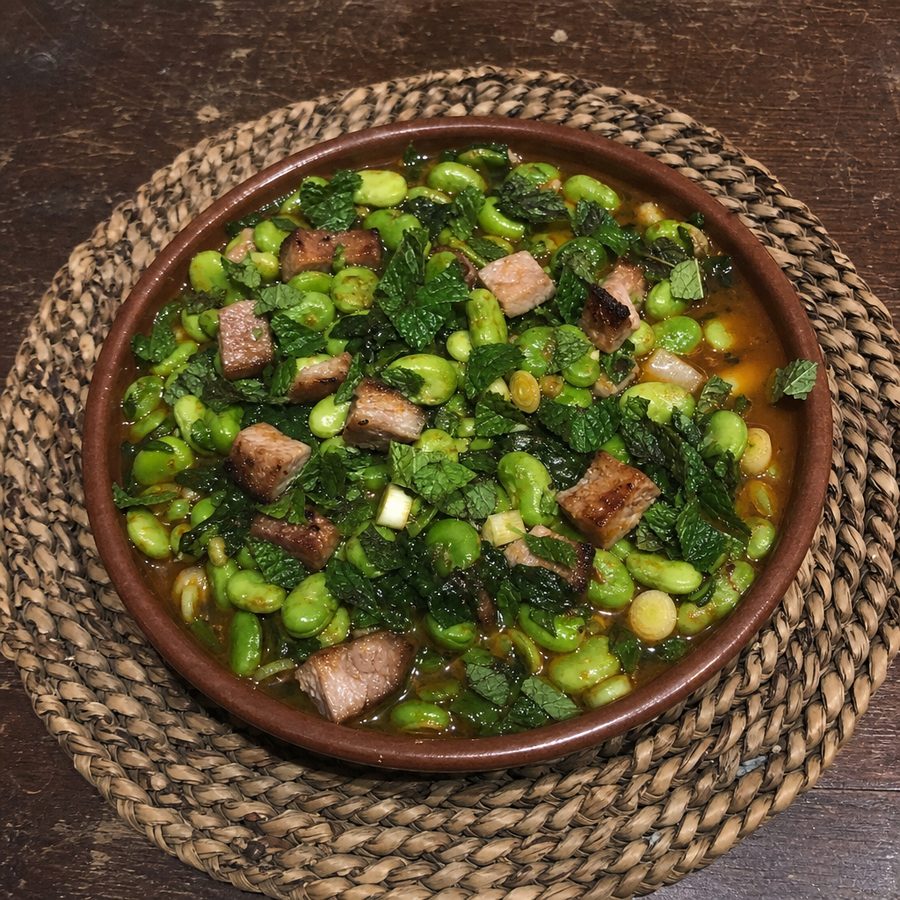
Catalan Fava Beans with Pork Tenderloin, Mint, and Smoked Paprika
Fava beans stewed briefly with scallions, garlic, and smoked paprika, with browned cubes of pork tenderloin and wilted spinach folded through and a great deal of torn mint at the end.
Why You'll Love This Recipe
Faves a la catalana is a spring dish, made in Catalonia the week the first fava beans reach the market, and traditionally it carries botifarra sausage and a piece of cured pork. I use cubes of tenderloin browned hard in the same pan, which keeps the dish quick and lets the beans stay the point of it. Skinning the favas is the only tedious part and it is worth every minute, because the pale jacket around each bean is tough and slightly bitter and what is inside it is sweet and bright green. Frozen favas make this a year-round dinner.
It eats fresh and smoky at the same time, which is an unusual combination. The smoked paprika and the browned pork give it depth, the beans and the scallions keep it tasting like spring, and the mint torn in off the heat lifts the whole pan. The beans should still have a little resistance when you bite one, so this is a short cook rather than a long stew. A spoonful of sherry vinegar at the end cuts through the paprika, and if the pan tastes slightly flat when you taste it, vinegar rather than salt is almost always the answer.
I make this in April and May when favas are worth buying, and in February from the freezer when I need reminding that spring exists. It takes about fifty minutes start to finish and most of that is podding and peeling, which is pleasant work to do sitting down. It is a good dish for feeding four people from one pan without anything on the side, and it is even better at room temperature the next day, eaten standing at the counter with a fork.
Ingredients
- 1 1/4 lb pork tenderloin, trimmed and cut into 3/4-inch cubes
- 2 cups shelled fava beans (fresh or frozen, about 10 oz), outer skins slipped off
- 5 oz spinach, thick stems removed
- 2/3 cup canned crushed tomatoes
- 1 small onion, finely chopped
- 5 scallions, cut into 1-inch lengths
- 4 garlic cloves, thinly sliced
- 1 cup vegetable broth
- 2 1/2 tbsp olive oil
- 2 tsp sweet smoked paprika
- 1/2 cup mint leaves, torn at the last minute
- 1 bay leaf
- 1 tbsp sherry vinegar or cider vinegar
- 1/3 tsp fine sea salt
- 1/2 tsp freshly ground black pepper
Instructions
- Skin the favas: If you are starting with pods, shell them, then drop the beans into boiling water for 60 seconds and into cold water straight after. Pinch each bean and it will slip out of its pale jacket. Frozen favas need the same 60-second dip and the same pinch. Skip this step and the beans stay tough no matter how long you cook them.
- Brown the pork: Pat the pork cubes dry and season with the black pepper and half the salt. Heat 1 1/2 tbsp of the olive oil in a wide skillet over medium-high until it shimmers, add the pork in one layer, and leave it undisturbed for 3 minutes so a crust forms. Turn and cook 2 minutes more, until golden on two sides but still pink at the center. Move it to a plate.
- Build the sofregit: Lower the heat to medium, add the remaining 1 tbsp of oil, and cook the onion with the rest of the salt for 6 to 7 minutes until soft and translucent. Add the garlic and the smoked paprika and stir for 30 seconds, off the heat if you need to, since paprika scorches fast and goes bitter. Add the crushed tomatoes and the bay leaf and cook 4 minutes, until the tomato darkens and stops looking wet.
- Stew the beans: Add the favas, the scallions, and the broth, bring it to a gentle simmer, and cook uncovered for 8 to 10 minutes. The beans should be tender with a slight resistance at the center and the liquid should have reduced to a shallow pool rather than a soup. Stir in the spinach in two handfuls and let it collapse, about 1 minute.
- Finish: Return the pork and any juices from the plate and cook 2 minutes more, just until it is heated through and cooked to 145°F. Take the pan off the heat, add the vinegar, and swirl. Fish out the bay leaf, tear the mint over the top, and serve straight from the pan while the beans are still bright.
Variations
- With artichokes: Add a cup of quartered artichoke hearts with the beans, which is a common Catalan pairing and makes the pan feel more substantial.
- Green beans instead: Out of fava season entirely, use cut green beans and add them four minutes earlier so they cook through.
- With a fried egg: Slide a fried egg onto each portion, which turns the whole thing into a lunch worth taking seriously.
- More herbs: Add chopped parsley along with the mint, and a little chopped dill, for a greener and less smoky pan.
Storage & Leftovers
It keeps three days in a sealed container in the refrigerator and is genuinely good cold or at room temperature, which is how a lot of Catalan cooks eat the leftovers. The beans lose some of their brightness overnight and the smoky flavor deepens, so it becomes a different but perfectly good dish.
Reheat gently in a skillet over medium-low with a splash of broth, and stop as soon as it steams. Long reheating turns the favas gray and the pork tough. Fresh mint torn over at the end brings the color and the lift back better than anything else you could add.
Freeze it for up to two months in flat sealed portions if you must, though I would say this is the least good thing to do with it, since favas soften considerably on thawing. If you know you are cooking ahead, undercook the beans by two minutes and leave the mint and vinegar until the day you eat.
Notes & Tips
- Dry the pork before it hits the pan: Wet meat steams instead of browning. A minute with paper towel is the difference between golden cubes and gray ones, and the browned bits are what flavor the broth.
- Pull the pork early: Tenderloin is close-grained and goes chalky the moment it is overdone. Take it out while the center is still pink and let it finish in the last two minutes with the beans.
- Add the paprika off the heat: Half a minute in warm onions is plenty. In a hot dry pan it burns before you have finished stirring and there is no fixing it after that.
- Vinegar before salt: If the pan tastes flat at the end, reach for the vinegar bottle first. Nine times out of ten what a smoky dish like this needs is acid rather than more salt.
Nutrition & Mindful Eating
- The favas, the pork, and the greens are three things doing three jobs. The beans give the pan its body and most of its fiber, the pork carries the protein, and the spinach and scallions keep something this smoky tasting fresh.
- Fava beans are one of the sweeter legumes once the tough outer skin is off, and they bring both fiber and plant protein along with folate, which is part of why they are eaten in such quantity around the Mediterranean in spring.
- Pork tenderloin is a close-grained, quick-cooking cut that stays juicy when it is pulled at the right moment, and it carries a dense amount of protein along with thiamin.
- Spinach wilted in during the last minute keeps its color and adds iron and magnesium, and the vinegar that goes in just after helps your body take up more of that iron than it would otherwise.
- Smoked paprika, sliced garlic, and torn mint are the whole flavor structure here. The paprika gives the smoke, the mint arrives cold at the end, and the sherry vinegar is what keeps the two of them from settling into one heavy note.
- As you eat, notice how the mint arrives after the smoke rather than with it, and give the beans enough attention to catch the point where they stop being firm and start being sweet.
Frequently Asked Questions
Do I really have to peel the fava beans twice?
For anything but very young beans, yes. The outer pod comes off first, and then each bean has a pale skin that stays leathery through any amount of cooking. A minute in boiling water loosens it and the whole panful takes about ten minutes to pinch. Very small early favas can be left whole.
Can I use frozen or canned beans?
Frozen favas are excellent and are what I use most of the year, though they still need the boiling water dip and the pinch. Canned favas are already soft, so add them in the last three minutes and skip the simmering, or they will collapse into a puree.
What can I use in place of pork tenderloin?
Boneless chicken thigh cut into cubes browns the same way and needs to reach 175°F. If you can find botifarra or another mild fresh sausage, that is the traditional choice and you would brown it in coins at the start of the recipe.
My paprika tasted bitter. What happened?
It hit the pan too hot. Paprika is a ground dried fruit and it burns at a much lower temperature than most spices. Pull the pan off the burner, stir the paprika into the softened onions for half a minute, then put it back on the heat with the tomatoes.