
Celeriac and Rutabaga Gratin with Cheddar and Walnut Crumb
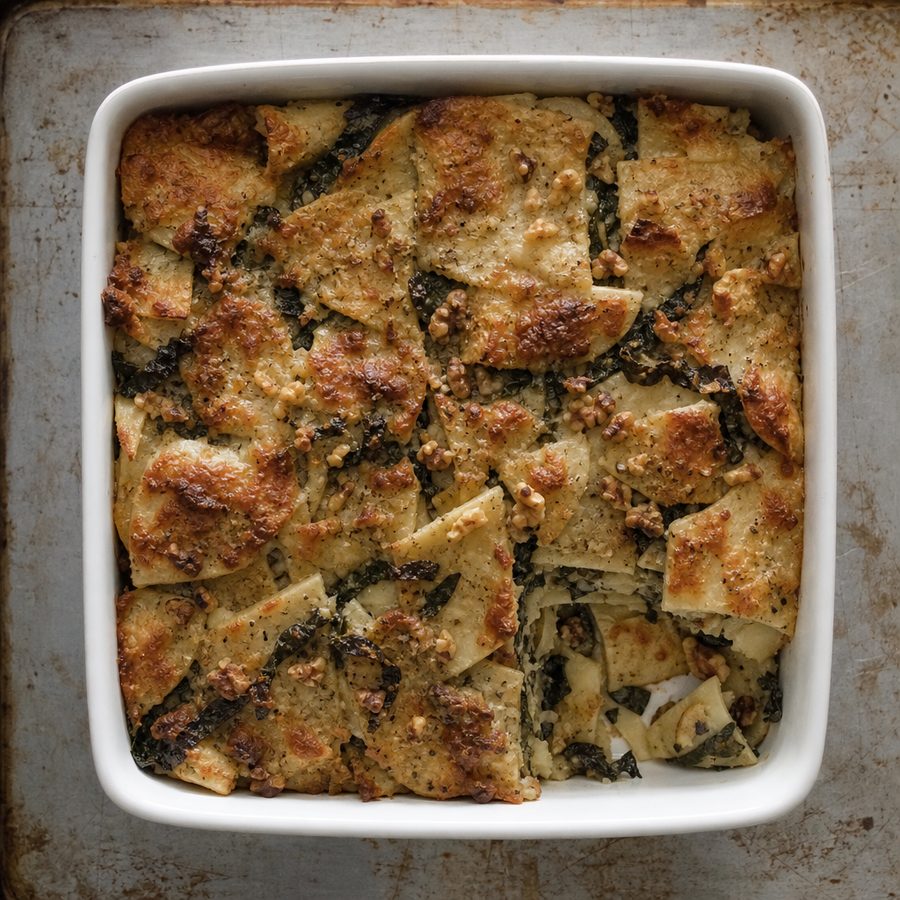
Thin slices of celeriac and rutabaga simmered in broth, layered with sharp cheddar and swiss chard, and baked under a parmesan and walnut crumb until the top is deep gold.
Why You'll Love This Recipe
A gratin is the dish I bring out when people are coming and I want the oven to do the work in front of everyone. This one is built on celeriac and rutabaga rather than potato, so it slices cleanly into squares and holds its shape on a plate rather than collapsing into mash. It takes about twenty-five minutes of slicing and layering, then a little over an hour when you are not really needed. What comes out is deeply savory, the top craggy with cheese and walnuts, and it goes on the table in its dish with a salad beside it and nothing else required of anybody.
The step that makes this work is simmering the slices in broth before they ever see the baking dish. Celeriac and rutabaga are dense, and a gratin baked from raw gives you a gorgeous brown top over vegetables that still squeak. Ten minutes in seasoned broth with butter, thyme, and dijon gets them most of the way tender and, better still, leaves you with a liquid that has taken on their flavor. That is what you pour back over the layers. Garlic-infused olive oil goes into the chard, which means the whole dish tastes like it was built on aromatics even though the pan never held any.
Sharp cheddar between the layers is doing more than melting. It seasons every slice, browns where it meets the edge of the dish, and it is where most of the protein in a vegetarian dinner like this comes from. The crumb on top is walnuts and parmesan and nothing else, and it goes crisp and slightly bitter in the best way against all that sweetness underneath. Give it fifteen minutes of rest before you cut, which is the part everybody skips. Straight out of the oven it slumps. Rested, it lifts out in neat squares with the layers still visible.
Ingredients
- 2 medium celeriac (about 2 lb total), peeled and sliced 1/8 inch thick
- 1 medium rutabaga (about 1 1/4 lb), peeled and sliced 1/8 inch thick
- 1 bunch swiss chard (about 7 oz), stems sliced thin and leaves torn
- 2 cups vegetable broth
- 3 tbsp butter, divided
- 1 tbsp garlic-infused olive oil
- 7 oz sharp cheddar, grated (about 2 cups)
- 1/2 cup finely grated parmesan
- 1/2 cup walnuts, finely chopped
- 1 tbsp dijon mustard
- 1 tbsp fresh thyme leaves
- 2 tbsp chopped chives
- 1 tsp fine sea salt, divided
- 1/2 tsp black pepper
Instructions
- Slice the roots thin: Heat the oven to 375°F (190°C) and butter a 3-quart baking dish, about 9 by 13 inches. Peel the celeriac and rutabaga and slice them 1/8 inch thick, using a mandoline if you have one. Thickness matters more than neatness here, since a thick slice among thin ones will still be firm when the rest is tender.
- Simmer the slices: Bring the broth, 2 tablespoons of the butter, the thyme, the dijon, 3/4 teaspoon of the salt, and the pepper to a simmer in a wide pot. Add the sliced roots, cover, and cook for 10 to 12 minutes, stirring gently twice, until a slice bends without breaking. Lift the slices out with a slotted spoon and keep the broth.
- Wilt the chard: Heat the garlic-infused olive oil in a skillet over medium, add the chard stems with the remaining salt, and cook 3 minutes until they lose their squeak. Add the leaves and cook 2 minutes more until just collapsed, then press them in a sieve to get the water out. Wet chard makes a loose gratin.
- Layer the dish: Lay a third of the roots in the dish in overlapping rows, scatter over a third of the cheddar and half the chard, and repeat, finishing with roots and the last of the cheddar. Pour the reserved broth over until it comes just below the top layer, then press the whole thing down firmly with your palm.
- Bake covered, then open: Cover with foil and bake for 30 minutes. Meanwhile stir the walnuts, parmesan, and remaining tablespoon of butter together with your fingers into a rough crumb. Uncover the dish, scatter the crumb over the top, and bake 25 to 30 minutes more, until the top is deep gold and a knife meets no resistance in the center.
- Rest and cut: Let it sit for 15 minutes on the counter before cutting. This is what lets the broth settle back into the layers so the squares hold together. Scatter the chives over the top and cut into four large squares, running a knife around the edge of the dish first.
Variations
- Turnip and carrot: Swap the rutabaga for turnip and a couple of carrots when you want the dish sweeter and lighter in color.
- Goat cheese layer: Dot half the layers with goat cheese along with the cheddar for a tangier gratin with softer pockets.
- Kale in place of chard: Use torn kale, wilted a minute longer, when you want the greens to keep more chew between the layers.
- Pecan crumb: Trade the walnuts for pecans and add a pinch of cayenne to the crumb for a sweeter, hotter top.
- Bacon for the table: Scatter a couple of slices of crisped chopped bacon over the top after baking when you are feeding people who want meat in everything.
Storage & Leftovers
Covered in the refrigerator, the gratin keeps for up to 4 days and cuts more cleanly cold than hot. Leave it in the baking dish with foil over the top rather than moving it, since transferring squares while they are soft is how the layers come apart in the container.
Reheat squares on a sheet pan at 375°F (190°C) for 15 to 18 minutes, which crisps the walnut crumb a second time. A microwave works in about 2 minutes if you are in a hurry, though the top goes soft and the dish loses the contrast between the crunchy lid and the silky middle.
It freezes better than most gratins because there is no cream in it to split. Cool completely, cut into squares, wrap each one, and freeze for up to 2 months. Reheat from frozen, covered, at 375°F (190°C) for about 35 minutes, then uncover for 10 minutes to bring the top back.
Notes & Tips
- Garlic-infused oil is the workhorse: The taste of garlic dissolves into oil while the parts that trouble a sensitive gut stay behind in the clove, so infused oil gives you the flavor and none of the trouble. Use it anywhere a recipe would have started with chopped garlic in the pan.
- Slice thin and slice evenly: An eighth of an inch is the number. A mandoline is worth it here, and a fat slice hiding in the middle will still be firm when everything around it is silky.
- Keep the simmering broth: It has taken on the flavor of the roots and the mustard, so pouring it back over the layers is most of the seasoning in the finished dish.
- Press the layers down: A firm push with your palm before it goes in the oven closes the gaps, and closed gaps are what let a gratin cut into squares rather than sliding apart.
- Rest before cutting: Fifteen minutes on the counter is not optional. The dish reabsorbs its own liquid in that time and goes from loose to sliceable.
- Feeding a household with different needs: This reheats square by square all week, so it doubles as lunch. For anyone who wants meat with dinner, crisp a few slices of chopped bacon and scatter them over their square after it is cut.
Nutrition & Mindful Eating
- Root vegetables, melted cheese, and a nut crumb hold this together. The celeriac and rutabaga give the body and the fiber, the cheddar carries the protein through every layer, and the walnuts on top bring fat and crunch to a dish that would otherwise eat soft.
- Celeriac is knobbly and unpromising to look at, and it cooks into something silky with a clean parsley note, bringing potassium and a gentle fiber along with it.
- Rutabaga tastes faintly sweet and faintly peppery at once, and slices of it hold their shape through a long bake, which is what gives the gratin its structure and a good dose of vitamin C.
- Sharp cheddar melted between the layers does the seasoning as well as the melting, and it is where the calcium and most of the protein in this dinner come from.
- Walnuts chopped into the topping toast in the oven heat and turn resinous and slightly bitter against all that sweetness, and they carry the plant omega-3 fats.
- As you eat, notice how the crisp walnut lid gives way to the soft layers underneath, and let the fifteen minutes you waited for it set the pace for the meal itself.
Frequently Asked Questions
Can I use potatoes here?
You can, and it will taste good, though it will be softer and starchier and it will not slice as cleanly. If you go that way, skip the simmering step and layer them raw, since potato cooks through in the oven on its own and turns to paste if you cook it twice.
My gratin was watery at the bottom. What happened?
Usually the chard. It holds a surprising amount of water, and it all comes out in the oven, so press it hard in a sieve before it goes in. The other cause is too much broth, which should come just below the top layer rather than over it.
Can I assemble it the day before?
Yes. Build it right through the layering step, cool it, cover, and refrigerate for up to 24 hours. Add the walnut crumb only when it goes in the oven, and give it an extra 10 minutes covered since it starts cold from the refrigerator.
Does this work as a main course rather than a side?
It does. Between the cheddar, the parmesan, and the walnuts there is real protein in a square this size, and it suits a low-FODMAP dinner since the savory base comes from browning, mustard, thyme, and garlic-infused oil rather than from aromatics that would be stripped out.