
Celery Root and Potato Mash with Frizzled Leeks and Paprika Butter
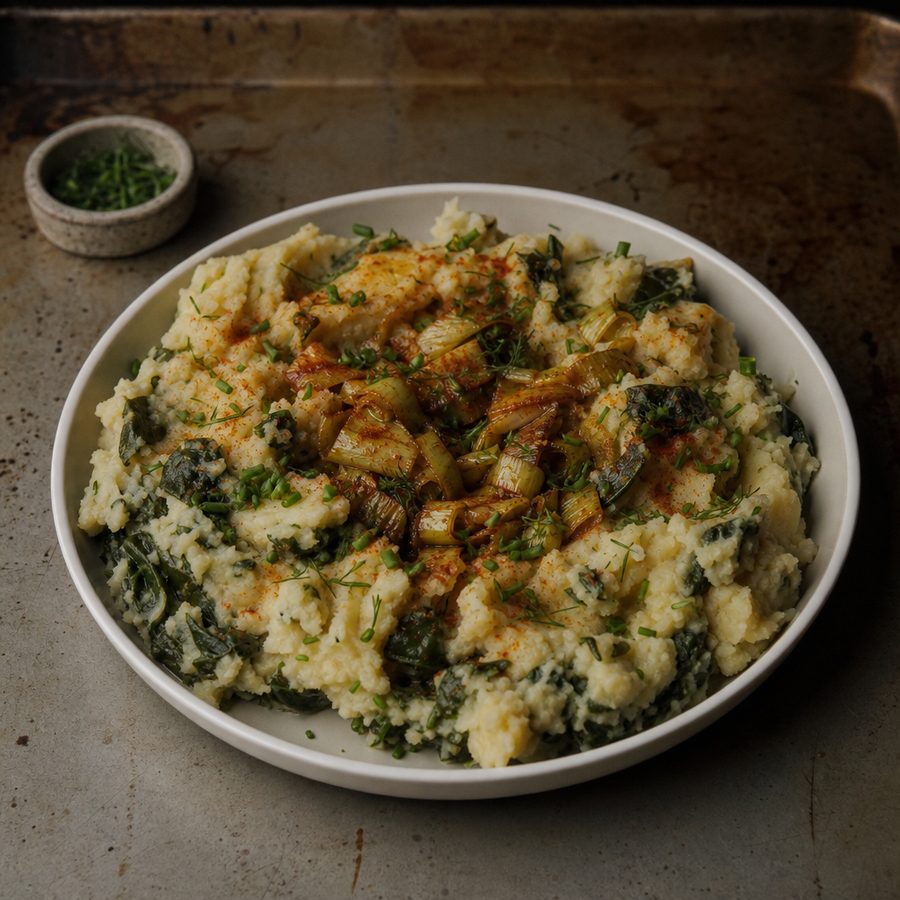
Celery root and gold potatoes boiled together and mashed with warm milk, with collard ribbons folded through and sliced leeks browned in paprika butter spooned over the top.
Why You'll Love This Recipe
Celery root is the ugliest thing in the produce aisle and the one I buy most often in January. Under all that knobbly skin is dense ivory flesh that tastes like celery crossed with a parsnip, and it cooks in the same time a potato does, which is why the two of them go into one pot here. On its own celery root mashes a little loose and a little sharp. Cut with gold potatoes it comes out silky and mild with an herbal note running behind it, and that note is what keeps a bowl of mash from being one flat sweet thing.
The leeks on top are the reason this eats like a dinner rather than a side dish. Sliced thin and cooked hard in butter until the tips frizzle brown, they go sweet and almost crisp, and the paprika stirred in at the end coats every strand and turns the butter a deep rust color. You spoon that over the pale mash and it pools. Collard ribbons folded through the pot give the whole bowl something to push against, so every few bites there is a piece of green that is still firm among all that softness.
On a dark, cold evening, dinner should be warm and uncomplicated and on the table in half an hour. It is one pot and one skillet, and both of them are working at the same time, so the leeks are done when the mash is. It reheats well enough to be lunch, and it is generous with a fried egg on top if somebody at your table wants one. I make it most often in the middle of winter, when celery root is cheap and everything else looks tired.
Ingredients
- 1 medium celery root, about 1 lb 2 oz, peeled thickly and cut into 3/4-inch cubes
- 1 1/4 lb Yukon Gold potatoes, peeled and cut into 3/4-inch cubes
- 2 medium leeks, white and pale green parts only, halved lengthwise, washed well, and sliced into thin half-moons
- 7 oz collard greens, thick stems stripped out and leaves rolled and sliced into thin ribbons
- 1 cup milk, warmed
- 2 tbsp butter
- 1 tbsp olive oil
- 2 tsp sweet paprika
- 2 cloves garlic, minced
- 3 tbsp finely chopped chives
- 2 tbsp chopped fresh dill
- 1/2 tsp coarsely ground black pepper
- 1/2 tsp fine sea salt
Instructions
- Peel and cube the celery root: Slice the top and bottom off the celery root so it sits flat, then cut the skin away in strips from top to bottom with a knife rather than a peeler, going deep enough to lose the brown grooves. Cut it into 3/4-inch cubes, and cut the potatoes to match, since even sizing is what makes them finish together.
- Boil them together: Put both vegetables in a saucepan, cover with cold water by an inch, add the salt, and bring to a boil. Lower to a steady simmer and cook for twelve to fifteen minutes, until a knife slides into a cube of celery root with no resistance at all. Test the celery root rather than the potato, since it is the slower of the two.
- Frizzle the leeks: While the pot simmers, heat the olive oil and butter in a skillet over medium-high. Add the leeks and cook for six to eight minutes, stirring every minute or so, until they are limp, sweet smelling, and browned at the tips. Add the garlic and cook thirty seconds more, then take the pan off the heat, stir in the paprika, and let it sizzle in the residual heat until the butter turns rust colored.
- Wilt the collards: Drop the collard ribbons into the boiling pot for the last two minutes of the vegetables' cooking time. They will turn bright green and go limp. Drain everything together in a colander and let it steam dry for a minute, which matters, since wet vegetables make a loose mash.
- Mash and serve: Return everything to the warm pot, pour in the warmed milk, and mash with a hand masher until it is mostly smooth with some texture left. Beat in the black pepper. Spoon it into wide bowls, press a hollow into the middle of each, and pile in the paprika leeks with all the butter from the pan. Finish with the chives and dill.
Variations
- Caraway and mustard: Stir a teaspoon of caraway seed into the leeks as they brown and a spoonful of grainy mustard into the mash for a sharper, more distinctly German bowl.
- Horseradish mash: Beat two teaspoons of prepared horseradish into the mash at the end, which gives the whole bowl a clean heat that sits behind the sweetness of the leeks.
- With a fried egg: Set a fried egg on each bowl and break the yolk into the mash, which makes an already generous plate into a very full one.
- Kale in place of collards: Use the same weight of lacinato kale, dropped into the pot for the last ninety seconds, for a softer green with a slightly sweeter edge.
Storage & Leftovers
The mash keeps four days in a sealed container in the refrigerator, and I store the leeks separately in a small jar so they keep some of their texture. Kept together they soften into the mash overnight, which still tastes good but loses the contrast that makes the dish what it is.
Reheat the mash in a saucepan over low heat with a splash of milk stirred in, since it firms up considerably when cold. Give it five minutes and beat it once with a spoon before serving. The leeks come back in a dry skillet over medium heat in about ninety seconds, and the paprika smells fresh again as soon as they warm.
This freezes for up to two months, though the texture changes and it comes back looser than it went in. Thaw overnight in the refrigerator, reheat gently, and beat in a knob of butter at the end to bring it back together. Frizzled leeks do not freeze well, so make those fresh on the day.
Notes & Tips
- Peel celery root with a knife: A vegetable peeler cannot follow the grooves and leaves brown pockets that stay tough. Flatten the top and bottom, stand it up, and cut the skin off in downward strips, taking a little flesh with it.
- Cut everything the same size: Celery root cooks a touch slower than potato, so matching the cubes at 3/4 inch is what lets the two of them arrive at soft in the same minute. Uneven cubes give you a mash with hard chips in it.
- Let the drained vegetables steam dry: A minute sitting in the colander lets the surface water evaporate. Mash them straight from the water and the milk has nowhere to go, and the bowl comes out slack.
- Warm the milk first: Cold milk poured into hot vegetables drops the temperature and stiffens the starch. Thirty seconds in the microwave is enough, and the mash comes out looser with less beating.
- Stir the paprika in off the heat: Paprika burns fast and goes bitter in a hot pan. Pull the skillet aside, stir it into the butter, and the residual heat is enough to bloom the color and the aroma without scorching it.
Nutrition & Mindful Eating
- Celery root, potatoes, collards, and milk are what carry this bowl. The two roots give it body and slow carbohydrate, the collards run a firm green thread through all that softness, and the milk and butter give the mash enough richness to feel like a finished plate rather than a component.
- Celery root is the swollen base of a celery plant, and it mashes to a silky ivory that tastes faintly of the stalk it came from. It is mostly water and fiber with potassium behind it, which is part of why a bowl of it eats lighter than the same volume of potato.
- Collard greens hold their shape after two minutes in boiling water, and they are one of the plant foods that genuinely delivers calcium, so folding a real quantity through the mash does more for the bowl than a pinch of anything green on top.
- Leeks belong to the onion family, and cooking them hard in butter turns their sulfur compounds sweet and their edges brown. They also feed the bacteria in your gut, and people who find onion harsh usually get along with leeks cooked this far.
- Sweet paprika, chives, and dill are doing the finishing work. The paprika bloomed in butter gives the bowl its color and a warm, faintly fruity smell, and the two herbs go on cold at the very end so they stay green and sharp against everything soft underneath.
- As you eat, work the browned leeks down through the mash a little at a time and notice how the paprika butter changes each spoonful, and give yourself long enough at the table to feel the bowl settle.
Frequently Asked Questions
What does celery root actually taste like?
Like the sweeter, nuttier heart of a celery stalk with the stringiness gone. Cooked and mashed it is mild and faintly herbal, closer to a parsnip in texture than to celery. If you have been walking past it for years because it looks unfriendly, this is the recipe that will change your mind about it.
Can I make it entirely with potatoes?
You can, and it will be a good bowl of mash, though it will taste rounder and simpler. The celery root is what gives the dish its faintly savory backbone. If your store does not carry it, parsnip or rutabaga in the same quantity gets you closer than more potato will.
Why did my mash turn gluey?
A food processor or a stick blender is almost always the culprit. Potato starch turns elastic when it is whipped hard, and once that happens no amount of butter fixes it. A hand masher or a ricer keeps the texture short and pleasant, and a little unevenness is a good thing here.
How do I get the grit out of leeks?
Halve them lengthwise first, then fan the layers under cold running water, since the soil sits between the layers rather than on the outside. Slice after washing, or slice first and swish the half-moons in a bowl of water and lift them out with your hands, leaving the sand behind.