
Chicken and Artichoke Frittata with Broccoli and Lemon
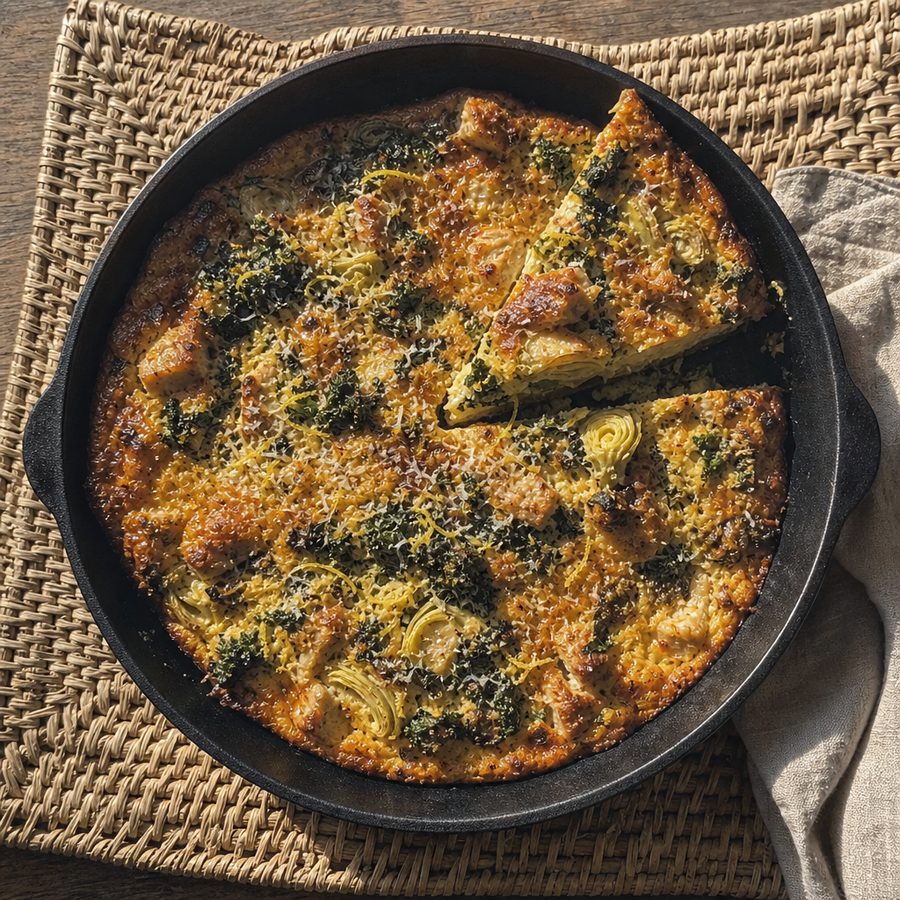
A thick skillet frittata of browned chicken thigh, quartered artichoke hearts, charred broccoli, and torn kale, finished with parmesan and lemon zest grated over the hot surface.
Why You'll Love This Recipe
On a Sunday morning with people in the house, nobody wants to stand at the stove making eggs to order. One pan, one bake, four thick wedges, and it is just as good at room temperature an hour later as it is straight out of the oven. Chicken thigh is what turns it from a side dish into breakfast. Thigh meat stays juicy through a second cooking in a way that breast does not, so it can brown first and then sit in the oven inside the eggs without going stringy.
The trick with any frittata is getting the water out of the vegetables before the eggs go in. Broccoli and kale are both full of it, so they get real time in a hot pan, uncovered, until the broccoli is spotted brown and the kale has gone dark and slightly crisp at the edges. The artichokes get the same treatment for the same reason, and browning them turns out to be the best thing you can do to a jarred artichoke. Then the eggs go in over low heat, and the oven finishes the top.
It eats like something between an omelet and a savory tart. The edges are firm and a little crisp where they met the pan, the middle stays custardy if you pull it at the right minute, and the artichokes are the thing everybody comments on. Lemon zest grated over the hot surface is not optional. It cuts the richness of nine eggs and makes the whole wedge taste lighter on the tongue than it has any business tasting.
Ingredients
- 9 large eggs
- 10 oz boneless, skinless chicken thighs, cut into 1/2-inch pieces
- 1 small head broccoli (about 13 oz), cut into small florets, stem peeled and sliced
- 4 packed cups chopped kale (about 7 oz), stems stripped out
- 1 cup artichoke hearts, drained well and quartered
- 1 small yellow onion, finely diced
- 1/4 cup finely grated parmesan
- 1 1/2 tbsp olive oil
- 1 1/2 tbsp fresh lemon juice, plus the zest of the lemon
- 1/4 cup chopped flat-leaf parsley
- 3 cloves garlic, thinly sliced
- 3/4 tsp coarsely ground black pepper
- 1/4 tsp fine sea salt
Instructions
- Brown the chicken: Pat the chicken pieces dry and season with half the salt and half the pepper. Heat 1 tbsp of the olive oil in a 10-inch ovenproof skillet over medium-high, add the chicken in one layer, and leave it undisturbed for three minutes until the undersides are golden. Turn and cook two minutes more, then move it to a plate. It does not need to be cooked through.
- Brown the artichokes and broccoli: Blot the artichoke quarters dry on paper towel, add them to the pan with the remaining oil, and cook for three minutes until the cut faces color. Add the broccoli florets and sliced stem and cook five to six minutes more over medium-high, stirring only occasionally, until the florets are spotted brown and no longer squeaky.
- Wilt the kale: Stir in the onion and garlic and cook two minutes, then add the kale in two handfuls, turning each one until it collapses. Keep the pan uncovered and cook four to five minutes, until the kale is dark green, the pan is dry, and there is no free water pooling at the bottom. Heat the oven to 350°F.
- Beat and pour: Whisk the eggs with the lemon juice, the rest of the salt and pepper, and half the parmesan until the whites and yolks are completely combined and slightly foamy. Return the chicken and its juices to the pan, spread everything into an even layer, lower the heat to medium-low, and pour the eggs over the top. Draw a spatula through the middle once so the egg reaches the bottom.
- Set the bottom, then bake: Cook undisturbed on the stovetop for five to six minutes, until the outer inch has set and the center still sloshes when you tip the pan. Scatter the remaining parmesan over the surface and slide the skillet into the oven for ten to twelve minutes, until the center is puffed and barely set and a knife slid into it comes out clean.
- Rest and finish: Let it sit in the pan for five minutes, which lets the middle finish and makes it possible to lift a clean wedge. Grate the lemon zest over the hot surface, scatter the parsley, and cut into four wedges. Run a thin spatula around the edge and under the base before serving.
Variations
- Feta rather than parmesan: Crumble two ounces of feta over the vegetables just before the eggs go in for soft salty pockets through the wedge.
- Green olive and chile: Add a handful of chopped kalamata olives and a pinch of red chile flakes with the artichokes for a sharper, hotter pan.
- Mushroom: Swap half the broccoli for sliced mushrooms browned hard and dry, which pushes the frittata darker and more savory.
- Bacon: Render three slices of chopped bacon first and cook everything in the fat, using it in place of the chicken.
- Herb-heavy: Fold a full cup of chopped parsley, dill, and chives into the beaten eggs so the wedges come out flecked green throughout.
Storage & Leftovers
It keeps four days wrapped in the refrigerator and is one of the few egg dishes that is genuinely good cold. Wrap wedges individually rather than covering the whole pan, since a pan covered while still warm traps steam and the bottom goes damp overnight.
Warm a wedge in a 300°F oven for eight to ten minutes, or in a dry skillet over medium-low with a lid for three minutes, which crisps the bottom again. A microwave works in thirty second bursts but eggs turn rubbery quickly there, so stop while it is still slightly cool in the middle.
Frittata freezes better than most people expect. Wrap individual wedges tightly, freeze up to two months, and thaw overnight in the refrigerator before reheating in the oven. Fresh lemon zest and parsley after reheating do most of the work of making it taste newly made.
Notes & Tips
- Dry the artichokes: Straight from the jar they are too wet to brown and will steam the broccoli beside them. Two minutes on paper towel changes the whole pan.
- Use a 10-inch pan, not a 12: Nine eggs in a wide pan give you a thin frittata that overcooks before the middle sets. A narrower pan gives you the thick wedge this recipe is built around.
- Cook the vegetables uncovered: A lid traps the water you are trying to drive off. Leave the pan open and let the steam leave the kitchen.
- Pull it while the center wobbles: It carries on setting for several minutes out of the oven. Baked until it looks fully firm, it will be dry by the time you cut it.
- Whisk the eggs properly: Streaks of unmixed white set into rubbery ribbons. Whisk until the color is uniform and the surface has a light foam on it.
- Zest over the hot pan: Lemon zest grated onto a hot surface releases its oil immediately and perfumes the whole frittata. Zest it cold and you taste almost nothing.
Nutrition & Mindful Eating
- The eggs, the chicken, and the vegetables are built to hold each other up. Nine eggs and a good amount of thigh meat give the wedge its protein, and the broccoli, kale, and artichokes are what give it enough bulk and fiber to eat like a full plate rather than a slice of something.
- Chicken thigh is the darker, more forgiving cut, which is why it comes through a sear and a bake still juicy. It brings protein along with iron and zinc, and its own fat is part of what keeps the frittata from tasting dry.
- Artichoke hearts bring a lot of fiber for their weight, and browning the cut faces turns them nutty and faintly sweet where they were only tender before.
- Kale cooked down until the edges crisp goes deep green and loses the raw squeak, and those dark leaves carry vitamin K, vitamin C, and the lutein that gives them their color.
- Lemon zest grated over the hot surface is the finishing move. The oils in the peel carry more perfume than the juice does, and that lift is what keeps a pan built on nine eggs and parmesan from sitting heavy.
- As you eat, notice how different the crisp browned edge is from the soft center of the wedge, and let the lemon and the pepper pull you into eating this one slowly rather than standing up.
Frequently Asked Questions
Can I use chicken breast rather than thigh?
You can, but cut it larger and pull it from the first sear even earlier, after about ninety seconds a side. Breast meat has less fat to protect it through the oven stage and turns dry and fibrous inside the eggs. Thigh is written in because it forgives the second cooking.
The middle came out watery. What did I do wrong?
Vegetables that went in still wet. Broccoli and kale both hold a lot of water and it has nowhere to go once it is sealed inside egg. Cook them uncovered until the pan bottom is visibly dry and the kale squeaks against the spoon before the eggs go anywhere near the pan.
Can I make this the night before?
Yes, and it is a good thing to have in the refrigerator. Bake it fully, cool it uncovered, then wrap and chill. Serve it cold or at room temperature, or warm the wedges in a low oven. Do not stop halfway and bake it in the morning, since half-set eggs weep overnight.
What kind of artichoke hearts should I buy?
Quartered hearts packed in water or brine rather than marinated in oil and vinegar, which brings a sharpness that fights the lemon. Whichever you use, drain them and blot them dry, because the browning step is what makes them worth including at all.