
Chicken Roulades Stuffed with Spinach, Almond, and Sun-Dried Tomato
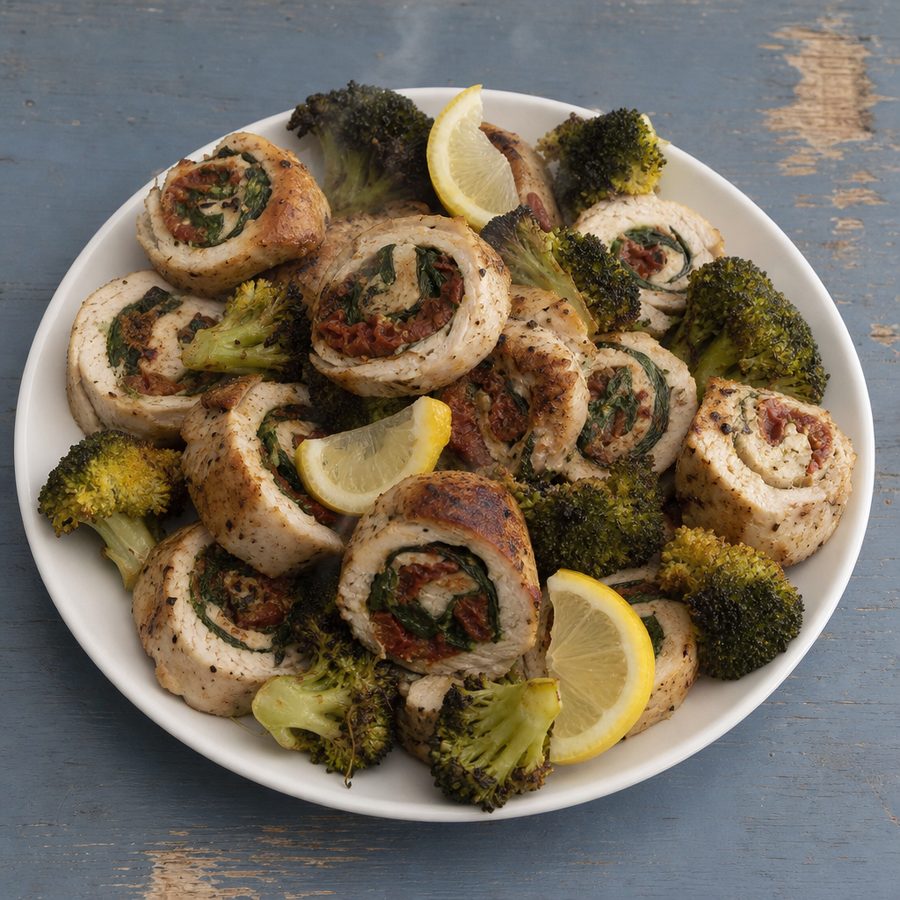
Chicken breasts pounded thin, rolled around wilted spinach, chopped almonds, sun-dried tomato, and basil, then seared and roasted alongside broccoli charred at the edges.
Why You'll Love This Recipe
Rolling a chicken breast takes ten minutes and changes what it is. A flat breast cooks from the outside in and is dry the moment you look away, while a roll cooks around a wet filling that steams it from the inside, so the margin between done and overdone widens considerably. It also means every slice has something in it. I make these when I want a plate that looks like it took effort, on a night when I do not actually have much effort to give. Written down the technique sounds fussy, and in practice it is ten minutes, most of that pounding.
The filling is built to be dry rather than wet, which matters more than it sounds. Spinach wilted and then squeezed hard, almonds chopped fine, and sun-dried tomato soaked and drained give you something that holds together and does not run out of the ends in the pan. Almonds do the work a breadcrumb filling usually does, holding the moisture and adding a little grit against the soft spinach. Basil goes in raw so it stays fragrant rather than turning black. Chop the almonds finer than feels necessary, since large pieces push the seam open from the inside as the roll cooks.
Broccoli roasts in the same oven at the same temperature, so this is effectively a one-oven dinner with a five-minute sear in the middle of it. Cut the florets long, with a good length of stem, and lay them cut side down; the flat faces caramelize and the tips crisp. Slice the rolls thick and fan them out over the broccoli with lemon squeezed over everything at the table. It is a good dish for company, since everything but the slicing can be done a day ahead and the rolls sit happily in the refrigerator raw. Leftovers, sliced cold, are the best chicken salad you will make all week.
Ingredients
- 4 boneless, skinless chicken breasts (about 1 1/2 lb total)
- 2 large heads broccoli (about 1 1/2 lb), cut into long florets, stems peeled and sliced
- 9 oz baby spinach
- 1/3 cup almonds, toasted and chopped fine
- 1/3 cup dry-packed sun-dried tomatoes, soaked in hot water 10 minutes and chopped
- 1/2 cup fresh basil leaves, torn
- 1 large shallot, minced
- 3 garlic cloves, minced
- 2 tbsp olive oil, divided
- 2 tbsp lemon juice, plus wedges to serve
- 1 tsp dried oregano
- 1 tsp ground black pepper
- 1/4 tsp fine sea salt
Instructions
- Wilt and dry the spinach: Heat a teaspoon of the olive oil in a large skillet over medium and cook the shallot and garlic for two minutes until soft. Add the spinach in handfuls and toss until it has all collapsed, about three minutes. Tip it into a sieve and press hard with the back of a spoon, then chop it roughly. It should feel almost dry; wet filling steams the roll open.
- Mix the filling: Combine the chopped spinach with the almonds, sun-dried tomato, oregano, half the black pepper, and half the basil. Taste it. It should be assertive on its own, since it will be diluted by a good deal of chicken once it is rolled.
- Pound and fill the breasts: Lay each breast between two sheets of parchment and pound with a heavy pan or a mallet from the center outward until it is an even quarter inch thick. Season with the salt and the rest of the pepper. Spread a quarter of the filling over each, leaving a half-inch border, roll up snugly from the narrow end, and tie with two loops of kitchen twine or secure with toothpicks.
- Sear the rolls and start the broccoli: Heat the oven to 425°F (220°C), since the broccoli needs that much heat to char at the tips in the time the rolls take. Toss the broccoli with a tablespoon of the oil and spread it cut side down on a sheet pan. Meanwhile, heat the remaining oil in an ovenproof skillet over medium-high and brown the rolls on all sides, turning every ninety seconds, five to six minutes total. They should be deeply golden, not pale.
- Roast, rest, and slice: Slide both pans into the oven and roast fifteen to eighteen minutes, until a thermometer through the center of a roll reads 165°F and the broccoli tips are dark and crisp. Rest the chicken five minutes before cutting the twine, so the roll sets and holds its spiral instead of unwinding, then slice each one crosswise into thick rounds. Scatter the remaining basil over everything and finish with the lemon juice.
Variations
- Olive and caper: Add a tablespoon of chopped green olives and a teaspoon of rinsed capers to the filling for a sharper, saltier spiral.
- Walnut and sage: Swap the almonds for chopped walnuts and the basil for a few sage leaves, which pushes the whole plate toward autumn.
- Kale rather than spinach: Use finely shredded kale, cooked a few minutes longer, for a filling with more chew and a darker flavor.
- Charred lemon: Halve two lemons and roast them cut side down alongside the broccoli, then squeeze them hot over the sliced chicken.
Storage & Leftovers
Sliced or whole, the rolls keep four days in a sealed container. Store them with the broccoli but pour the lemon over only what you are eating, since acid sitting on roasted broccoli overnight turns it drab and soft. Whole rolls hold their moisture better than sliced ones, so leave them intact if you are not in a hurry the next day.
Reheat covered in a 325°F oven for ten minutes with a spoonful of water in the dish. Low and covered is the rule here, because chicken breast reheated hot and dry goes stringy in a way nothing will fix. The broccoli is better refreshed separately for four minutes at 425°F so it crisps again rather than steaming.
The rolls freeze well for three months, either cooked or assembled raw. Raw is my preference: brown and roast them straight from frozen, adding about ten minutes to the oven time. Roasted broccoli does not freeze, so make that fresh when the time comes.
Notes & Tips
- Squeeze the spinach twice: Once in the sieve, once in your hands after chopping. Nine ounces of spinach holds a startling amount of water and every drop of it works against the seam holding shut.
- Pound from the center out: Working outward keeps the thickness even and stops the thin edges from tearing. Tears are where filling escapes, so patch any you make by folding the edge over before you roll.
- Brown the seam first: Set each roll seam side down in the hot pan and leave it for ninety seconds. That first contact glues the edge shut and everything after it is easy.
- Broccoli cut side down, in one layer: The flat face is where the caramelization happens, and a crowded pan steams. Use two sheet pans if you have to; it is the difference between browned florets and olive-drab ones.
- Rest before you cut the twine: Five minutes lets the juices settle back into the meat. Cut immediately and the spiral relaxes and pushes the filling out onto the board.
Nutrition & Mindful Eating
- Chicken, spinach, almonds, and broccoli each cover something the others do not. The breast carries the protein, the spinach and broccoli together bring nearly all the fiber on the plate, and the almonds add the fat that makes a filling this green feel satisfying rather than sparse.
- Spinach cooked down and squeezed concentrates into a few spoonfuls of intensely green filling, and what stays behind after the water goes is where its iron, folate, and vitamin K are. Cooking it also softens the oxalates that give raw spinach that chalky feeling on the teeth.
- Broccoli roasted at high heat until the tips blacken tastes almost nutty, a long way from what it is when boiled. It holds vitamin C and a sulfur compound called sulforaphane, which is the reason broccoli turns up in so much research, and cutting the florets long gives you more browned surface per bite.
- Almonds chopped fine hold the filling together and bring vitamin E and magnesium along with a real amount of fiber for something used by the spoonful. Toasting them first is what makes them taste of anything.
- Sun-dried tomatoes are concentrated by drying, so a third of a cup carries the depth of a much larger amount of fresh tomato, including its lycopene. Soaking softens them enough to disappear into the spiral rather than sitting in it as chewy shards.
- As you eat, take a moment with the first cut slice and look at the spiral before it comes apart on the plate, then notice how much more filling than chicken you taste in each round.
Frequently Asked Questions
My rolls came unrolled in the pan.
Almost always too much filling, or filling that was still wet. A quarter cup per breast is plenty, the border matters, and the spinach needs a genuine squeeze in a sieve. Two loops of twine hold better than toothpicks, and starting the sear seam side down sets the edge before you turn it.
Can I use chicken thighs?
Yes. Boneless thighs opened out flat make smaller rolls, so you will get six or seven rather than four, and they need about the same time in the oven. They are more forgiving than breast and a good option if you have overcooked chicken before.
Do I need a meat thermometer?
For a stuffed roll, genuinely yes. The filling insulates the center, so the usual visual cues lie to you, and cutting one open to check means losing the juice from that piece. An instant-read through the thickest part reading 165°F is the only reliable answer.
Oil-packed sun-dried tomatoes rather than dry?
They work, and they are softer to start with so you can skip the soak. Drain them properly and blot them, and use a little less oil in the filling since they bring their own. Dry-packed have a more concentrated flavor, which is why I reach for them first.