
Chicken and Sauerkraut Collard Wraps with Dill
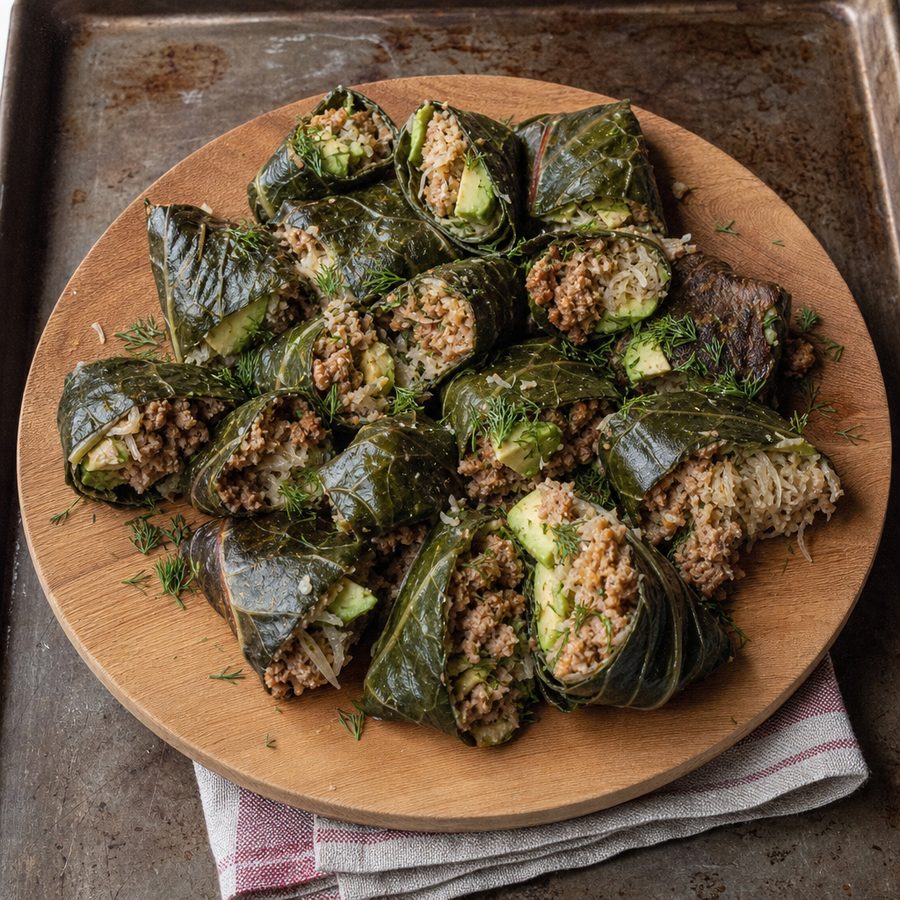
Browned ground chicken folded off the heat with sharp sauerkraut and dill, rolled up with sliced avocado in blanched collard leaves for a breakfast you eat in one hand.
Why You'll Love This Recipe
The morning you are already running late is what this was built for. Both parts get made the night before, the wrapping takes four minutes, and the whole thing goes into a container and gets eaten in the car or at a desk with one hand. I built it for a client who kept losing the elimination phase somewhere around day ten, always at breakfast, always because there was nothing in the house she could simply pick up. Ground chicken, sauerkraut, and avocado inside a blanched collard leaf is not what anybody pictures at seven in the morning, and then you eat one and it makes complete sense.
The two steps people skip are the two that make this work. Blanch the collard leaves for thirty seconds and drop them into ice water, and they turn pliable and bright green rather than cracking the moment you fold them. Then squeeze the sauerkraut dry in your hands over the sink, harder than feels polite, and fold it into the chicken off the heat rather than cooking it. Kraut that goes into a hot pan turns limp and loses the sourness that is the entire point. Ground chicken is the other thing to watch, since there is not much fat in it, so it wants oil and a hot skillet to brown properly.
What holds this together is contrast. Sour kraut, rich avocado, mild chicken, and a great deal of dill, all rolled into something dark green with a little chew left in it. The avocado is doing real work beyond flavor, because ground chicken on its own tends to leave a person hungry by ten, and the fat in a few slices per wrap is what fixes that. Make all eight on a Sunday and breakfast is handled for two mornings. They travel better than anything else I make at this hour, and they are meant to be eaten cold, which is the best thing about them.
Ingredients
- 1 1/4 lb ground chicken
- 1 1/2 cups sauerkraut (about 7 oz), drained and squeezed dry
- 8 large collard leaves (about 8 oz), stems trimmed
- 1 large avocado, sliced
- 1 medium yellow onion, finely diced
- 3 cloves garlic, minced
- 3 tbsp chopped fresh dill
- 2 tbsp olive oil, divided
- 1 tbsp fresh lemon juice
- 1/2 tsp fine sea salt, divided
Instructions
- Blanch the collard leaves: Bring a wide pot of salted water to a boil and set a bowl of ice water beside it. Slide in the leaves one or two at a time for 30 seconds, until they turn deep green and go floppy, then move them straight to the ice water. Lay them flat on a towel and pat dry.
- Shave the ribs: Set each leaf vein side up and run a paring knife flat along the thick center rib to shave it down level with the leaf. This is what lets the wrap fold without splitting, and it takes about 15 seconds a leaf.
- Brown the chicken: Heat 1 tablespoon of the olive oil in a large skillet over medium-high. Add the ground chicken in large clumps with a quarter teaspoon of the salt and leave it undisturbed for 4 minutes so the underside browns, then break it up and cook 4 minutes more, until no pink remains.
- Cook the onion and garlic: Stir in the onion and cook for 4 minutes, until soft and translucent. Add the garlic and cook 45 seconds more, until it smells sweet. Take the pan off the heat.
- Fold in the kraut: Squeeze the sauerkraut in handfuls over the sink until no more liquid comes out. Stir it into the warm chicken along with the dill, the lemon juice, the remaining tablespoon of oil, and the rest of the salt. Taste it, then let the filling cool for 10 minutes.
- Roll the wraps: Lay a leaf vein side up, pile about a half cup of filling in a line across the lower third, and lay two slices of avocado on top. Fold the sides in, roll it up tightly away from you, and set it seam side down. Repeat with the rest, then cut each wrap in half.
Variations
- Pork and dill: Swap in ground pork and skip the first tablespoon of oil, since the pork gives up plenty of fat on its own.
- Olive and lemon: Add a quarter cup of chopped kalamata olives with the kraut for a saltier, brinier filling.
- Bowl version: Skip the wrapping entirely, chop the collards, and wilt them into the pan, then top the bowl with avocado.
- Napa cups: Use whole napa cabbage leaves as open cups when you want something lighter and crunchier to hold it.
- Chive and scallion: Stir in a handful of sliced scallions and chopped chives with the dill for a sharper, more oniony filling.
Storage & Leftovers
The filling keeps in a sealed container in the refrigerator for up to 4 days and is better on the second day, once the dill and the kraut have worked their way through the chicken. Cool it uncovered for 20 minutes before the lid goes on so the leaves you wrap it in later do not steam.
Assembled wraps hold for 2 days rolled tightly in parchment or beeswax wrap, seam side down. Squeeze a little extra lemon over the avocado slices before they go in and press the wrap closed so there is no air against the fruit, which is what keeps it from browning at the cut faces.
Freeze the filling flat in bags for up to 3 months and thaw it overnight in the refrigerator. The collard leaves and the avocado do not freeze, so blanch fresh leaves on the morning you want them, which takes about 5 minutes for the whole batch.
Notes & Tips
- Blanch briefly, then shock: Thirty seconds and straight into ice water. A minute of boiling turns collards army green and slippery, and they tear as you roll them.
- Shave the rib flat: The thick center vein is the reason most greens split when folded. Take it down level with a paring knife rather than cutting it out.
- Squeeze the kraut hard: Wet kraut makes a soggy wrap by morning. Wring it out in handfuls until it stops dripping, and save the brine for a vinaigrette.
- Buy kraut from the cold case: Shelf-stable jars have been heated, so the live cultures are gone and the texture is softer. The refrigerated kind is crunchier and sharper.
- Roll it like a burrito: Sides in first, then roll away from you, keeping tension the whole way. A loose wrap comes apart in a bag by nine in the morning.
- Salt at the very end: Sauerkraut brings a lot of salt with it. Season the chicken lightly, then taste after the kraut is folded in and adjust from there.
Nutrition & Mindful Eating
- Chicken, sauerkraut, and avocado are the three things doing the work here. The meat brings the protein, the kraut brings sourness and crunch, and the avocado brings the fat that turns a handful of filling into a breakfast that lasts.
- Sauerkraut is cabbage fermented in salt, and the refrigerated kind carries live lactic acid bacteria along with the fiber of the cabbage itself, which is a combination your gut generally welcomes. Folding it in off the heat is what keeps those cultures alive.
- Avocado gives the wrap its richness, and the monounsaturated fat in it is the reason a few slices per wrap hold you well past midmorning. It brings potassium and a good amount of fiber along with that softness.
- Collard leaves are sturdy enough to roll and still tender after half a minute in boiling water, and they are one of the better plant sources of calcium, with vitamin K and folate in the same dark green leaf.
- Dill, garlic, and a squeeze of lemon are what tie a sour filling to a mild meat. Dill is grassy and slightly anise-like, and it is the flavor that makes people ask what is in these before they finish the first one.
- As you eat, notice the sourness of the kraut arriving just after the softness of the avocado, and reach for the second wrap only if you still want it once the first one is gone.
Frequently Asked Questions
Can I use a different leaf for the wrapper?
Yes. Large Swiss chard leaves work with a 20 second blanch, napa cabbage leaves want about a minute, and romaine hearts can be used raw as open cups if you would rather skip the pot entirely. Collards hold up best in a bag, since they stay intact for two days.
Will the avocado turn brown by morning?
Not much, if you toss the slices in lemon juice and roll the wraps tightly enough that no air sits against them. If you are making them more than a day ahead, keep the avocado whole and slice it in the morning, which adds about a minute.
Can I use a different meat?
Ground pork and ground turkey both work at the same weight, and pork brings enough fat that you can drop the first tablespoon of oil. Ground beef works too, though it is heavier against the kraut, so add an extra squeeze of lemon at the end.
Does this fit an AIP elimination phase?
It does, as long as you read the sauerkraut jar. You want one with cabbage and salt on the label and nothing else, since many krauts are seasoned with caraway or juniper. Buy the refrigerated kind rather than the shelf-stable kind, which has been heated and lost its cultures.