
Chicken Souvlaki over Santorini Fava with Lemon and Oregano
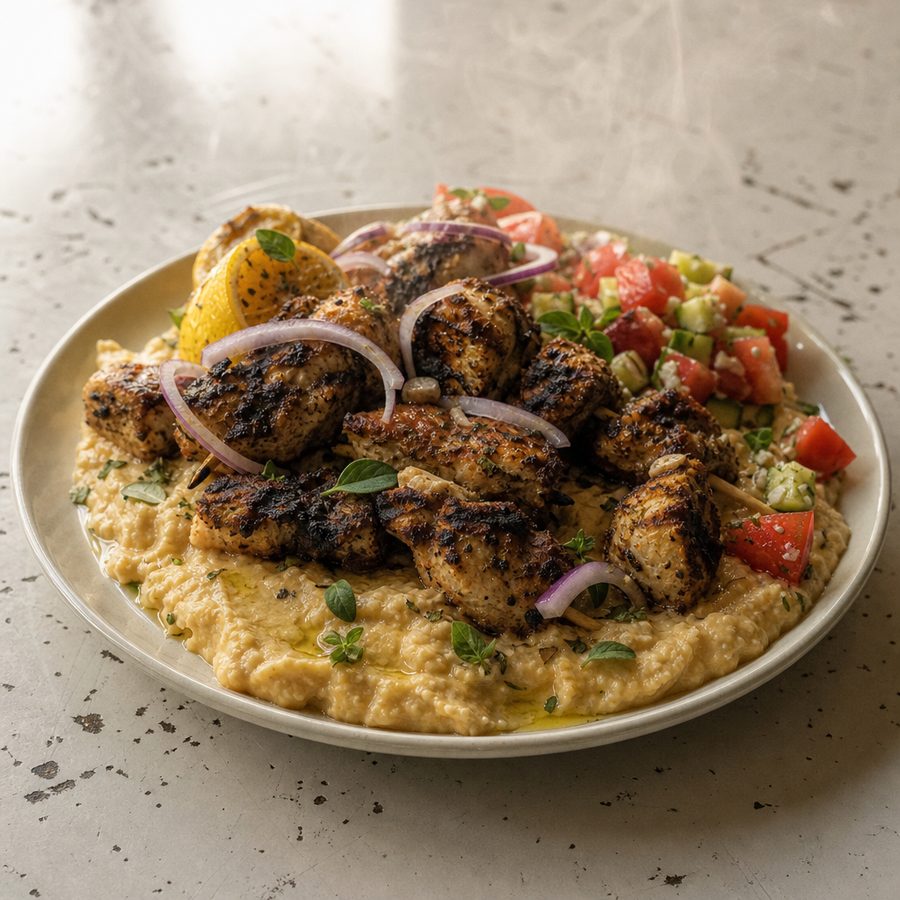
Chicken thighs marinated in lemon, garlic, and oregano, threaded onto skewers and charred in a hot pan, served over the soft yellow split pea puree Greeks call fava, with a chopped cucumber and tomato salad and sharp slivers of red onion.
Why You'll Love This Recipe
Fava is what Greeks call the yellow split pea puree they make on Santorini, and it has nothing to do with fava beans. It is one of the great cheap foods: dried peas, an onion, water, and enough time on a low burner for them to fall apart. What you get is soft, sweet, and savory in a way that makes people ask what is in it, and the answer is almost nothing. I started putting souvlaki over it after a trip where every taverna served the two side by side, and once you eat them together it is hard to go back to serving them separately.
The chicken is marinated the way souvlaki has always been marinated: lemon, garlic, oregano, olive oil, and pepper, and nothing else. Twenty minutes is enough, an hour is better, and any longer than that and the acid starts cooking the surface of the meat. Thighs are the cut to use because they stay juicy through the char you want on the outside. I cook them in a ripping hot pan rather than on a grill most of the year, and I put the lemon halves in cut side down beside them so they blacken and go jammy and sweet enough to squeeze over everything.
This is a summer dinner in my house but I make it in February too, because the fava is warming and the cold salad wakes the whole plate up. It comes to the table on a board or a wide platter, the puree spread underneath, the skewers on top, the salad heaped to one side, and everybody builds their own plate, which is half the pleasure of it. The fava can be made a day ahead and reheated with a splash of water, so on the night you actually want to eat this it becomes a twenty minute dinner. That is the version I cook most often, and nobody has ever noticed the difference.
Ingredients
- 1 1/4 lb boneless, skinless chicken thighs, cut into 1 1/2-inch pieces
- 2/3 cup dried yellow split peas, rinsed (they cook down to about 1 1/3 cups)
- 1 English cucumber, quartered lengthwise and cut into thick half-moons
- 1 cup cherry tomatoes, halved
- 1/2 small red onion, sliced paper thin
- 3 tbsp fresh lemon juice, plus 2 lemons halved for the pan
- 2 1/2 tbsp extra virgin olive oil
- 3 garlic cloves, 2 minced and 1 left whole
- 1 1/2 tsp dried Greek oregano, crumbled between your fingers
- 1/3 cup chopped fresh flat-leaf parsley
- 1/4 tsp fine sea salt
- 1/2 tsp coarsely ground black pepper
Instructions
- Marinate the chicken: Toss the chicken pieces with the minced garlic, the oregano, 2 tablespoons of the lemon juice, 1 tablespoon of the olive oil, the black pepper, and half the salt. Leave it at room temperature for 20 minutes while you start the peas, or cover and refrigerate for up to an hour. Longer than that and the lemon starts to firm up the surface of the meat.
- Start the fava: Put the rinsed split peas in a saucepan with the whole garlic clove, half the red onion left in one piece, and 3 cups of water. Bring to a boil, skim off the foam that rises in the first two minutes, then lower the heat and simmer partly covered for 35 to 40 minutes, stirring now and then, until the peas have completely collapsed and the mixture looks like loose porridge.
- Blend it smooth: Fish out the onion piece and the garlic clove. Blend the peas with an immersion blender, or in a food processor, with 1 tablespoon of the olive oil, 1 tablespoon of the lemon juice, and the rest of the salt, adding hot water a spoonful at a time until it moves slowly off a spoon. It thickens as it cools, so leave it looser than you think you want.
- Make the salad: Slice the rest of the red onion paper thin and soak it in cold water for five minutes to take the bite off, then drain it well. Toss it with the cucumber, the cherry tomatoes, the parsley, and the remaining lemon juice. Leave it undressed with oil until the moment you serve, so the cucumber stays crisp.
- Char the skewers: Thread the chicken onto four skewers, pushing the pieces close together so the middles stay juicy. Heat a cast iron or heavy skillet over medium-high with the remaining olive oil until it just smokes. Lay the skewers in with the lemon halves cut side down and cook 4 minutes without moving them, until the underside is deeply browned in patches. Turn and cook 4 to 5 minutes more, until an instant-read thermometer in the thickest piece reads 175°F.
- Build the plate: Spread the warm fava across a wide platter or four plates in a thick swirl. Lay the skewers on top, pile the salad to one side, and squeeze the blackened lemon halves over everything. Serve while the fava is still warm and the salad is still cold.
Variations
- Pork souvlaki: Pork shoulder or tenderloin cut into cubes is the most traditional souvlaki of all. Marinate it the same way and cook it to 145°F.
- Capers and onion on top: Finish the fava the way they do on Santorini, with a spoonful of rinsed capers and more sliced red onion scattered over the surface.
- Charred peppers: Thread wedges of red bell pepper and onion between the chicken pieces so they blister alongside the meat.
- Yogurt on the side: A bowl of thick Greek yogurt whisked with lemon and a grated garlic clove turns this into a fuller plate and cools the pepper down.
- Herb swap: Fresh dill in place of the parsley in the salad pushes the whole plate in a greener, more island-tasting direction.
Storage & Leftovers
The fava keeps five days in the refrigerator and sets up firm and sliceable once cold, which is normal. Reheat it in a saucepan over low with a splash of water, whisking until it loosens back to a spoonable puree, and taste it again for lemon and salt since cold dulls both.
Cooked chicken keeps three days. Pull it off the skewers before you store it and keep it in its own container so the char does not go soft against the puree. It reheats best in a dry skillet over medium heat for two or three minutes, and it is very good cold, chopped into the leftover salad.
The fava freezes well for three months, the chicken less so. Freeze the puree in flat containers, thaw overnight in the refrigerator, and expect to whisk in a few tablespoons of water as it warms. Make the salad fresh, since cucumber and tomato both go watery after freezing.
Notes & Tips
- Skim the peas early: The gray foam that rises in the first two minutes carries a slightly bitter taste. Take it off and the finished fava is sweeter and cleaner.
- Leave the puree loose: Fava thickens dramatically as it cools. What looks right in the pan will be stiff on the plate, so thin it until it just holds a slow line off the spoon.
- Do not marinate too long: Lemon juice on chicken past an hour firms the outside and turns it slightly chalky when it cooks. Twenty minutes genuinely does the job.
- Crowd the skewer: Pieces pressed tight against each other protect one another and stay juicy. Spaced out, they dry from all sides at once.
- Char the lemons: Cut side down in a hot dry pan for three minutes turns lemon halves sweet and slightly smoky, and squeezing them over the plate is what ties the fava to the chicken.
- Dress the salad last: Cucumber and tomato start weeping the moment salt and acid hit them. Toss it in the minute before it goes on the table.
Nutrition & Mindful Eating
- The split peas, the chicken, and the cold salad each do a different job. The puree underneath is soft and starchy and carries most of the fiber, the skewers bring the protein and the char, and the cucumber and tomato give the plate the crunch and the acidity that keep it from feeling heavy.
- Yellow split peas break down into something sweet and almost creamy after 40 minutes, and they carry a great deal of soluble fiber along with plant protein and folate, which is why a small pool of this puree does more on a plate than its size suggests.
- Chicken thigh is a darker, more forgiving cut than breast and stays juicy through the hard sear that souvlaki needs. It brings protein in quantity along with selenium and B vitamins.
- Cucumber and cherry tomatoes go on cold and undressed until the last second. The tomatoes carry lycopene and a sharp sweetness, and the cucumber is mostly water, which is exactly what you want against a warm puree.
- Greek oregano crumbled between your fingers, garlic, and lemon are the whole seasoning here, and they are enough. Rubbing dried oregano releases its oils, which is why the marinade smells so strongly of it before the chicken ever hits the pan.
- As you eat, drag a piece of chicken through the warm puree and notice how the sweetness of the peas meets the char, and let the cold salad slow you down between bites.
Frequently Asked Questions
Are these the same as fava beans?
No, and the name catches everybody out. Greek fava is made from yellow split peas, which cook down soft and sweet in about 40 minutes. Fava beans are a different plant entirely and would give you something firmer and grassier.
Can I make this on a grill?
Yes, and it is the better way when the weather allows. Cook the skewers over direct medium-high heat for 10 to 12 minutes total, turning every three minutes, and put the lemon halves cut side down on the grate for the last five.
My fava is grainy rather than smooth. What went wrong?
The peas did not cook long enough. They need to fall apart completely before you blend them, and old split peas can take an hour rather than 40 minutes. Keep simmering and add water as needed until a pea crushes to nothing between your fingers.
Can I use chicken breast?
You can, and plenty of souvlaki is made with it. Cut it into slightly larger pieces, marinate it the same way, and pull it at 165°F, which comes up faster than the thighs do. Watch it closely, since breast goes from juicy to dry in about a minute.