
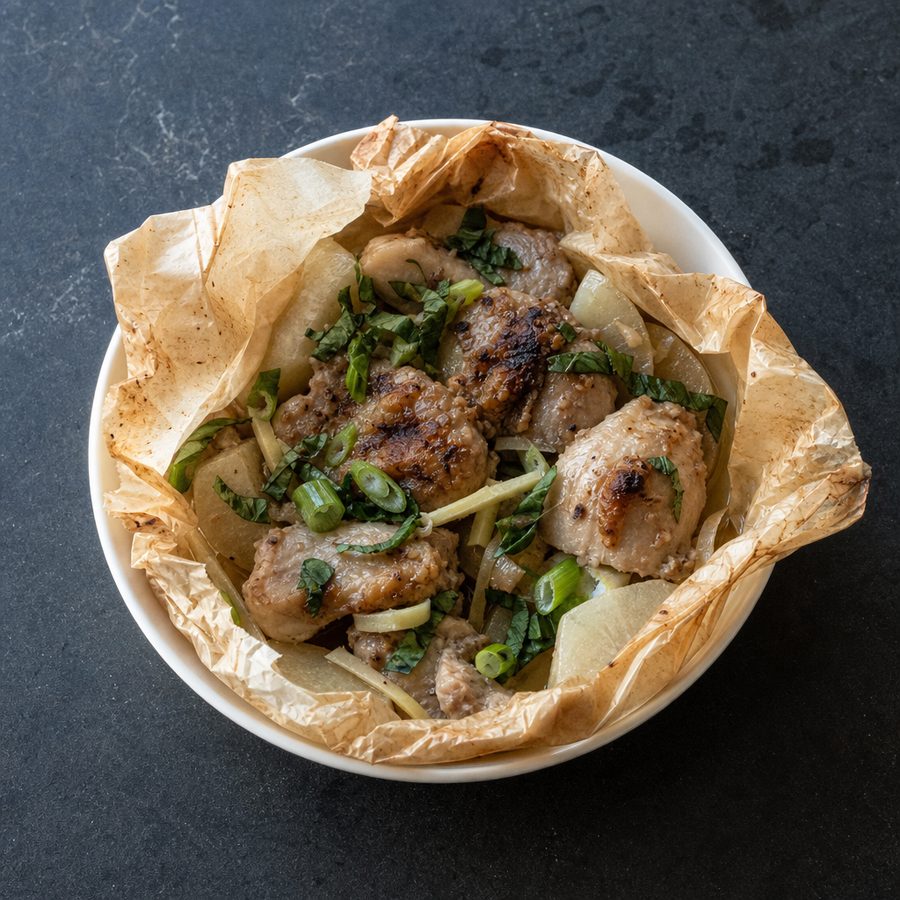
Chicken Thighs in Parchment with Kohlrabi and Lime
Boneless chicken thighs sealed in parchment over sliced kohlrabi with ginger, garlic, and scallion, so everything steams in its own juices and the packets open at the table.
Why You'll Love This Recipe
Cooking in parchment sounds fussy and takes about four minutes to learn. You pile everything onto a half sheet of paper, fold the edge over on itself two or three times all the way around, and put the packets on a tray. What happens in the oven is that nothing can escape, so the chicken steams in lime juice, ginger, and its own juices rather than drying in dry heat. I make this on weeknights when the sink is already full, because there is one tray to wash and the packets go straight from oven to plate. Opening them at the table is genuinely the best part of the meal.
Kohlrabi is the reason to try this one. It is the pale knobbly bulb people walk past in the produce aisle, a cabbage relative that tastes like a sweet broccoli stem, and unlike zucchini it does not slump into water when you cook it. Sliced a quarter inch thick, it comes out tender with a little resistance left, and it soaks up the chicken juices without giving up its texture. Boneless thighs are the right cut here because breast meat has nowhere to hide in a sealed packet: twenty-five minutes of steam leaves it stringy, while thighs stay soft and forgiving even if you leave them in an extra three minutes.
The flavor comes from things that would burn or fade in an open pan. Ginger cut into matchsticks rather than grated stays sharp and distinct, sliced garlic goes sweet, scallion softens into something almost silky, and lime juice trapped in the paper keeps its perfume instead of cooking off. Basil goes in only when the packet is opened, so the heat rising out of it is what releases the scent. Cut the packets at the table and let people open their own. The steam that comes up carries lime and ginger, and the smell is half of why anyone eats a second helping.
Ingredients
- 2 lb boneless, skinless chicken thighs (about 8)
- 3 medium kohlrabi bulbs (about 1 1/2 lb), peeled and sliced 1/4 inch thick
- 6 scallions, cut into 2-inch lengths
- 2 tbsp fresh ginger, peeled and cut into matchsticks
- 4 cloves garlic, thinly sliced
- 4 tbsp fresh lime juice (from 2 limes)
- 2 tbsp olive oil
- 1/4 cup chicken broth
- 1/2 cup torn fresh basil leaves
- 1 1/4 tsp fine sea salt, divided
Instructions
- Heat the oven and cut the paper: Heat the oven to 425°F (220°C) with a rack in the middle. Cut 4 sheets of parchment about 15 by 20 inches. Fold each one in half like a book and open it out again, so you have a crease to build against.
- Prepare the kohlrabi: Trim the kohlrabi and peel it deeply, taking off the fibrous layer that sits just under the skin along with the skin itself. Halve each bulb and slice it a quarter inch thick. Toss the slices in a bowl with the olive oil, the garlic, the ginger, and 3/4 teaspoon of the salt.
- Build the packets: Pile a quarter of the kohlrabi just to one side of each crease. Set 2 chicken thighs on top, season with the rest of the salt, scatter the scallion over, and spoon over a tablespoon each of lime juice and broth. Keep the pile compact so the paper can close around it.
- Seal them: Fold the empty half of the paper over the filling. Starting at one corner, fold the open edge over on itself in short overlapping pleats, working all the way around and pressing each fold flat, then twist the final corner under to lock it. The packet should be sealed but puffed with air rather than tight against the food.
- Bake: Set the packets on a rimmed sheet pan and bake for 22 to 26 minutes. They will inflate as the steam builds, which is the sign the seal is good. The chicken is done at 175°F (80°C) for thigh meat, which you can check by pushing a thermometer straight through the paper.
- Open at the table: Let the packets sit for 3 minutes, then move each one to a plate and cut an X across the top with scissors or a knife. Fold the paper back, tear the basil over the steam, and eat straight out of the parchment.
Variations
- Fennel and lemon: Swap the chayote for thinly sliced fennel and the lime for lemon, for a sweeter, more anise-driven packet.
- Quail packets: Use four semi-boneless quail rather than thighs and cut the bake to 18 minutes.
- Greens underneath: Lay a handful of spinach or bok choy under the chayote so it wilts into the juices at the bottom.
- Mint rather than basil: Finish with torn mint for a cooler, sharper note against the ginger.
- More heat from the ginger: Double the ginger and add a knob of it grated into the lime juice for a packet that opens sharper.
Storage & Leftovers
Leftovers keep in a sealed container in the refrigerator for up to 3 days. Tip the juices from the paper in with the chicken and kohlrabi rather than letting them go down the sink, since they are the seasoning for the whole dish and there is no sauce beyond them.
Reheat in a covered skillet over medium-low with a spoonful of water, 4 to 5 minutes, or in a fresh parchment packet at 375°F (190°C) for 8 minutes. Kohlrabi holds its texture on reheating better than most vegetables this size, so a second day does not turn it to mush.
You can build the packets up to a day ahead and refrigerate them flat on a tray, which makes this the easiest dinner party main I know. Add 3 minutes to the bake if they go into the oven cold. Cooked, it does not freeze well, since the kohlrabi softens and the lime dulls.
Notes & Tips
- Peel the kohlrabi deeply: There is a tough fibrous layer under the skin that never softens. Take it off with a knife rather than a vegetable peeler and slice a quarter inch thick, since thicker pieces stay raw in the time the chicken needs.
- Do not overfill: A crowded packet steams unevenly and is likely to split. Four thighs to a packet is too many, and two is right.
- Leave air in the packet: The dome of trapped steam is what cooks the top of the chicken. A packet pressed tight against the food bakes rather than steams.
- Matchstick the ginger: Grated ginger disappears into the juices, while matchsticks stay in distinct sharp pieces you find as you eat.
- Check through the paper: A thermometer pushed through the parchment tells you what you need without opening anything. Any small hole seals itself against the food.
- Basil at the very end: Sealed in from the start it turns black and tastes of hay. Torn over the open packet, it hits the steam and smells like the reason you cooked this.
Nutrition & Mindful Eating
- The chicken, the kohlrabi, and the aromatics cook in one sealed pocket, so nothing escapes. The meat gives up its juices, the kohlrabi takes them on along with the lime and ginger, and what collects in the bottom of the paper is both the sauce and most of the flavor.
- Chicken thighs stay tender through a long steam because of the fat marbled through them, and they carry more iron and zinc than breast meat does, along with the protein that anchors the plate.
- Kohlrabi is a cabbage relative that eats sweet and crisp rather than sulfurous, and it carries a surprising amount of vitamin C along with the fiber that keeps it substantial next to the chicken.
- Ginger cut into matchsticks stays sharp and warming through the bake, and it has been studied for its effect on an unsettled stomach, which is a nice thing to know about something you are eating for the flavor anyway.
- Lime juice sealed in the paper cannot evaporate, so the acid stays bright rather than cooking away, and it is what makes a steamed dinner taste finished with very little salt in it.
- As you eat, let the steam that comes up when you cut the paper reach you before the first bite, and notice how the kohlrabi has held its bite while the chicken has gone completely soft.
Frequently Asked Questions
What is kohlrabi, and what can I use if I cannot find it?
It is a pale bulb in the cabbage family, sold with or without its leaves, mild and sweet with the texture of a broccoli stem. Peel it deeply, since the layer under the skin stays woody. Sliced chayote, celeriac, or turnip all work in its place.
Can I use foil rather than parchment?
You can, and it seals more easily, though you lose the pleasure of the paper puffing up and browning at the folds. Foil also reflects heat rather than absorbing it, so give the packets an extra 2 to 3 minutes and check the chicken with a thermometer.
My packet leaked and everything went dry. What went wrong?
The folds were too shallow or the pile was too close to the edge. Leave at least two inches of bare paper on all sides, fold the edge over on itself two or three times rather than once, and press each pleat flat as you go around.
Is this all right during an AIP elimination phase?
Yes. Chicken, chayote, ginger, garlic, scallion, lime, olive oil, and basil are all allowed, and there is no pepper or spice blend anywhere in it. Just check the broth carton, since some brands add nightshade-based seasoning that would not be suitable.