
Chicken Thighs Roasted in Schmaltz with Skin Cracklings
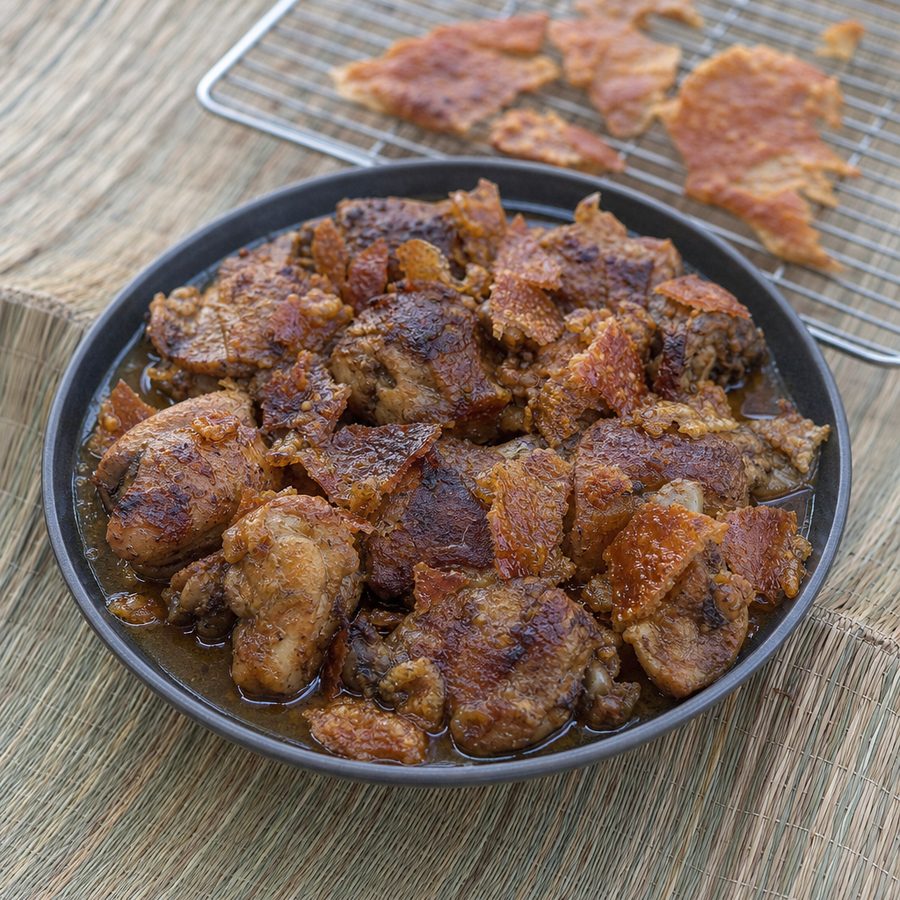
The skins come off and cook flat under a weight until they are glass, the thighs roast in the fat they gave up, and the pan juices are whisked into butter.
Why You'll Love This Recipe
This started as a way to fix the thing that always bothered me about roasted thighs. Skin left on top of the meat is caught between two jobs: it wants dry heat to crisp, and the meat underneath is giving off steam the whole time, so you end up with skin that is browned in patches and flabby everywhere else. Taking the skin off and cooking it separately, flat, under something heavy, solves it completely. You get skin that is uniformly crisp and thigh meat that browns properly in the fat, and both are better apart than they were together.
The skins render slowly in a cold pan set over medium-low heat, weighted with a smaller skillet so every part of the surface stays in contact with the metal. Over twelve or fifteen minutes the fat runs out of them and they shrink to about half their size, turning from white to gold to a deep amber that looks like stained glass held up to a window. Then the naked thighs go into that fat and sear, and finish in the oven, basting themselves in what came out of their own skin. Nothing is added and nothing is wasted.
It is a Tuesday dinner that eats like a Sunday one. Thigh meat is forgiving, so the timing is relaxed, and the whole thing takes about an hour with maybe fifteen minutes of actual attention. The last step is the one to save room for: cold butter whisked bit by bit into the hot pan juices, which emulsifies into a thin glossy sauce that tastes intensely of the chicken it came from. Spoon it over, break the cracklings over the top with your hands, and put the platter in the middle of the table.
Ingredients
- 8 bone-in, skin-on chicken thighs (about 2 1/2 lb)
- 2 tsp ghee
- 3 tbsp cold butter, cut into cubes
- 1/2 tsp fine sea salt, divided
Instructions
- Take the skins off and salt everything: Pull the skin from each thigh, working a finger underneath and tugging steadily. It comes away in one piece with a little patience. Lay the skins flat on a board, scrape any thick fat off the underside with the back of a knife, and pat both the skins and the thighs completely dry. Season the thighs with half the salt on all sides.
- Render the skins under a weight: Melt the ghee in a cold heavy skillet, then lay the skins flat, fat side down, without overlapping. Set a smaller skillet on top to press them down, since skin left to itself curls and renders only where it touches, and put the pan over medium-low heat. Cook for twelve to fifteen minutes, checking at ten, until the skins are amber, flat, and rigid. Lift them onto a rack, sprinkle with the remaining salt, and pour the rendered fat into a cup.
- Sear the thighs in their own fat: Heat the oven to 425°F (220°C), which is hot enough to finish a thigh quickly without drying what the sear has just built. Return 2 tablespoons of the rendered fat to the skillet over medium-high heat. Lay the thighs in smooth side down and leave them for five minutes, until the undersides are deeply browned and release without sticking. Turn them over. The pan should be sizzling steadily the whole time and never smoking.
- Roast until they are done: Slide the skillet into the oven and roast for eighteen to twenty-two minutes, until an instant-read thermometer pushed against the bone reads 175°F. Thigh meat is better taken past the point where chicken breast would be dry, since the connective tissue in it needs the extra heat to soften. The juices should run clear when you tilt a thigh.
- Rest the meat and build the pan butter: Move the thighs to a warm platter and let them rest for five minutes. Pour off all but a tablespoon of fat from the skillet, set it over low heat, and add 3 tablespoons of water, scraping up the browned film on the bottom. Whisk in the cold butter one cube at a time, letting each disappear before the next goes in, until the sauce is glossy and lightly thickened. Do not let it boil.
- Break the cracklings over the top: Pour any juices from the platter back into the sauce and whisk once more. Spoon the pan butter over the thighs, then snap the cooled skins into rough shards with your hands and scatter them over everything. Serve straight away, while the cracklings still crack under a fork.
Variations
- Duck skin cracklings: Render duck skin the same way for a thicker, richer shard, and roast the thighs in that fat.
- Cheddar crisps alongside: Melt small piles of grated cheddar in a dry pan until lacy and browned, then break them over the platter with the cracklings.
- Chicken legs: Use four whole legs instead, skinned the same way, and add ten minutes to the roasting time.
- A yolk in the sauce: Whisk an egg yolk into the pan juices off the heat before the butter goes in for a thicker, paler sauce that clings.
- Bacon fat sear: Sear the thighs in rendered bacon fat instead of schmaltz and crumble the crisped bacon over with the cracklings.
Storage & Leftovers
The thighs keep four days in a sealed container in the refrigerator and reheat better than most roasted chicken, since dark meat holds its moisture. Store them with the pan butter poured over, which sets firm in the cold and melts back over the meat as it warms.
Keep the cracklings in their own container in the refrigerator, where they hold three days. They are rendered chicken skin and they do not belong on a counter overnight, and because the cold softens them, give them two or three minutes in a hot oven before serving. Anything airtight traps the moisture they still hold and they go leathery overnight. Sixty seconds in a hot dry pan brings back the snap if they have softened.
Rendered chicken fat is the best thing you will take away from this recipe. Strain it into a jar and keep it a month in the refrigerator or six months frozen, then use it anywhere you would use butter over heat. The thighs themselves freeze for three months, cooked and cooled, in flat sealed portions.
Notes & Tips
- Start the skins in a cold pan: Fat needs time to melt out before the skin sets. A cold start gives it that time, and it is the single difference between glass and chewy leather.
- Scrape the underside of the skin: The pad of soft fat clinging to the inside renders unevenly and leaves greasy spots. Ten seconds with the back of a knife per skin fixes it.
- Dry the thighs hard: Wet meat steams and never browns. Paper towel, both sides, and then let them sit uncovered for a few minutes while the skins render.
- Do not move them while they sear: Chicken sticks to a hot pan and then releases on its own once a crust has formed. If it resists the spatula, it is not ready to turn.
- Keep the butter cold: Cold butter whisked in slowly emulsifies into the pan juices. Melted butter poured in at once will separate into a greasy layer on top.
- Salt the cracklings while they are hot: Salt sticks to the surface fat in the first thirty seconds off the heat and slides right off a crackling that has cooled.
Nutrition & Mindful Eating
- The thighs, the fat they render, and the butter at the end are the whole recipe, and each does one job. The dark meat carries the protein and stays juicy, the rendered fat browns everything, and the butter turns a few spoonfuls of pan juices into a sauce.
- Chicken thigh is darker than breast meat because those muscles work harder, and that extra myoglobin is where its deeper flavor and its iron and zinc come from. It is also the reason a thigh stays succulent at a temperature that would leave other cuts dry.
- The skin is mostly fat and collagen, and pressing it flat over gentle heat is what turns it into something you can shatter. It is on the plate for its texture, which is one of the best textures in all of cooking, and for the deep roasted flavor it leaves behind in the fat.
- Butter whisked into the hot juices carries vitamin A and it also carries flavor, since fat is what holds and delivers the browned chicken taste that the water alone would leave thin.
- A plate of dark meat like this holds you for a long stretch. The protein does most of that, the fat slows the meal down, and it is the kind of dinner that ends with people still sitting at the table.
- As you eat, listen for the crack when a shard of skin breaks against your fork, notice how much juice a thigh still holds after all that time in the oven, and let this be a meal you sit down for.
Frequently Asked Questions
Can I use boneless thighs?
You can, and they will cook in about twelve minutes in the oven, but you will have to buy skin separately or go without the cracklings. Bone-in is worth the small extra cost here, since the bone slows the cooking near the center and keeps that part of the thigh juicy.
My skins curled instead of going flat. What happened?
Either the pan started hot or the weight was too light. Skin put into a hot pan seizes and shrinks before the fat has a chance to run out. Start cold, keep the heat low, and use a heavy skillet on top, adding a can of something to it if the pan alone is not pressing everything down.
Why cook chicken thighs to 175°F?
Dark meat has far more connective tissue than white meat, and that tissue only breaks down and turns silky above about 170°F. A thigh pulled at 165°F is safe but chewy, and the extra ten degrees is exactly what makes it tender. Breast meat is the opposite and should never go that far.
Can I do the skins ahead?
Yes, and it makes the dinner much faster. Render them in the morning, cool them on a rack, and refrigerate the cracklings and the fat in separate containers. Give them a minute in a dry pan before serving. I would not render them more than a day ahead, since they slowly lose their snap.