
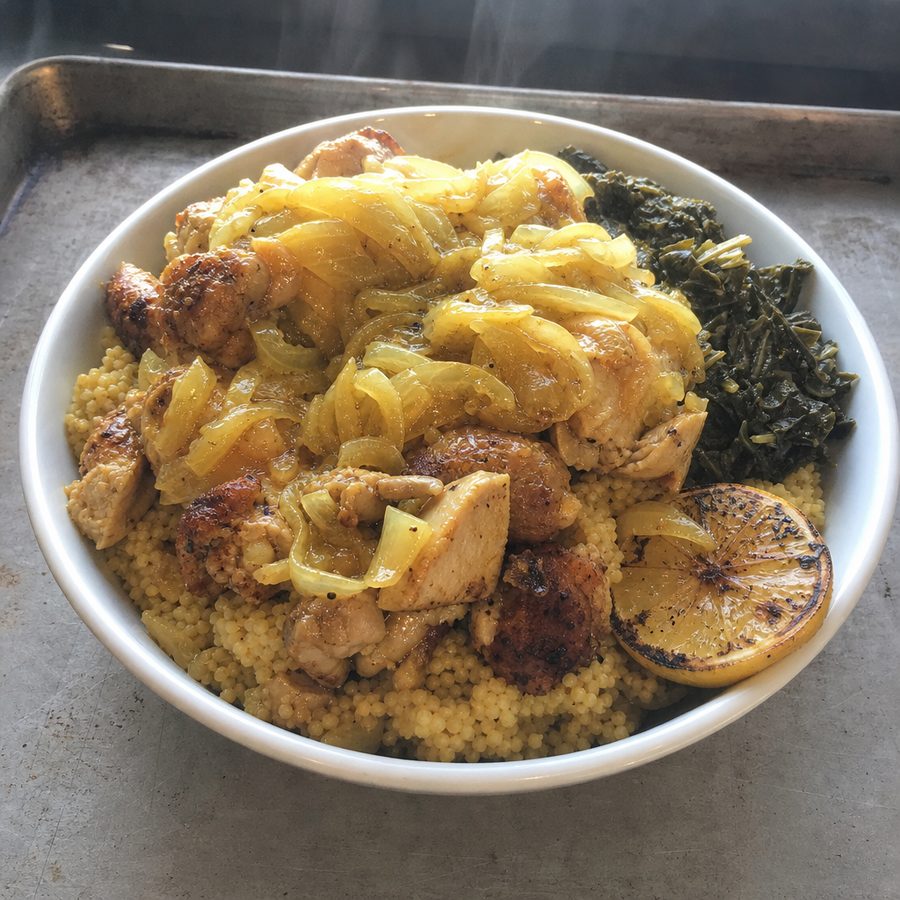
Chicken Yassa with Braised Collard Greens over Millet
Chicken marinated in lemon, mustard, and a mountain of onion, seared and then simmered until the onions melt into a tart golden sauce, served over millet with collard greens braised in the same pan.
Why You'll Love This Recipe
Yassa is a Senegalese dish and the onions are not a supporting player in it. Four large ones for four people looks like a mistake in the bowl and turns out to be exactly right, because they cook down to a fraction of their volume and become the sauce itself. Lemon juice and mustard go into the marinade with them, which is what gives yassa its particular sharpness. Start the marinade in the morning if the day allows, or the night before if it does not, because the lemon needs hours rather than minutes. It is tart, savory, and oniony in a way that stays with you, and I have never served it to anyone who did not ask what was in it.
The method has one real rule: brown the chicken and the onions separately, then bring them together. If you put everything in the pan at once, the onions release water, the chicken poaches, and you end up with something pale and one-note. Sear the chicken hard first, take it out, then let the onions go slowly in the same pan with the marinade until they collapse and turn golden at the edges. Twenty minutes is not too long. When they look almost like a jam, the chicken goes back in to finish.
The collard greens are my own addition rather than something you would necessarily find in Dakar, and they earn their place. They braise in a ladle of the onion sauce so they taste of the same lemon and mustard, and their slight bitterness is a good counterweight to all that sweetness. Millet underneath is traditional and worth seeking out. It is faintly nutty, it cooks in fifteen minutes, and it catches sauce better than rice does. Make it while the onions are cooking and everything lands at once.
Ingredients
- 1 1/3 lb boneless skinless chicken breast, cut into large 3-inch pieces
- 4 large yellow onions (about 1 lb 2 oz), halved and sliced into thin half moons
- 1/4 cup lemon juice, from 2 lemons, halves kept for charring
- 2 tbsp dijon mustard
- 5 garlic cloves, grated
- 1 tsp coarsely ground black pepper
- 1/2 tsp cayenne, or more if you want it closer to how it is eaten in Dakar
- 1/4 tsp fine sea salt
- 2 tbsp olive oil
- 3 bay leaves
- 2 bunches collard greens (about 1 lb 2 oz), stems stripped out and leaves cut into wide ribbons
- 2 1/2 cups cooked millet (from about 3/4 cup dry), hot and fluffed
Instructions
- Marinate the chicken and onions together: In a large bowl, combine the sliced onions, lemon juice, dijon mustard, grated garlic, black pepper, cayenne, and salt, and work it with your hands until the onions are slick and starting to soften. Add the chicken pieces, turn them through it, and leave the whole bowl at room temperature for 30 minutes or covered in the refrigerator overnight.
- Cook the millet: Rinse the millet and simmer it in unsalted water, covered, for about 15 minutes until the grains are tender and the water is gone. Take it off the heat and leave the lid on for five minutes, then fluff it with a fork. This can be done while the onions cook, or a day ahead.
- Sear the chicken: Lift the chicken out of the marinade, shaking the onions back into the bowl, and pat the pieces dry, since a wet piece coated in lemon and mustard will steam rather than color. Heat the olive oil in a wide heavy pot over medium-high and brown the chicken in two batches, three to four minutes a side, until deeply colored. It does not need to be cooked through, because it finishes in the onions at the end. Move it to a plate.
- Cook the onions down: Tip all the onions and every drop of marinade into the same pot, add the bay leaves, and turn the heat to medium. Cook for 18 to 20 minutes, stirring every few minutes and scraping the browned bits off the bottom, since those bits are the whole flavor of the sear and they belong in the sauce rather than in the pan. They will go from crunchy and white to slumped and translucent to golden and almost jammy. That last stage is the one you are waiting for.
- Braise the collards: Move about a third of the onions to a separate wide pan with half a cup of water, add the collard ribbons, cover, and cook 12 to 15 minutes over medium-low, until the leaves are dark and tender enough to cut with the side of a spoon.
- Finish the chicken: Return the chicken and any juices to the pot of onions, add half a cup of water, cover, and simmer gently for eight to ten minutes, until the chicken reaches 165°F (74°C) and is easy to pull apart. Fish out the bay leaves. Taste, and add more lemon if it has gone quiet. Serve over the millet with the collards alongside and the onion sauce spooned over everything.
Variations
- Grilled yassa: Grill the marinated chicken over coals before it goes into the onions, which is how it is most often made and adds a layer of smoke.
- With olives and mustard seed: Stir a handful of green olives and a teaspoon of mustard seed into the onions in the last five minutes for a sharper, brinier sauce.
- Fish yassa: Use thick cod or halibut fillets, marinated for only 20 minutes and laid on top of the finished onions to steam for six minutes.
- Hotter: Add a whole habanero to the pot with the onions and leave it in, then remove it before serving, which gives you the perfume without the full force of the heat.
Storage & Leftovers
This keeps four days in a sealed container in the refrigerator and is a dish that genuinely improves overnight. The onions keep softening, the lemon and mustard settle into the chicken, and day two tastes less sharp and more rounded than the night you cooked it.
Reheat it covered in a pot over low heat with a splash of water, eight to ten minutes, so the chicken warms without tightening. The collards and the millet both reheat well in the same pot on top. A fresh squeeze of lemon at the end brings the whole thing back into focus.
The chicken and onions freeze for three months and thaw well, which is not true of many chicken dishes. Freeze the millet separately in a flat sealed bag, or make it fresh in the fifteen minutes the rest takes to warm through. The collards freeze acceptably and come back a little softer.
Notes & Tips
- Slice the onions with the grain: Half moons cut from root to tip hold together through a long cook, while onions sliced across the equator fall apart into strings. You want soft pieces you can still see, not a puree.
- Dry the chicken before it hits the pan: Marinade clinging to the surface will steam and keep it gray. Shake each piece off, blot it with paper towel, and give it a hot pan and four still minutes for a real crust.
- Push the onions past slumped: Most people stop when the onions turn translucent, which is about eight minutes short. Keep going until they are golden and starting to stick, scraping as you go, because that stage is where the sweetness that balances the lemon comes from.
- Save some lemon for the end: Long cooking dulls citrus. Taste right before serving and add another squeeze if the sauce has gone flat, which it often has after half an hour on the heat.
Nutrition & Mindful Eating
- Chicken, collard greens, and millet split the work on this plate. The chicken carries the protein, the collards bring calcium and a dark leafy bitterness that stands up to the lemon, and the millet underneath gives the meal its whole-grain base and catches every drop of the onion sauce.
- Collard greens are one of the most generous leafy sources of calcium there is, and unlike some greens they give it up readily. Braised slowly in the onion sauce they turn silky and dark, and their faint bitterness is what keeps the plate from going sweet.
- Chicken breast is a fine-textured cut that stays tender when it finishes gently in liquid rather than over direct heat, and it brings a great deal of protein along with niacin and selenium.
- Onions cooked this far change entirely. They lose their bite, take on a jammy sweetness, and carry quercetin and the prebiotic fibers that feed the bacteria in your gut. A pound of them across four plates is a real amount of vegetable, not just seasoning.
- Millet is a small round grain with a faintly nutty taste, common across West Africa long before it turned up in health food stores, and it brings magnesium and steady whole-grain carbohydrate to a plate that would otherwise be all protein and greens.
- As you eat, notice how sweet the onions have become against the lemon still cutting through them, and let the collards and the millet slow the plate down so you finish it at the pace it was cooked.
Frequently Asked Questions
Is that really the right amount of onion?
It is, and it is the reason the dish is called yassa rather than lemon chicken. Four large onions cook down to about two cups, and at that point they stop reading as a vegetable and become the sauce. Cutting the quantity gives you a thin pan sauce and a dish that misses the point.
Can I use chicken thighs or a whole cut-up chicken?
Yes, and bone-in pieces are the traditional choice. Sear them the same way, then give them 20 to 25 minutes buried in the onions rather than eight to ten, cooking to 175°F for dark meat. The sauce comes out richer from the bones.
What is the mustard doing?
Carrying the lemon and emulsifying the sauce. Dijon is standard in Senegalese kitchens for exactly this reason: it thickens the onion juices slightly so the sauce clings, and its sharpness stacks on top of the citrus rather than competing with it.
What if I cannot find millet?
Rice is the usual alternative and is completely at home here. Couscous, fonio, or bulgur all work as well. Whatever you choose, cook it plain in unsalted water, because the sauce arrives with plenty of its own flavor.