
Cold Poached Pork Tenderloin with Shaved Celeriac and Chives
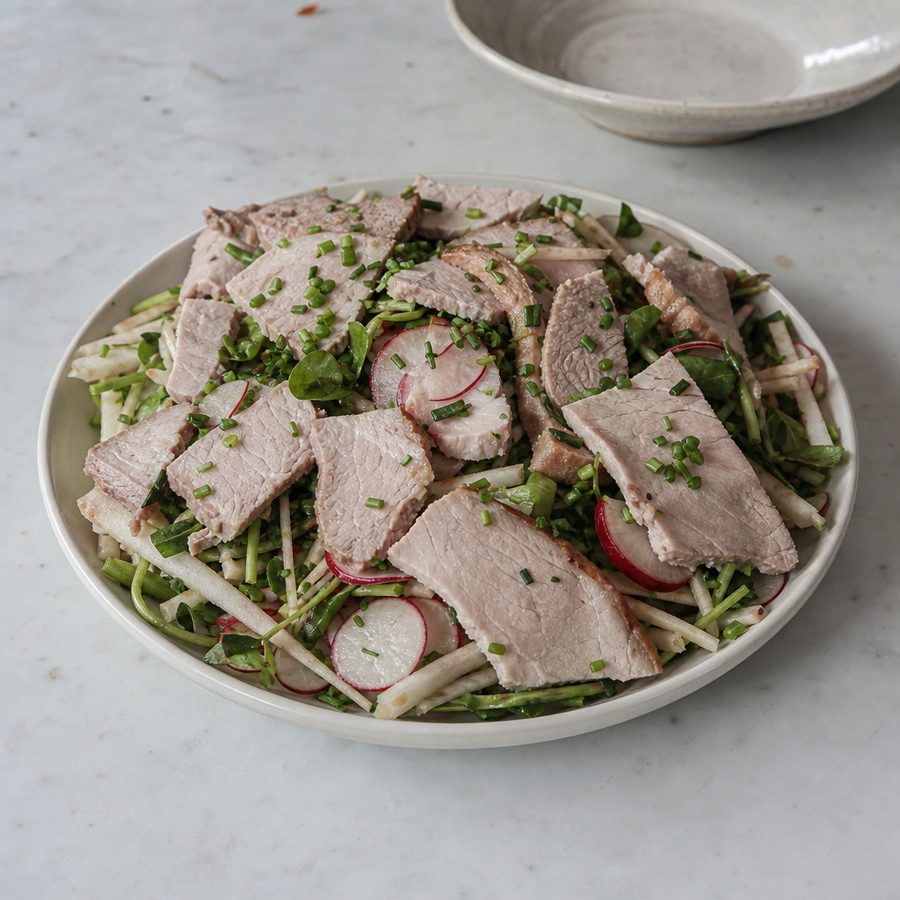
Pork tenderloin poached gently in herbed broth, chilled, and sliced thin over raw celeriac matchsticks, radishes, and watercress with a lemon and chive dressing.
Why You'll Love This Recipe
This is the one I pack on purpose, cold, the night before. Most lunches you carry are leftovers making the best of a bad situation. This one is designed to be eaten cold and is honestly worse warm, which changes how it feels to open the container at your desk. I started making it because pork tenderloin goes from good to sawdust in about ninety seconds of extra heat, and poaching is the method that takes that risk almost entirely away. The meat sits in barely trembling broth, comes out at the temperature you wanted, and then cools down in its own liquid, which is what keeps it juicy through a night in the refrigerator.
Poaching is not boiling, and that difference is the whole recipe. Bring the broth up with the bay leaves and a little salt, then drop the heat until the surface is barely moving before the pork goes in. You are looking at around fifteen minutes for a small tenderloin, and 145°F (63°C) at the thickest point, which leaves it faintly pink and completely safe. Then take the pot off the heat and let the meat cool in the liquid for at least half an hour. Meat that cools in its poaching broth pulls moisture back in as the fibers relax, while meat lifted straight onto a board does not. That single step is why this slices cleanly rather than crumbling.
The plate underneath is all raw and all crunch, which is deliberate against the softness of the pork. Celeriac is knobbly and ugly and worth the trouble, tasting like celery crossed with parsley, and cut into matchsticks it stays crisp for two days once the lemon is on it. Radishes and watercress bring the pepper. The dressing is lemon, cider vinegar, olive oil, and a lot of chives, and it doubles as the thing that keeps the celeriac from browning, so dress it the moment it is cut. Layered into a container with the pork on top, it is the rare packed lunch that looks better at noon than it did the night before.
Ingredients
- 1 1/2 lb pork tenderloin (2 small tenderloins), silverskin trimmed off
- 1 medium celeriac (about 1 lb), peeled and cut into thin matchsticks
- 8 radishes, sliced paper thin
- 3 cups watercress, thick stems removed
- 3 cups chicken broth, plus water to cover
- 3 tbsp fresh lemon juice, plus the zest of 1 lemon
- 3 tbsp olive oil
- 1 tbsp apple cider vinegar
- 3 tbsp chopped fresh chives
- 3 tbsp chopped fresh parsley
- 2 bay leaves
- 1 1/4 tsp fine sea salt, divided
Instructions
- Trim and season the pork: Pull the silverskin off the tenderloins by sliding a thin knife under it and drawing it away from you, since it will not soften no matter how long the meat cooks. Pat the tenderloins dry and season them all over with 1/2 teaspoon of the salt.
- Bring the broth to a poach: Put the broth, the bay leaves, and 1/4 teaspoon of the salt into a pot just wide enough to hold both tenderloins lying flat. Add water until the liquid will cover the meat by an inch. Bring it to a simmer, then lower the heat until the surface only shivers, with no bubbles breaking.
- Poach the tenderloins: Slide the pork into the liquid and hold the pot at that bare shiver for 14 to 18 minutes, adjusting the burner if it starts to bubble. The pork is done at 145°F (63°C) at the thickest point, and it will look pale outside and faintly pink at the center.
- Cool the pork in the liquid: Take the pot off the heat and leave the tenderloins in the broth for at least 30 minutes, until the liquid is barely warm. Move the whole pot to the refrigerator and chill for at least 2 hours or overnight. Save the poaching broth, which is now light pork stock and makes a good base for soup.
- Cut and dress the vegetables: Peel the celeriac deeply with a knife and cut it into matchsticks about the thickness of a wooden skewer. Toss it immediately with the lemon juice, the lemon zest, the vinegar, the olive oil, the chives, the parsley, and the remaining salt so it cannot brown. Fold in the radishes and let it sit 10 minutes to soften slightly.
- Slice and assemble: Lift the cold pork out of the broth, pat it dry, and slice it across the grain about a quarter inch thick. Fold the watercress through the dressed celeriac, spread it out on plates or into containers, and lay the pork slices over the top. Spoon any dressing left in the bowl over the meat.
Variations
- Apple and fennel: Add half a shaved fennel bulb to the celeriac for an anise note, and a little more lemon to keep it from going sweet.
- Warm version: Slice the pork straight from the pot while hot and lay it over the dressed celeriac so the salad wilts a little under it.
- Herb-heavy: Double the parsley and add a handful of chopped dill for a dressing that is closer to a green sauce than a vinaigrette.
- Beet and orange: Swap the radishes for a shredded raw beet and use orange juice for half the lemon.
- Broth on the side: Warm a mug of the saved poaching liquid with a little lemon and drink it alongside the cold plate.
Storage & Leftovers
Keep the poached tenderloins whole and submerged in their broth in the refrigerator for up to 3 days, and slice only what you are about to eat. Pork stored in slices dries at every cut face within a day, while a whole tenderloin sitting in liquid stays as juicy as it was the hour it came off the stove.
The dressed celeriac salad holds for 2 days and gets better on the second, since the acid softens the matchsticks into something between raw and pickled. Add the watercress only when you are packing the container, because delicate leaves collapse within a few hours of meeting lemon and oil.
Do not freeze this one. Poached pork turns dry and grainy on thawing, and raw celeriac goes limp and weeps water. If you want to work ahead, poach the pork and cut the celeriac up to 2 days early and keep them separate until the morning you are packing lunch.
Notes & Tips
- No bubbles, ever: A boiling poach tightens the outer half inch of the tenderloin before the middle is warm. If bubbles break the surface, lift the pot off the burner for a minute.
- Use a thermometer: Fifteen minutes is a guess that depends on how thick your tenderloin is. At 145°F (63°C) it is juicy, and by 160°F (71°C) it is chalky, which is a narrow window to eyeball.
- Take the silverskin off: That pearly membrane shrinks as it heats and bows the tenderloin into a curve, and it stays chewy on the plate.
- Dress the celeriac the second it is cut: Cut surfaces go brown within a few minutes. The lemon in the dressing is what stops it, so have the bowl ready before you pick up the knife.
- Slice across the grain: The muscle fibers run the length of a tenderloin. Cutting straight across them shortens every fiber and is the difference between tender and springy.
- Keep the broth: After poaching, that liquid is light pork stock. Strain it, chill it, and use it within 3 days or freeze it for soup.
Nutrition & Mindful Eating
- The poached pork, the raw roots, and the lemon dressing give you three separate textures on one plate. The meat is soft and cool, the celeriac and radish stay crisp against it, and the acid running through everything is what makes cold meat appetizing rather than flat.
- Pork tenderloin is close-grained and mild, and a gentle poach keeps it that way. It is one of the better sources of thiamin, the B vitamin your body uses to turn food into usable energy, and a few slices carry a serious amount of protein.
- Celeriac eaten raw is crisp and faintly sweet, somewhere between celery and parsley in flavor, and it brings fiber, vitamin K, and potassium to the crunchy side of the plate.
- Radishes and watercress are both in the mustard family, which is where their pepperiness comes from, and watercress carries a lot of vitamin K and vitamin C for something so light on the fork.
- Chives, parsley, lemon, and cider vinegar make the dressing, and the acid does double duty by keeping the cut celeriac pale while it sits. Dressing raw roots early also means they soften slightly and taste seasoned all the way through by the time you eat.
- As you eat, notice the contrast between the cool soft pork and the crunch underneath it, and give the plate a few minutes of your attention rather than eating it over a keyboard.
Frequently Asked Questions
Can I use chicken in this recipe?
Yes. Boneless chicken breasts poach the same way and want about 15 minutes at the same bare shiver, cooked to 165°F (74°C). Keep the cooling-in-the-liquid step, since chicken breast dries out even faster than tenderloin does once it leaves the pot.
Is pink pork safe?
At 145°F (63°C) followed by a rest, yes, and that has been the official guidance for years. A faint blush at the center of a tenderloin is what juicy pork looks like. The old habit of cooking pork to gray comes from a parasite risk that is not a factor in the modern supply.
What if I cannot find celeriac?
Kohlrabi is the closest match raw, crisp and mild, at the same weight. Jicama works if you want it sweeter, and a firm turnip works if you want it sharper. All three want the same immediate toss with lemon so the cut surfaces stay pale.
Does this fit an AIP elimination phase?
It does. There are no grains, legumes, dairy, eggs, nuts, seeds, or nightshades in it, and the seasoning is bay, lemon, cider vinegar, chives, and parsley rather than a spice blend. Check the broth you poach in, since many boxed ones carry black pepper.