
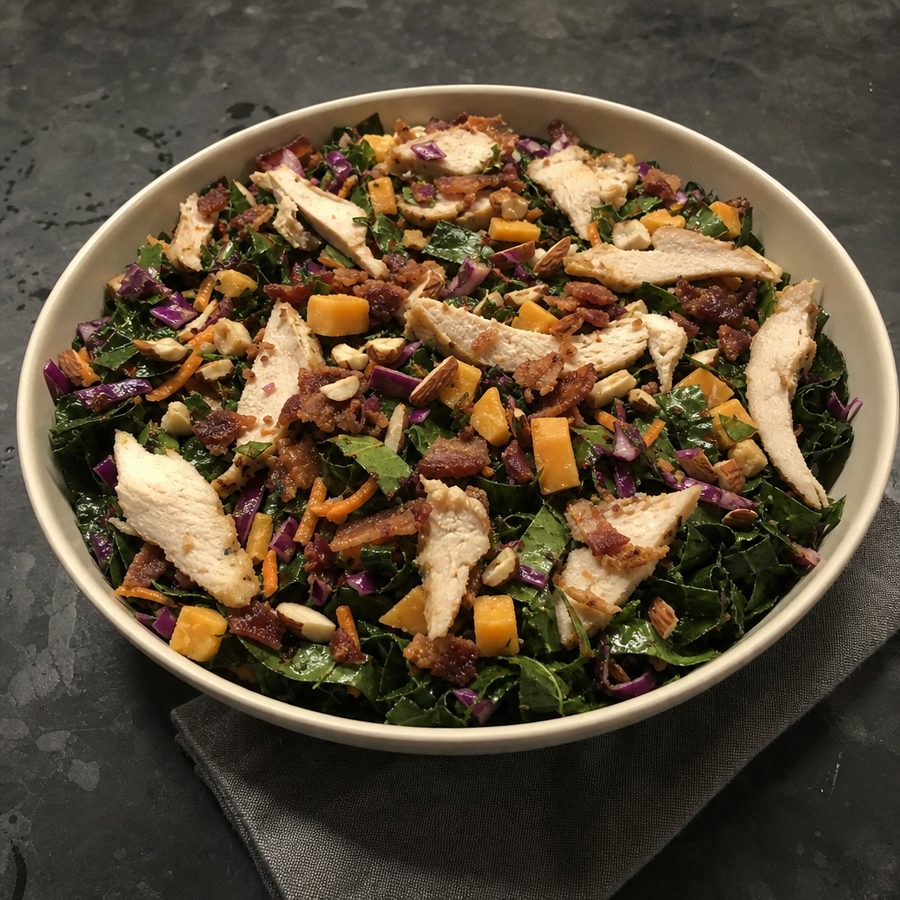
Collard Ribbon Slaw with Chicken, Bacon, and Cheddar
Thin ribbons of collard greens and red cabbage dressed in warm bacon fat and cider vinegar, then folded through roasted chicken, sharp cheddar, and toasted almonds.
Why You'll Love This Recipe
This is the salad I make when I want lunch handled for three days and I do not want to think about it again. Collards are the reason it works. A bunch of them, stemmed and rolled and sliced into ribbons no wider than a shoelace, will sit dressed in the refrigerator for three days and be better on the second day than the first. I started making it in the fall, when the greens at the market are cheap and enormous, and it turned into the thing I pack whenever the week looks bad. Four containers, one skillet, one sheet pan, and nothing that has to happen in the morning.
Warm bacon fat poured over cold greens is an old trick and it is the whole method here. You crisp the bacon, pour off most of the fat but keep two tablespoons of it, and whisk that into cider vinegar, mustard, and smoked paprika while it is still hot. Poured over the collard ribbons it does in ninety seconds what an hour of marinating would do, softening them and coating every strand. Then you work it through with your hands for a full minute, squeezing as you go, and watch them turn from stiff and squeaky to dark and pliable. That massaging is the step people skip, and skipping it gives you a bowl of green confetti.
Chicken breast is what makes this hold you until dinner, and it is the ingredient most likely to be disappointing. Roast it at high heat, pull it at 160°F (71°C), rest it ten minutes, and slice against the grain, and it stays juicy cold all week. The cheddar and the almonds are not decoration. Sharp cheddar cut into small cubes gives you a salty, fatty bite every few forkfuls, the almonds go toasted for crunch, and the bacon runs through the whole thing in small crisp pieces. It is a big, chewy, slightly chaotic salad, and it is the only kind I have ever managed to eat at a desk without wishing I had brought something else.
Ingredients
- 1 1/2 lb boneless, skinless chicken breasts
- 1 large bunch collard greens, about 10 oz of leaves after stemming
- 3 cups finely shredded red cabbage (about 7 oz)
- 3 medium carrots, coarsely shredded (about 1 1/2 cups)
- 6 slices thick-cut bacon
- 4 oz sharp cheddar, cut into small cubes
- 1/2 cup almonds, roughly chopped
- 1/4 cup apple cider vinegar
- 3 tbsp olive oil, divided
- 1 tbsp dijon mustard
- 1 1/2 tsp smoked paprika
- 1/4 cup chopped fresh parsley
- 2 tbsp thinly sliced chives
- 3/4 tsp fine sea salt, divided
- 3/4 tsp freshly ground black pepper
Instructions
- Roast the chicken: Heat the oven to 425°F (220°C). Pat the chicken breasts dry, rub them with 1 tablespoon of the olive oil, half the salt, and half the black pepper, and roast on a sheet pan for 18 to 22 minutes, until the thickest part reads 160°F (71°C). Rest them 10 minutes before slicing, so the juices settle back into the meat, then cut thin against the grain.
- Crisp the bacon: Lay the bacon in a cold skillet, set it over medium heat, and cook 8 to 10 minutes, turning once, until the fat has rendered and the slices are properly crisp. Move them to a paper towel. Pour off all but 2 tablespoons of the fat and keep the pan warm.
- Toast the almonds: Spread the chopped almonds on a small pan and toast them in the hot oven for 5 to 6 minutes, until they smell sweet and turn a shade darker. Watch them from minute four, since almonds go from toasted to burnt in well under a minute. Tip them out to cool.
- Ribbon the greens: Strip the collard leaves off their thick center stems and discard the stems. Stack six or eight leaves, roll them into a tight cigar, and slice across into ribbons about an eighth of an inch wide. Shred the red cabbage as finely as you can and grate the carrots on the large holes of a box grater. Fine is the whole point with collards, since a thick ribbon stays tough no matter how hard you massage it.
- Make the warm dressing and massage: Off the heat, whisk the cider vinegar, dijon mustard, smoked paprika, remaining 2 tablespoons olive oil, and the rest of the salt and pepper into the warm bacon fat. Pour it over the collards and cabbage in your largest bowl and work it through with your hands for a full minute, squeezing as you go. The ribbons will darken and lose about a third of their volume.
- Combine and pack: Add the shredded carrot, the sliced chicken, the cheddar cubes, the crumbled bacon, the almonds, the parsley, and the chives. Toss everything well, taste for salt and vinegar, and divide it among four sealed containers. Let it sit at least an hour before you eat it, because collards need that time in the dressing to soften from stiff into something you actually want to chew.
Variations
- Turkey or pork: Roasted turkey breast or thinly sliced pork tenderloin both work in place of the chicken at the same weight.
- No bacon: Skip the bacon and start the dressing with 2 extra tablespoons of olive oil plus an extra half teaspoon of smoked paprika.
- Seed swap: Use toasted pumpkin seeds or sunflower seeds in place of the almonds for a nut-free bowl with the same crunch.
- Sharper cheese: Swap the cheddar for crumbled feta or shaved parmesan when you want the salt to land harder.
- More heat: Add a pinch of cayenne to the warm dressing and a little more mustard when you want it to bite.
Storage & Leftovers
This keeps in sealed containers in the refrigerator for 3 days and genuinely improves for the first two. The collards keep softening in the dressing and the smoked paprika works its way through the whole bowl overnight, so a container packed Sunday evening eats better on Tuesday than it did on Monday.
Pack it fully dressed and fully mixed, which is the opposite of the advice for most salads and is the point of using collards. If you want the bacon and almonds to stay properly crisp, hold them back in a small bag and scatter them over at the table.
The dressed greens do not freeze. If you want a longer head start, roast a double batch of chicken and freeze half of it sliced for up to 2 months, then build the slaw fresh around it. Thawed chicken folded into freshly massaged collards is very hard to tell from the original.
Notes & Tips
- How it packs: Divide the finished slaw among four sealed containers straight from the mixing bowl, dressed and mixed. No separate dressing pot and no assembly at noon.
- How far ahead: Make it up to 3 days ahead. It is at its best on day two, so one Sunday evening covers Monday through Wednesday comfortably.
- Pour the dressing warm: Hot bacon fat is what softens the ribbons quickly. A cold dressing works eventually, but it takes several hours to get to the same place.
- Massage means massage: A minute of real squeezing is the difference between silky and squeaky. Your hands are the only tool that does this properly.
- Cut the ribbons narrow: Wide strips stay tough and awkward on a fork. An eighth of an inch is the width that softens all the way through by morning.
- Hold the crisp things back: Bacon and almonds folded in early go soft in a wet bowl. Carry them separately and add them at the table if crunch matters to you.
Nutrition & Mindful Eating
- The collards, the cabbage, and the chicken are doing different jobs and they work together. The greens give the bowl its body and its bite, the chicken gives it the protein that makes it lunch, and the bacon fat and cider vinegar in the dressing tie the two together.
- Collard greens are thick, faintly bitter, and much sweeter once warm fat and acid have worked through them. They carry vitamin K and calcium, and an hour in the dressing is what turns them from stiff to silky in the container.
- Chicken breast roasted hot and rested before slicing stays juicy even straight from the refrigerator. It is close-grained and mild, it is dense in protein, and it carries niacin and vitamin B6 along with it.
- Bacon, sharp cheddar, and smoked paprika are what give a bowl of raw greens the taste of something cooked. The bacon goes in crisp and broken small, the cheddar in cubes so you get a salty bite rather than an even coating, and the paprika colors the whole dressing.
- A bowl this dense eats slowly and holds you well into the afternoon. The protein in the chicken is doing most of that, the fiber in the collards and cabbage is doing the rest, and the toasted almonds bring fat and vitamin E to the top of it.
- As you eat, notice how much softer the collards are than they were when you packed them, and give the bowl the few extra minutes it takes to chew it properly rather than eating over your inbox.
Frequently Asked Questions
Can I use kale or cabbage on its own?
Kale works well and behaves the same way, though it softens faster, so massage it for thirty seconds rather than a minute. Cabbage on its own is good but sweeter and simpler. Tender lettuces are the wrong choice here, since they collapse within an hour of meeting this much hot fat and vinegar.
My collards still taste tough and bitter. What went wrong?
Either the ribbons were cut too wide or they were not massaged long enough. Thin ribbons and a full minute of squeezing are what break down the cell walls and turn the bitterness sweet. If you are past that point, let the bowl sit another hour and it will keep improving on its own.
How far ahead can I make this?
Up to 3 days, and I would make the full three at once. Everything can happen the night before or two nights before. If you would rather split the work, roast and slice the chicken up to 3 days ahead and keep it separate, then dress the greens and combine in about ten minutes.
Does this fit a low-FODMAP lunch?
It does. The savory depth comes from bacon fat, smoked paprika, sharp cheddar, and mustard rather than from garlic or onion, so nothing gets removed and nothing tastes hollow. Read the bacon label, since some cures carry onion or garlic powder, and use garlic-infused olive oil in the dressing if you keep it.