
Crisp-Skinned Duck Breast over Celeriac Mash with Blistered Grapes
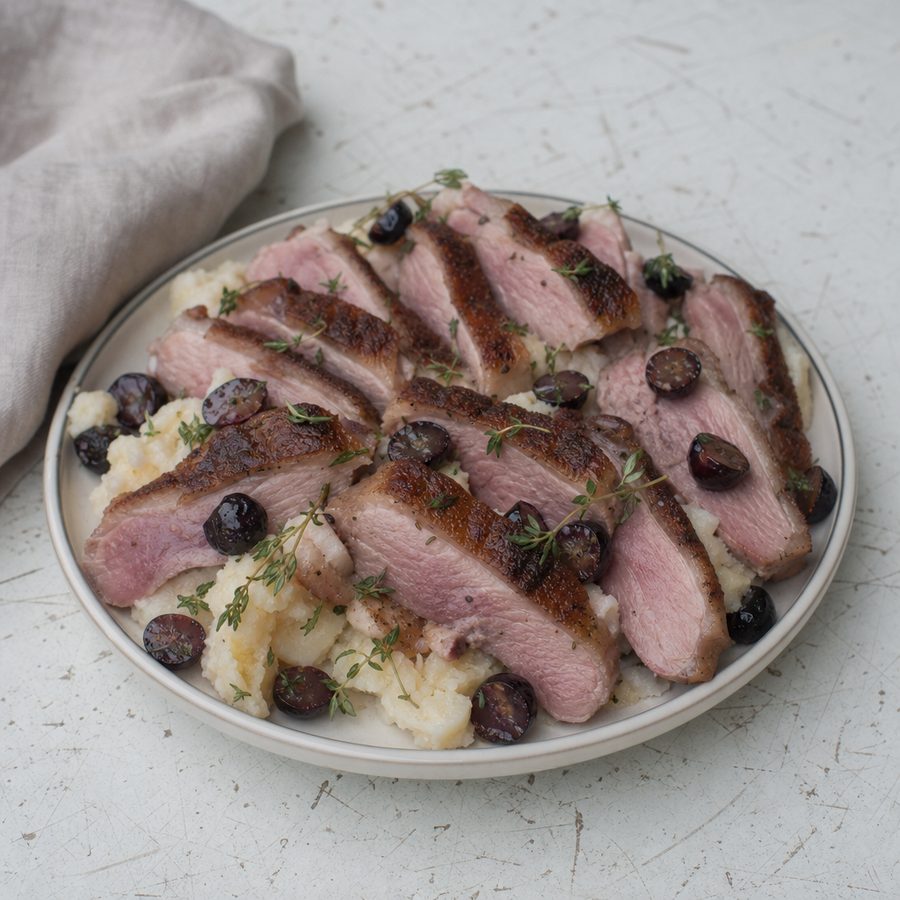
Duck breasts started skin down in a cold pan until the fat renders and the skin turns crisp, sliced over a soft celeriac and parsnip mash with grapes blistered in the drippings.
Why You'll Love This Recipe
Duck for breakfast sounds like a restaurant idea until you have done it once, and then it becomes the thing you make on a slow Saturday when you want one very good plate rather than a table full of dishes. Two breasts feed four people, the pan does nearly all of the work, and the only real skill involved is patience while the fat renders. I keep this in the rotation for mornings when I have coffee going and half an hour to stand at the stove doing very little. It is quiet cooking. You start the duck in a cold pan, you mash the celery root, and the two things finish within a minute of each other.
The cold pan is the whole trick. Duck skin is thick and full of fat, and if you drop it into a hot pan the surface seizes before the fat underneath has anywhere to go, which is how you end up with a chewy pale band along the top of the meat. Started cold and brought up slowly, that fat melts out over about fifteen minutes and leaves the skin thin, brittle, and deep brown. You pour it off as it collects, which is what keeps the pan from smoking, and you save a spoonful for the grapes. Nothing about the method is difficult. It only asks that you leave the duck alone.
Underneath, the mash is looser and softer than most, because celery root and parsnip both hold more water than a potato does and cook down to something almost creamy on their own. I keep it slack with warm broth and a little butter so it behaves like a sauce rather than a side, and I mash it by hand so a few pieces stay whole. The grapes are the part people question first and ask about later. Halved and dropped into the hot drippings with a splash of balsamic, they split, sweeten, and go syrupy in about two minutes, and that sharp edge is exactly what a rich slice of duck wants beside it.
Ingredients
- 2 boneless duck breasts, skin on (about 1 1/2 lb total)
- 1 small celery root (about 12 oz), peeled and cut into 1-inch chunks
- 4 medium parsnips (about 1 1/4 lb), peeled and cut into 1-inch chunks
- 2 tbsp butter
- 1/2 cup chicken broth, warmed
- 1 1/2 cups seedless red grapes, halved
- 2 tbsp balsamic vinegar
- 1 tbsp fresh thyme leaves, plus 4 sprigs
- 2 tbsp garlic-infused olive oil
- 1/4 cup thinly sliced chives
- 1 1/2 tsp fine sea salt, divided
- 1 tsp freshly ground black pepper
Instructions
- Get the mash going: Put the celery root and parsnip chunks in a pot, cover with cold water by an inch, add 1/2 teaspoon of the salt, and bring to a boil. Simmer 18 to 20 minutes, until a knife slides through the celery root with no resistance at all. Drain and let them steam dry in the colander for a minute.
- Score the duck skin: Pat the duck breasts completely dry. With a sharp knife, cut a crosshatch through the skin and fat at 1/2-inch intervals, stopping before you reach the meat. Season both sides with 1/2 teaspoon of the salt and half the black pepper. Dry skin and open cuts are what let the fat escape.
- Render it in a cold pan: Lay the breasts skin down in a cold, dry skillet and set it over medium-low heat. Cook 12 to 15 minutes without moving them, pouring the rendered fat into a bowl whenever it rises above the level of the skin. The skin is ready when it is deep brown, thin, and rigid under the spatula.
- Flip, finish, and rest: Turn the breasts, drop the thyme sprigs into the pan, and cook 3 to 5 minutes more, until the thickest part reads 135°F (57°C) for medium or 145°F (63°C) for medium well. Move them to a board skin side up and rest 10 minutes. They climb a few degrees as they sit.
- Mash, then blister the grapes: Mash the celery root and parsnip with the butter, the warm broth, the remaining salt, and the rest of the pepper, keeping it loose and a little rough. Pour off all but 1 tablespoon of duck fat, lay the grapes cut side down over medium-high heat, and cook 2 minutes, until they blister. Add the balsamic and swirl 30 seconds.
- Slice and plate: Slice the rested duck across the grain about 1/4 inch thick, cutting through the skin with one confident pull so the crackling does not shatter. Spoon the mash onto warm plates, lay the duck over it, and spoon the grapes and pan syrup around. Finish with the garlic-infused olive oil, thyme leaves, and chives.
Variations
- Duck fat mash: Use a tablespoon of the rendered duck fat in place of the butter for a mash that tastes of the whole plate.
- Blistered cranberries: Swap the grapes for a cup of fresh cranberries with a teaspoon of maple syrup, and cook them until they pop.
- Orange and thyme: Add the grated zest of one orange to the mash and finish the pan with 2 tablespoons of orange juice in place of the balsamic.
- Potato mash: Use yukon gold potato in place of the parsnip for a milder, starchier mash under the duck.
- Peppery greens: Wilt a few handfuls of arugula in the last of the duck fat and lay the slices over that rather than over the mash.
Storage & Leftovers
The duck and the mash keep separately in sealed containers in the refrigerator for 3 days. Keep the sliced meat in one and the grapes and their syrup in another, since that syrup softens whatever crackling is left by morning. The mash sets firm when it is cold and loosens again with a splash of broth.
Reheat the mash in a small pan over low with a little broth, stirring until it steams and slumps off the spoon again. The duck is best given 60 to 90 seconds in a dry skillet, sliced side down, or eaten cold straight from the refrigerator, which is honestly how I like it on a weekday.
Cooked duck freezes reasonably well for 2 months, though the skin never comes back crisp, so freeze it already sliced and plan on using it in a bowl or a salad. The mash freezes for a month and wants a hard stir and extra broth after thawing overnight in the refrigerator.
Notes & Tips
- Start cold, always: A cold pan is not a suggestion here. It is the only way the fat under the skin melts out before the surface sets.
- Pour the fat off as it comes: Skin sitting in melted fat is frying, and it will never go properly brittle. Tip the fat into a bowl two or three times as you go.
- Why garlic-infused olive oil works: Garlic flavor dissolves into oil while the part of garlic that upsets a sensitive gut stays behind in the clove, so an infused oil gives you the taste on its own. Spoon it over the finished plate rather than cooking with it, since the smell fades with heat.
- Rest it longer than feels right: Ten minutes off the heat lets the juices settle back through the meat. Cut it early and most of what makes duck good runs out onto the board.
- Keep the mash loose: Add the broth a little at a time until the mash slumps when you tilt the spoon. A stiff mash sits under the duck like a wall and soaks up none of the pan syrup.
- Read the broth carton: Most broths are built on onion and garlic. Look for one made without them, or use plain water with a little extra butter and salt in the mash.
Nutrition & Mindful Eating
- Duck, celery root, parsnip, and grapes divide this plate between them. The duck brings the richness and the protein, the mash gives it something soft to sit on, and the blistered grapes bring the sharp sweet note that keeps a rich breakfast from feeling like too much.
- Duck breast is dark meat all the way through, which is why it eats more like a steak than like poultry, and it carries iron in the form animal foods provide along with a good run of B vitamins. Cooked to a rosy medium and rested, it slices tender rather than firm.
- Celery root and parsnip mashed together turn soft and almost creamy with nothing but warm broth and a little butter stirred through them, and they bring potassium and a little fiber to the softest part of the plate.
- The grapes are the reason this works as a plate. Two minutes cut side down in hot drippings and they split, caramelize at the edges, and turn syrupy with the balsamic, so every rich bite of duck has something bright waiting beside it.
- Fat and protein together are what make this hold you, and the duck brings both in the same slice. A plate this size sits comfortably through a long morning, with the thyme and chives on top giving it a fresh green smell as it comes to the table.
- As you eat, listen for the snap of the skin against the softness underneath, take a grape with each slice of duck, and give the plate the same unhurried ten minutes the meat took to rest.
Frequently Asked Questions
Can I use duck legs or chicken thighs instead?
Skin-on chicken thighs work with the same cold pan start, though they want 15 to 18 minutes skin down and a finish to 175°F (80°C). Duck legs are a different project, since they need long slow cooking before they turn tender, so save those for a braise rather than a weekday pan.
My skin came out chewy rather than crisp. What went wrong?
Either the pan started hot or the fat stayed in it. Duck skin needs a slow climb from cold so the fat has time to melt out, and it needs that fat poured off as it collects, because skin sitting in a pool of its own fat is frying rather than rendering.
What do I do with all the rendered fat?
Save it. Strained into a jar it keeps in the refrigerator for a month, and it is the best thing you will ever fry a potato in. A tablespoon of it stirred into the mash is very good too if you would rather not use the butter.
Does this fit a low-FODMAP breakfast?
It does at this serving size. Duck itself has nothing in it to trouble a sensitive gut, parsnip is one of the gentlest vegetables there is, and the celery root and the grapes are both portioned to stay in the range most people handle comfortably. The savory depth comes from garlic-infused olive oil and thyme rather than garlic cloves.