
Dry-Fried Cabbage Noodles with Tofu, Edamame, and Sichuan Chile
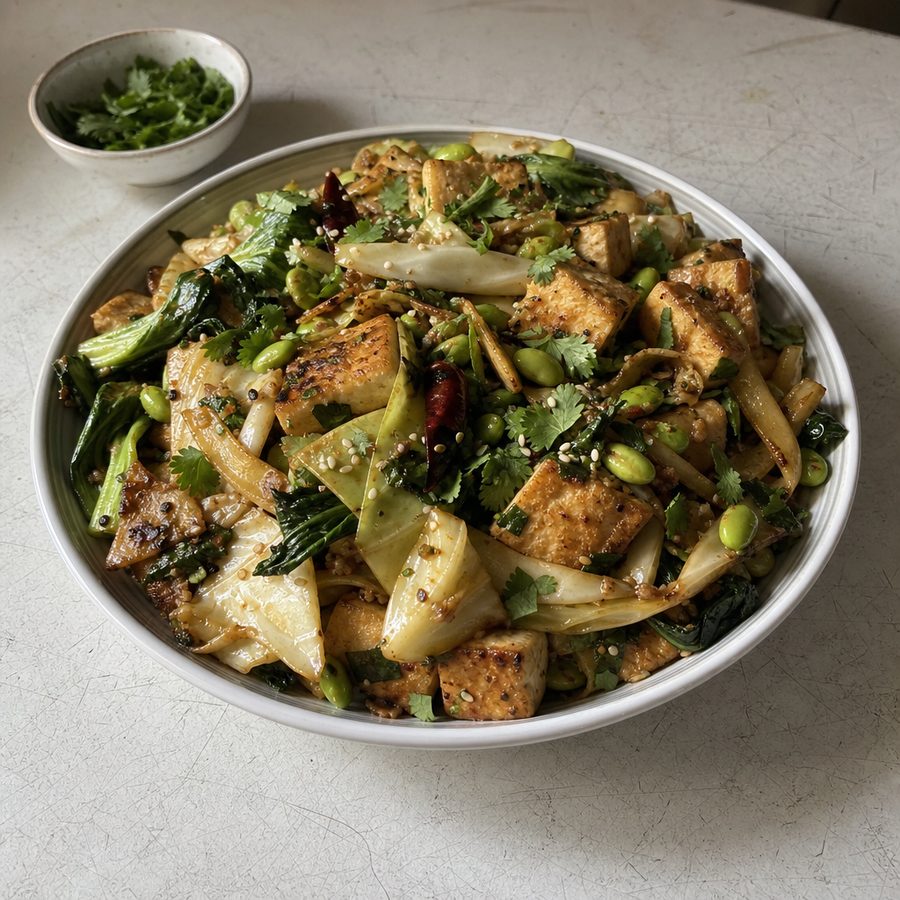
Cabbage and bok choy cut into long noodle-width ribbons and dry-fried hard with chile and Sichuan pepper, tossed with browned tofu, edamame, water chestnuts, and black vinegar.
Why You'll Love This Recipe
Sichuan cooks have a technique called dry-frying, where a vegetable is held against a hot pan with very little fat until its surface blisters and its water cooks off, which concentrates it and gives it a chewy, almost meaty texture. It is usually done to green beans. Cabbage takes to it just as well, and if you cut the head into long thin ribbons first, what comes out of the pan looks and eats remarkably like a plate of wide noodles. That is the whole idea here, and it makes a lunch out of a vegetable that usually costs about two dollars.
The seasoning is small in volume and large in effect. Whole dried chiles snipped open give a warmth that spreads slowly, and Sichuan peppercorns toasted and ground fresh give the buzzing, faintly citrus tingle that is the signature of this kitchen. Ginger cut into fine slivers rather than grated stays visible and gives you sharp bites of it. The black vinegar goes in last, off the heat, where it hisses and perfumes the whole pan, and that sour note is what keeps a plate of cooked cabbage from tasting heavy. Everything in that list is a teaspoon or less, which is worth noticing when you look at the ingredient list and wonder where the flavor is going to come from.
I make this on days when the refrigerator is nearly empty, because a cabbage keeps for weeks and everything else here is a pantry item or a freezer item. It comes together in under half an hour, it makes a genuinely large amount of food, and it is one of the few cooked vegetable dishes I actively look forward to eating cold the next day. Serve it as it is, or over rice if you want something heavier. The tofu and the edamame are what turn a pan of vegetables into an actual lunch, so I would not skip them, and both live permanently in my freezer for exactly this reason.
Ingredients
- 1 small head green cabbage (about 1 1/2 lb), quartered, cored, and cut into long ribbons the width of a noodle
- 3 heads baby bok choy, stems cut into long ribbons and leaves left in wide strips
- 7 oz firm tofu, pressed dry and cut into 1/2-inch cubes
- 1 cup shelled edamame, thawed if frozen
- 1 small can water chestnuts (about 4 oz drained), rinsed and sliced
- 4 scallions, cut into 2-inch lengths
- 1 packed cup cilantro leaves and tender stems
- 5 garlic cloves, thinly sliced
- 1 1/2 tbsp finely julienned fresh ginger
- 6 whole dried Sichuan chiles, snipped in half, or 1 1/2 tsp chile flakes
- 1 tsp Sichuan peppercorns, toasted and coarsely ground
- 4 tsp Chinkiang black vinegar, or cider vinegar
- 1 tbsp soy sauce
- 1 tsp maple syrup
- 5 tsp avocado oil
- 1 1/2 tsp toasted sesame oil
- 3 tbsp sesame seeds, toasted in a dry pan
Instructions
- Cut the cabbage into ribbons: Quarter the cabbage through the core, cut the core out of each quarter, and slice lengthwise down the leaves so you get long ribbons rather than short shreds, roughly the width of a fettuccine noodle. Pull them apart with your fingers. Cut the bok choy stems the same way and leave the leaves in wide strips.
- Brown the tofu: Set a 12-inch skillet or wok over medium-high, add two teaspoons of the avocado oil, and lay the tofu cubes in one layer. Leave them undisturbed for three minutes, until the undersides are deep gold and release cleanly, then turn and give them two minutes more. Move them to a plate.
- Dry-fry the cabbage: Turn the heat to high, add the rest of the avocado oil, and pile in the cabbage ribbons and bok choy stems. Press them flat against the pan with the back of a spatula and leave them for two minutes at a time, tossing between, for about six minutes total. They will squeak, then wilt, then start blistering brown in patches and smelling sweet rather than sulfurous.
- Add the aromatics: Push the cabbage to one side, add the dried chiles, ginger, garlic, and ground Sichuan peppercorns to the bare metal, and stir them for thirty seconds until they smell toasted and the garlic is pale gold. Fold them through the cabbage with the bok choy leaves, edamame, water chestnuts, scallions, and the browned tofu, and toss for a minute to heat through.
- Finish with vinegar off the heat: Take the pan off the burner and pour the black vinegar, soy sauce, and maple syrup around the edge, where it will hiss and steam. Toss hard for fifteen seconds so it coats everything, then stir in the sesame oil and scatter the cilantro and toasted sesame seeds over the top. Serve straight from the pan.
Variations
- Mushroom: Add eight ounces of torn shiitake caps with the cabbage, which dry-fry to a deep chewy brown alongside it.
- Napa and celery: Swap half the green cabbage for napa and add two sliced celery ribs for a juicier, milder pan.
- Tempeh: Use crumbled tempeh in place of the tofu, browned hard in the same first step for a firmer, nuttier bite.
- Extra sour: Double the black vinegar and add a second teaspoon at the table for a sharply hot and sour version.
- Over rice noodles: Toss the finished pan through a half pound of soaked rice noodles to stretch it into a larger dish.
Storage & Leftovers
This keeps four days sealed in the refrigerator and I would happily eat it cold on any of them. The cabbage stays chewy rather than collapsing, because the dry-frying drove the water out of it in the pan, and the vinegar and chile settle into everything overnight.
Reheat it in a hot dry skillet for two or three minutes, spread flat and left alone for the first minute so the edges catch again. Add a fresh splash of vinegar at the end. A microwave will warm it through but the cabbage goes limp and the tofu turns spongy.
It does not freeze. Cabbage releases a great deal of water when it thaws and the texture that this whole method exists to create is lost. If you want to prepare ahead, cut the cabbage ribbons and press the tofu the night before and keep them in separate containers.
Notes & Tips
- Cut with the leaf, not across it: Slicing lengthwise down the leaves gives you long ribbons that behave like noodles on the fork. Cutting across the head gives you short shreds and a slaw.
- Press the cabbage against the pan: Contact is what makes this method work. A spatula held down on the pile for a minute at a time is the difference between blistered brown ribbons and steamed cabbage.
- Grind the peppercorns fresh: Sichuan pepper loses its tingle within months of grinding. Thirty seconds in a dry pan and a quick turn in a mortar gives you a completely different spice.
- Sliver the ginger rather than grating it: Fine matchsticks stay intact through the heat and give you occasional sharp, bright bites. Grated ginger disappears into the background.
- Add the vinegar off the heat: Poured around the hot edge of the pan with the burner off, it steams up and coats everything. Cooked in over a flame, most of the aroma is gone before it reaches the plate.
- Use your widest pan: A pound and a half of cabbage needs room to sit against metal. Two batches in a small skillet beat one crowded batch, every time.
Nutrition & Mindful Eating
- Cabbage, bok choy, tofu, and edamame share the plate here rather than one of them running it. The two greens give the dish its bulk and its chew, and the tofu and edamame are where the protein and most of the calcium sit.
- Bok choy is one of the most calcium-rich vegetables in the produce aisle, and its stems stay juicy and crisp while the dark leaves wilt in seconds, so you get two textures from one head.
- Cabbage dry-fried this way loses its water and concentrates, which is why a plate of it eats so much more substantially than the same cabbage boiled, and it keeps its fiber and its vitamin C through a cook this quick.
- Edamame are soybeans picked young, sweet and firm, and a cup of them scattered through a pan of vegetables brings plant protein, folate, and a color that makes the whole dish look better.
- Toasted Sichuan peppercorn, split dried chile, and a late splash of black vinegar are what make this memorable, a slow warmth and a citrus tingle cut through by something sharp at the very end.
- As you eat, notice the tingle the peppercorns leave on your lips and how much chew the cabbage kept, and let a dish this loud on the palate hold your attention for the length of the meal.
Frequently Asked Questions
What if I cannot find Sichuan peppercorns or black vinegar?
Use coarsely cracked black pepper and cider vinegar and the dish still works, though it becomes a plainer one. Both ingredients keep for a year and are stocked by most Asian grocers and by a growing number of supermarkets, so they are worth picking up if you make this more than once.
My cabbage went watery rather than browning. Why?
The pan was crowded or not hot enough. Cabbage releases a lot of liquid, and a pan that cannot boil it off fast enough ends up simmering the vegetable. Use your widest skillet on high heat, and if your burner is weak, dry-fry in two batches and combine them at the end.
Can I make it less spicy?
Leave the dried chiles whole rather than snipping them open, since most of the heat is in the seeds and the cut edges. You still get the fragrance without much burn, and the Sichuan peppercorns provide the tingle independently of the chile heat.
What should I serve with it?
It is a full plate on its own, with the tofu and edamame carrying the substance. If you want it heavier, a scoop of brown rice underneath soaks up the vinegar and turns it into a bigger meal.