
Duck Breast with Blackberries and Watercress
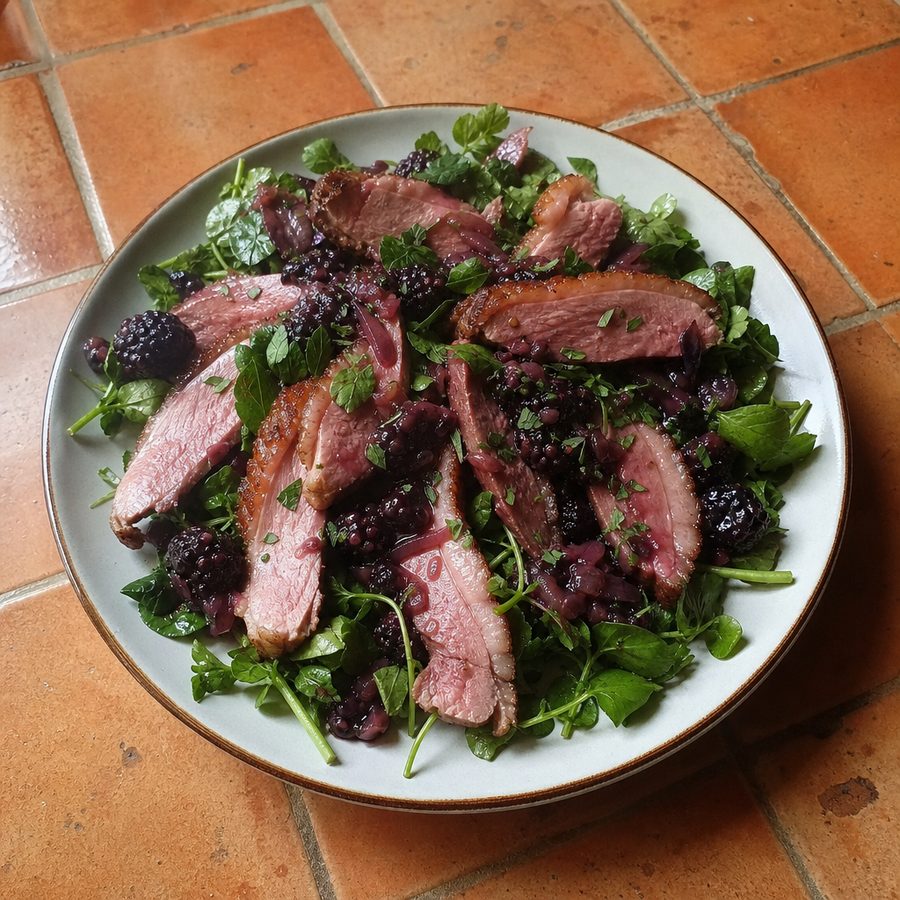
Crisp-skinned duck breast sliced over peppery watercress with a quick blackberry and shallot pan sauce, a savory breakfast worth getting up for.
Why You'll Love This Recipe
Duck at breakfast sounds like a special occasion and it should, but the cooking is far less demanding than the price tag suggests. Two breasts feed four people, the pan sauce is made from the fat they render, and the whole thing takes 25 minutes with 10 of them spent doing nothing while the skin crisps. I make this on a birthday morning, or on the first cold Saturday of the fall when blackberries are still around. On an elimination phase it is the plate that proves the food can be genuinely good rather than something you tolerate for a few more weeks.
The technique is the interesting part. Duck breast goes into a cold, dry pan, skin side down, over medium-low heat, which sounds wrong and is the entire secret. Starting cold gives the thick fat layer time to melt out slowly and leaves the skin thin, brown, and crisp rather than flabby with a burnt crust. That takes about 10 minutes and you pour off the fat as it collects. Then a couple of minutes on the meat side, a rest, and the shallots and blackberries go into the same pan with the balsamic, where the berries collapse into a glossy sauce in about 4 minutes.
Blackberries and duck belong together because the berries are tart and slightly bitter, which is exactly what a rich dark meat wants beside it. Half of them break down into sauce and half stay whole, so you get both the coating and the pop. The watercress is not a garnish either. Its pepperiness cuts the fat and keeps the plate from feeling like dinner at seven in the morning. Duck is dense in protein and slower to leave you than most breakfasts, so a plate this size carries you comfortably to lunch without sitting heavy.
Ingredients
- 2 large boneless duck breasts (about 1 1/2 lb total), skin scored
- 2 cups fresh blackberries
- 5 packed cups watercress, thick stems trimmed
- 2 shallots, finely sliced
- 2 tbsp balsamic vinegar
- 1 tbsp extra virgin olive oil
- 2 tsp fresh thyme leaves
- 3/4 tsp fine sea salt, divided
Instructions
- Score and season the duck: Pat the breasts dry, since any water on the skin has to boil off before the fat can start rendering, and score the skin in a crosshatch about a quarter inch apart, cutting through the fat but not into the meat. Season both sides with half a teaspoon of the salt and let the breasts sit at room temperature for 10 minutes.
- Render the skin: Lay the breasts skin side down in a cold dry skillet and set it over medium-low heat. Cook for 10 to 12 minutes without moving them, pouring off the fat into a heatproof jar two or three times as it collects, until the skin is thin, deep brown, and crisp.
- Finish the duck and rest it: Turn the breasts and cook for 3 to 4 minutes on the meat side, until the thickest part reads 130°F (54°C) for medium rare or 140°F (60°C) if you prefer it cooked through. Move them to a board, skin side up so the crust does not sit in its own steam, and let them rest for 8 minutes while you make the sauce.
- Make the blackberry sauce: Pour off all but a tablespoon of the fat. Add the shallots and cook over medium for 2 minutes until soft, then add the balsamic and scrape the pan. Add the blackberries, the thyme, and the remaining salt, and cook for 3 to 4 minutes, crushing about half the berries with the back of a spoon, until the sauce is glossy and lightly thickened.
- Dress the greens and serve: Toss the watercress with the olive oil. Slice the duck across the grain about a quarter inch thick, catching any juices and adding them to the sauce. Lay the greens on four plates, fan the duck over them, and spoon the warm blackberry sauce across the top.
Variations
- Cherry and thyme: Swap the blackberries for pitted cherries, which are sweeter and make a darker, more syrupy sauce.
- Orange and ginger: Add the zest of an orange and a teaspoon of grated ginger to the sauce for a brighter, sharper plate.
- Arugula instead: Use arugula or young dandelion greens in place of watercress when you want more bitterness under the duck.
- Roasted roots alongside: Crisp cubed parsnip or celeriac in the poured-off duck fat and serve them beside the greens for a bigger plate.
- Chicken thigh version: Use bone-in chicken thighs, skin side down in the same slow render, for a weekday plate at a fraction of the cost.
Storage & Leftovers
Sliced duck keeps in a sealed container in the refrigerator for up to 3 days, with the sauce stored separately so the skin does not go soft in it. The meat is very good cold, sliced thin over greens, which is the way I use most leftovers.
Reheat the slices in a dry skillet over medium heat for about 60 seconds a side, just to take the chill off. Any longer and duck goes from rosy to gray and firm. Warm the sauce separately in a small pan with a spoonful of water to loosen it.
The blackberry sauce freezes well on its own for up to 3 months and is worth making a double batch of. Cooked duck freezes acceptably for a month, though the skin never crisps again, so plan on using thawed slices cold in a salad rather than trying to revive them.
Notes & Tips
- Score the fat, not the meat: The cuts let the fat escape as it melts. If your knife reaches the meat, the juices run out into the pan and the breast dries as it cooks.
- Pour the fat off as you go: A breast sitting in half an inch of its own fat is frying, not rendering, and the skin browns before it thins. Pour it off two or three times.
- Use a thermometer: Duck is a dark meat and is meant to be served pink. At 130°F (54°C) it is tender and rosy, and by 155°F (68°C) it is firm and gray, which is a big difference on the plate.
- Rest it properly: Eight minutes lets the juices settle back through the meat. Cutting straight away loses them to the board and takes the sauce with them.
- Crush only half the berries: The crushed ones make the sauce and the whole ones give you the bursts of tartness. Mashing all of them turns it into jam.
- Dress the watercress last: Oil on the leaves more than a couple of minutes before serving and they wilt under the warm duck instead of standing up to it.
Nutrition & Mindful Eating
- Duck, blackberries, and watercress work as three sharp contrasts. The meat is rich and dark, the berries are tart enough to cut it, and the raw peppery greens underneath keep the whole plate feeling fresh rather than heavy.
- Duck breast is close-grained and dark, closer to a steak than to chicken, and it carries iron in the form your body absorbs most readily along with B12 and zinc. That is a lot of substance in a few thin slices.
- Blackberries carry real fiber in their seeds and skins, along with the deep purple anthocyanins that give them their color. Cooked briefly with shallot they turn tart and glossy rather than sweet, closer to a sauce than to a jam.
- Watercress tastes of black pepper and mustard when it is raw, which is exactly the note a rich meat wants beside it, and it brings vitamin K and calcium in a leaf with real flavor of its own.
- The skin is where the technique pays off. Rendered slowly it goes thin and crisp and most of the fat ends up in the jar rather than on the plate, so what is left tastes of duck rather than of grease.
- As you eat, notice how the tartness of the berries resets your mouth after each slice of duck, and let a plate that took some care be eaten slowly enough to notice it.
Frequently Asked Questions
Why start the duck in a cold pan?
The fat under duck skin is thick and needs time to melt out. A cold pan and gentle heat let it render slowly, so the skin thins and crisps. A hot pan seizes the skin immediately, and you end up with a dark crust over a soft layer of unrendered fat.
What should I do with the poured-off fat?
Keep it. Strained into a jar it lasts for months in the refrigerator and is excellent for roasting root vegetables, which is roughly the best use of any cooking fat. It is also what I use to crisp the leftovers.
Can I use frozen blackberries?
Yes, and they make a slightly looser sauce because they release more water. Use the same weight, add them straight from frozen, and give the pan an extra 2 minutes so the liquid cooks down and the sauce turns glossy again.
Does this work for an AIP elimination phase?
It does. There are no grains, legumes, dairy, eggs, nuts, seeds, or nightshades in it. Check the balsamic label and pick one that is grape must and vinegar with nothing added, or use apple cider vinegar with a teaspoon of honey, which behaves the same way in the pan.