
Elk Stew with Pears and Turnips
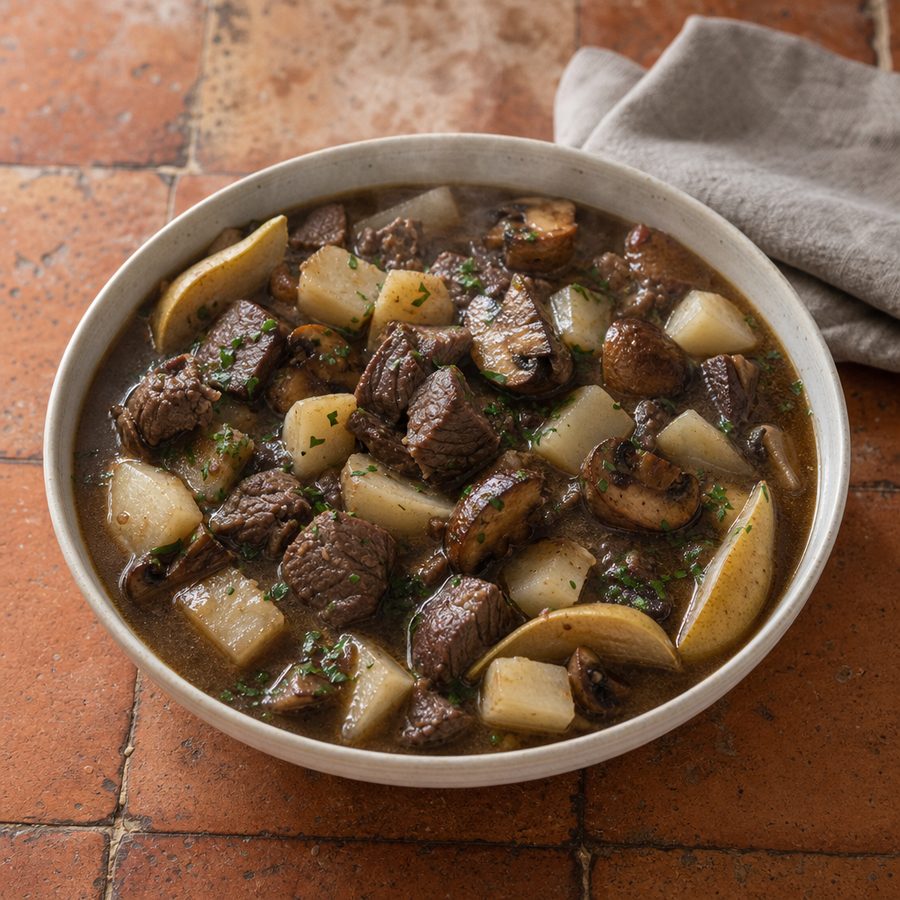
Cubes of elk browned and simmered with mushrooms, turnips, and a little cinnamon until tender, with firm pears added late so they hold their shape in the pot.
Why You'll Love This Recipe
I make this in November, when the pears at the market are still firm enough to stand up to a pot and someone in the family has come back with elk. It is the kind of dinner that asks for one busy half hour at the start and then leaves you alone for two hours while the house fills up with the smell of rosemary and browned meat. If you do not have elk, venison or beef chuck goes in the pot exactly the same way. What makes it worth the afternoon is that it is a game stew with fruit in it, which sounds fussy and turns out to be the most straightforward thing on the table.
The fruit is the part people get wrong, so here is the rule: pears go in for the last thirty minutes and not a minute sooner. Any earlier and they collapse into the broth and sweeten the whole pot, which is a different and much duller dish. Added late, they stay in wedges, soften just enough to give under a spoon, and read as a sweet note beside the meat rather than through it. The quarter teaspoon of cinnamon and the pinch of cloves do the same job from underneath, and the cider vinegar goes in at the start so it has hours to work into the elk.
Elk is dense and full-flavored, so a stew like this holds you the way very few vegetable-heavy dinners do. The turnips are what give it body: mash three or four pieces against the side of the pot at the end and the broth thickens on its own, without any flour or starch stirred into it. It is better on the second day than on the first, which makes it a good thing to cook on a Sunday. Ladle it into wide bowls, put the parsley on at the table rather than in the pot, and keep the last of the broth for bread or for drinking.
Ingredients
- 2 lb elk shoulder, cut into 1 1/2-inch cubes
- 1 lb turnips (about 3 medium), peeled and cut into 1-inch chunks
- 2 firm Bosc pears, peeled, cored, and cut into thick wedges
- 8 oz cremini mushrooms, halved
- 1 large onion, chopped (about 1 1/4 cups)
- 5 cloves garlic, sliced
- 3 cups beef bone broth
- 2 tbsp apple cider vinegar
- 2 tbsp olive oil, divided
- 2 sprigs fresh rosemary
- 2 bay leaves
- 1/4 tsp ground cinnamon
- 1/8 tsp ground cloves
- 1/4 cup chopped fresh parsley
- 1 1/4 tsp fine sea salt, divided
Instructions
- Dry and season the elk: Pat the elk cubes very dry with paper towels and toss them with 3/4 teaspoon of the salt. Let them sit while you chop the onion and garlic. Dry meat is the whole difference between a browned cube and a gray steamed one, and with a cut this fine-grained the crust is where much of the flavor comes from.
- Brown the meat in batches: Heat 1 tablespoon of the olive oil in a Dutch oven over medium-high. Brown the elk in two batches, about 5 minutes each, turning the cubes so at least two faces go deep brown. Crowding the pan will steam the meat, so give it room. Move the browned cubes to a bowl as they are done.
- Build the base: Add the remaining oil, the onion, and the mushrooms to the pot and cook over medium heat for 7 to 8 minutes, until the mushrooms have given up their water and started to brown. Add the garlic, cinnamon, and cloves and stir for 1 minute, then pour in the cider vinegar and scrape the bottom of the pot clean.
- Simmer low and long: Return the elk and any juices, pour in the bone broth, and add the rosemary sprigs and bay leaves. Bring it to a bare simmer, cover, and cook over low heat or in a 300°F (150°C) oven for 1 hour and 45 minutes, until the meat is close to tender but not falling apart.
- Add the turnips, then the pears: Stir in the turnips and the remaining salt and simmer, covered, for 20 minutes. Add the pear wedges, set the lid back on, and cook 25 to 30 minutes more, until the turnips are soft, the pears hold their shape, and the elk gives way under a spoon.
- Thicken and finish: Fish out the rosemary stems and bay leaves. Press three or four turnip pieces against the side of the pot and stir so they thicken the broth. Taste for salt, let the pot sit off the heat for 10 minutes, and scatter the parsley over the bowls as you serve.
Variations
- Dried fruit: Swap the fresh pears for a handful of dried figs, added an hour in so they plump in the broth.
- Root mix: Use half turnip and half parsnip for a sweeter pot, or half celeriac when you want it more savory.
- Orange and bay: Add a wide strip of orange zest with the broth and pull it out at the end for a brighter, rounder stew.
- Greens at the end: Stir two big handfuls of kale or chard into the pot in the last 5 minutes so they wilt in the broth.
- Slow cooker: Brown everything in a skillet, then cook on low for 7 hours, adding turnips at hour 5 and pears at hour 6.
Storage & Leftovers
This keeps in the refrigerator for up to 4 days and improves overnight, once the cinnamon and the pears have worked their way through the broth. Store it in one container rather than portioned out, since the meat stays juicier sitting under liquid than it does in a shallow dish.
Reheat it gently on the stovetop over low heat with a splash of broth, stirring now and then for about 10 minutes. A hard boil will shred the pear wedges and tighten the elk, so keep it just below a simmer and let it come up slowly while you set the table.
It freezes well for up to 3 months, with one caution: pears go soft and slightly grainy after freezing. If you know a batch is heading for the freezer, leave them out, freeze the stew without them, and add fresh pear wedges to the pot during the last half hour of reheating.
Notes & Tips
- Cut the meat big: Inch-and-a-half cubes shrink to a good size over two hours. Small pieces dry out and disappear into the broth.
- Brown in two batches: A crowded pot steams. The extra 5 minutes of browning is the single biggest thing you can do for the flavor here.
- Go easy on the cloves: An eighth of a teaspoon is right. Cloves take over a pot quickly, and once they have, there is no walking it back.
- Keep it barely simmering: A rolling boil tightens game meat and keeps it tough. You want the occasional lazy bubble and nothing more.
- Choose firm pears: Bosc holds its shape where a soft Bartlett dissolves. Press near the stem, and if it gives easily, save it for eating.
- Parsley at the table: Stirring it into the hot pot turns it dull green in a minute. Over the bowls, it stays sharp and fresh.
Nutrition & Mindful Eating
- The elk, the turnips, and the pears each pull in a different direction, which is why this works. The meat gives the pot its depth and most of its protein, the turnips carry the broth and thicken it, and the pears bring a soft sweetness that keeps a long-cooked stew from tasting flat.
- Elk is dark and fine-grained with a clean, faintly sweet flavor that stands up to hours in a pot, and it is among the better sources of heme iron and B12, the pair red meat is really known for, both riding along with a serious amount of protein.
- Turnips soften into the broth and turn mild and faintly peppery as they cook, and they bring fiber and vitamin C to a pot that is otherwise mostly meat. Mashing a few pieces to thicken the stew spreads that through every spoonful.
- Pears added in the last half hour hold their wedges and stay juicy, and the fiber in them is largely in the flesh rather than the skin, so peeling them costs you very little. Their sweetness is what makes the cinnamon and cloves make sense.
- Mushrooms browned at the start are doing quiet work. They give the broth its savory backbone, and mushrooms are one of the few foods that carry any vitamin D at all, more so if they were grown under light.
- As you eat, notice the sweetness of the pear arriving after the meat rather than with it, and let the warmth of the bowl in your hands slow the pace of the meal down to something closer to the pot's.
Frequently Asked Questions
What can I use in place of elk?
Venison shoulder, beef chuck, bison, and goat all work at the same weight and roughly the same timing. Beef chuck has more fat running through it and will be ready 15 to 20 minutes sooner, so start checking it early rather than going by the clock alone.
Can I use apples rather than pears?
Yes, though pick a firm variety like Honeycrisp or Granny Smith and add it in the last 20 minutes, since apple softens faster than a Bosc pear. Quince is even better if you can find it, but it needs a full hour in the pot to become tender.
My stew is thin. How do I thicken it without flour?
Mash more of the turnip against the side of the pot, which is the method built into the recipe, or lift the lid for the last 15 minutes and let the broth reduce. Pureeing a ladleful of the vegetables and stirring it back in also works and does not dull the flavor.
Is this suitable during an AIP elimination phase?
It is. Nothing here is a grain, a legume, a nightshade, a nut, or a seed, and the warm flavor comes from cinnamon and cloves, both of which are allowed. Use a bone broth with no added spice blends, since some cartons include pepper or paprika.