
Endive Boats with Walnut Tapenade
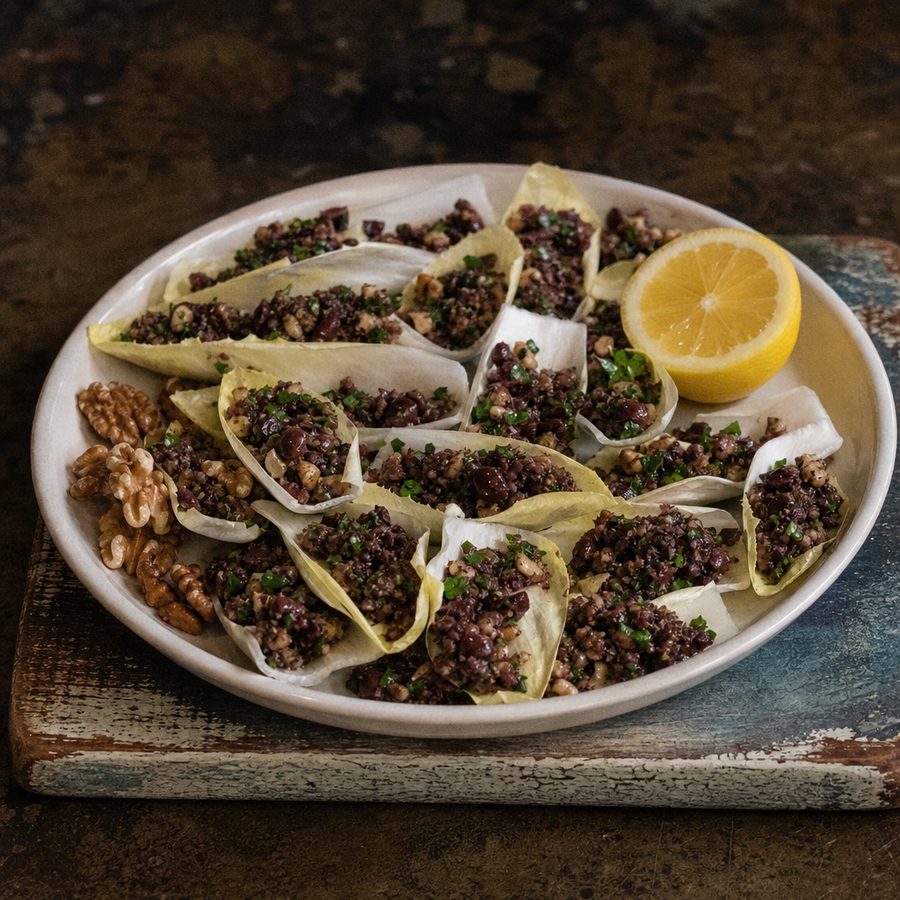
Crisp endive leaves filled with a coarse tapenade of toasted walnuts, kalamata olives, parsley, garlic, and lemon, chopped entirely by hand so it stays rough.
Why You'll Love This Recipe
This is what I make when people are arriving in twenty minutes and I want something that looks like effort. Endive leaves come off the head already shaped like little spoons, so there is no cutting and no assembly beyond a teaspoon of filling in each one. They sit on a platter looking sculptural and hold their shape for an hour without going soft, which is more than a cracker or a slice of bread manages under anything wet.
Toasting the walnuts is what separates this from an ordinary olive paste. Eight minutes in the oven drives off the raw tannin that makes walnuts taste bitter and brings out something warm and buttery underneath, which is exactly what stands up to the salt of the kalamatas. Chopping by hand rather than blending keeps the pieces distinct, so you taste nut, then olive, then parsley.
Endive itself is the reason this works at all. The leaves are firm, faintly bitter, and cool, and that bitterness meets the richness of the walnuts head on so neither one wins. They are also strong enough to be picked up and eaten in two bites without folding, which is more than a cracker manages under a wet filling. A squeeze of lemon over the filled boats right before they go out wakes the platter up and keeps the cut edges of the leaves pale.
Ingredients
- 4 heads endive, leaves separated
- 1 cup walnut halves
- 1/3 cup pitted kalamata olives
- 1 1/2 tbsp olive oil
- 1/4 cup chopped parsley
- 1 1/2 tbsp lemon juice
- 2 cloves garlic, minced
- 1/2 tsp black pepper
Instructions
- Toast the walnuts 8 to 10 minutes: Heat the oven to 350°F (175°C) and spread the walnut halves on a small sheet pan. Toast for 8 to 10 minutes, until they smell warm and nutty and the skins have darkened a shade. Stand near the oven from minute seven, since walnuts go from toasted to burnt faster than any other nut.
- Cool them for 10 minutes before chopping: Tip the walnuts onto a cool board and give them about 10 minutes to come down to room temperature before the knife touches them, because warm nuts release their oil under a blade and turn pasty. Chop fairly fine but leave some pieces the size of a lentil for texture.
- Chop the olives and aromatics by hand: Chop the pitted kalamata olives by hand into rough pieces, about 2 minutes of work, then mince the garlic and chop the parsley. A food processor would turn all of this into a gray paste in about four seconds, and the entire character of this filling is that you can see what is in it.
- Build the tapenade and taste before salting: Combine the walnuts, olives, garlic, and parsley in a bowl, add the olive oil, lemon juice, and black pepper, and stir until everything is coated. Taste it before you reach for any salt at all, since the olives carry plenty on their own and the filling should read bright rather than briny.
- Separate the leaves from the base: Trim a thin slice off the base of each endive head and the outer leaves fall away whole, then keep trimming and peeling as you work inward. Use the large and medium leaves for filling and save the tiny pale hearts for a salad, since anything smaller than a spoon holds no filling and breaks when it is picked up.
- Fill them within half an hour of serving: Spoon a rounded teaspoon of tapenade into the wide end of each leaf, arrange them on a platter in a spiral, and finish with a little more parsley and a squeeze of lemon. Fill them no more than 30 minutes before they go out, because the salt and oil in the filling start softening the leaf where they touch it and the snap is the point.
Variations
- Sun dried tomato: Chop a few sun dried tomatoes into the filling for a sweeter, deeper red version.
- Radicchio cups: Small radicchio leaves where the endive goes give a more bitter, purple platter.
- Woodsy herbs: Fresh thyme leaves and a little chopped rosemary make the tapenade more southern French.
- Add heat: A pinch of cayenne or a spoonful of minced jalapeno gives the filling a slow warmth behind the olives.
- Serve it warm: Spread the tapenade over halved endive heads and roast them cut side up for ten minutes until the edges char.
Storage & Leftovers
The tapenade is the part that keeps, and it improves as it sits. Five days in the refrigerator in a sealed jar with a film of olive oil on top, and by the second day the garlic has softened and the walnuts have taken on the olive flavor. Bring it back to room temperature before filling.
Endive heads keep about a week wrapped in a damp towel inside a bag in the refrigerator. Store them in the dark, since light turns the pale tips green and bitter. Separate the leaves only when you are ready to fill them, because cut edges brown quickly.
Filled boats do not keep at all. Within a couple of hours the salt from the olives draws water out of the leaves and the bases go limp and weep onto the platter. Fill what is going to be eaten and keep the jar and the endive apart for the next round.
Notes & Tips
- Watch the walnuts: They burn in the time it takes to answer a text, so stay by the oven from minute seven.
- Cool before chopping: Warm walnuts smear under the knife; cool ones cut into clean pieces.
- Knife, not machine: Hand chopping is the entire texture of this filling and there is no shortcut for it.
- Taste before salting: Kalamatas carry their own salt and this filling almost never wants more.
- Trim the base to free the leaves: Shaving a sliver off the root end lets the outer leaves fall away whole and unbroken.
- Fill late: Half an hour is the window. Past that the leaves begin to weep.
Nutrition & Mindful Eating
- The walnuts, the olives and the endive are working against each other in exactly the right way. Toasted nuts bring warmth and fat, the olives bring depth and a briny edge, and the cool bitter leaf underneath keeps a rich filling from ever feeling like too much.
- Walnuts are the one nut carrying a meaningful amount of the plant form of omega-3 fat, and a short spell in the oven turns their raw tannic edge into something warm and buttery. Chopped rather than ground, they stay in pieces you can feel.
- Endive leaves are firm, pale and faintly bitter, and that bitterness is the whole reason they work here. They come off the head already curved like a spoon, sturdy enough to carry a heavy filling, with fiber and folate riding along inside something that snaps when you bite it.
- Kalamata olives chopped rough give the filling its color and its savory backbone, and the oil they carry is the same monounsaturated fat that comes off the tree. Their salt is what draws the flavor out of the walnuts sitting beside them.
- Parsley, garlic and lemon are what keep this bright. The parsley is grassy and clean, the garlic stays raw and sharp because nothing here meets a pan, and the lemon squeezed over the filled leaves is the last thing on and the first thing you taste.
- As you eat, take one leaf at a time and feel the endive snap before you reach the soft toasted walnut behind it, and let the platter be part of the conversation rather than something you clear in a handful.
Frequently Asked Questions
Can I use a different nut?
Pecans and almonds both toast well and work here, though each changes the direction. Pecans are sweeter and softer and send the filling somewhere milder; almonds stay firm and give more crunch. Walnuts carry a slight bitterness that matches the endive best.
The filling tastes too salty.
That is the olives, and there are two fixes. Rinse the chopped olives under cold water and pat them dry before they go into the bowl, then add more lemon juice and parsley to push back against it. Never salt this filling before tasting it.
How far ahead can I do this for a party?
Make the tapenade up to five days ahead and keep it cold. Wash and dry the endive the morning of and keep the heads whole. Separate and fill within half an hour of guests arriving, which is about as long as a filled leaf stays crisp.
Is there anything from an animal here?
No. It is endive, walnuts, olives, olive oil, parsley, garlic, lemon, and pepper. It is a useful platter for a mixed table, though it does contain tree nuts, so mention that if you are bringing it somewhere.