
Greek Cabbage and Rice with Dill and Lemon
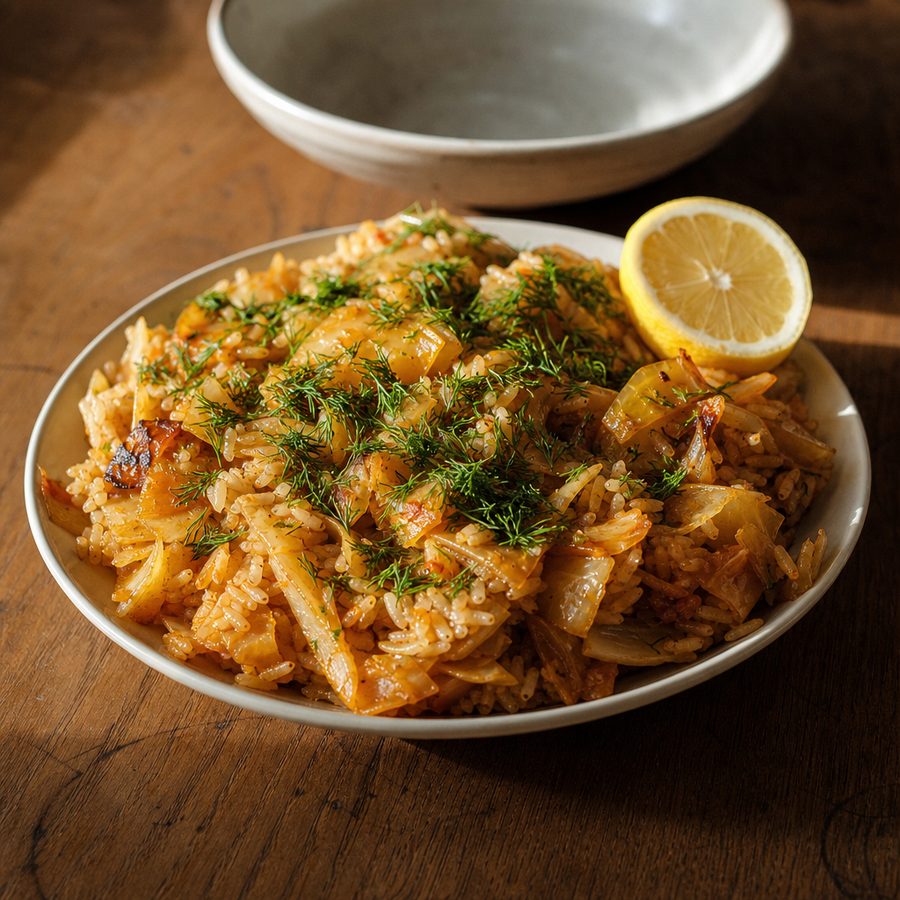
A whole head of cabbage cooked down in olive oil with onion, scallion, and a little tomato, then folded through rice so the grains take up the sweet cabbage juices, with dill and lemon stirred in at the end.
Why You'll Love This Recipe
Lahanorizo is the dish that taught me cabbage is a sweet vegetable, which is not obvious if your experience of it is a bowl of shredded slaw. Cooked long and slow in a lot of olive oil it changes completely. The sulfur smell of the first ten minutes goes away, the volume drops by two thirds, and what is left tastes closer to sweet onion than to anything from the brassica family. Greek cooks make this in winter for almost nothing, and I make it because it is one of the few dinners that feels substantial without a single thing on the plate that came from an animal.
The rice is not the point of the dish, which is a distinction worth making. It is there to soak up the liquid the cabbage releases, so what you want is enough of it to catch the juices and no more. Too much and you have a rice pilaf with cabbage in it, which is a duller thing to eat. Folded in near the end and left to sit covered for a few minutes, the grains take on the tomato, the olive oil, and the sweetness of the cabbage, and each one ends up tasting like the pan rather than like plain rice.
A Tuesday dinner and a Sunday leftover come out of the same pot. It is fully cooked, it holds for days, and it improves in the refrigerator in a way that very few vegetable dishes do. I usually make it in a wide Dutch oven, eat it warm the first night with lemon wedges and a lot of black pepper, and then eat it cold from the container the next day, at which point the dill has gone all the way through and it barely needs the lemon at all.
Ingredients
- 4 tbsp extra virgin olive oil
- 2 medium yellow onions, halved and sliced thin
- 5 scallions, white and green parts, thinly sliced
- 4 garlic cloves, thinly sliced
- 1 small head green cabbage (about 2 lb), quartered, cored, and shredded 1/4 inch thick
- 2 medium carrots, coarsely grated
- 3/4 cup canned crushed tomatoes, no salt added
- 2 cups cooked medium-grain white rice (from about 2/3 cup dry, simmered in unsalted water)
- 1 packed cup chopped fresh dill, tender stems included
- 1/4 cup chopped flat-leaf parsley
- 2 1/2 tbsp lemon juice, plus wedges for the table
- 3/4 tsp coarsely ground black pepper
- 1/4 tsp fine sea salt
Instructions
- Shred the cabbage: Quarter the cabbage through the core, cut the core out of each quarter, and slice the leaves crosswise about a quarter inch thick. Pull the shreds apart with your fingers so they are not clumped, and do not worry about being tidy. Two pounds looks like an absurd amount and it will reduce to about a third of that.
- Soften the alliums: Warm the olive oil in a wide Dutch oven or deep skillet over medium heat. Add the onions, scallions, and half the salt and cook for eight minutes, stirring occasionally, until they are limp and translucent. Add the sliced garlic and cook one minute more, until it smells sweet rather than sharp.
- Cook the cabbage down: Add the cabbage in three or four additions, turning each batch through the oil until it wilts enough to make room for the next. Once it is all in, add the grated carrot and the rest of the salt, cover, and cook for ten minutes. Then uncover and keep cooking over medium-low for fifteen to eighteen minutes, stirring every few minutes. The cabbage should go from white to pale gold and taste distinctly sweet when you try a strand.
- Add the tomato and simmer: Stir in the crushed tomatoes, the black pepper, and 1/2 cup of water. Simmer uncovered for eight minutes, until the tomato has lost its sharp tinned edge and the liquid in the bottom of the pan has reduced to a shallow, glossy pool rather than a broth.
- Fold in the rice and finish: Stir the cooked rice through the cabbage, cover, and leave it over the lowest heat for five minutes so the grains absorb the pan juices and heat all the way through. Take it off the burner, wait two minutes, then stir in the dill, the parsley, and the lemon juice. Taste and add more lemon. Serve warm with wedges on the side.
Variations
- With white beans: Stir a drained, rinsed can of cannellini beans in with the rice for a fuller, more filling pot.
- Leeks in place of onion: Two sliced leeks in place of the onions turns this toward prasorizo, the leek version, which is sweeter and more delicate.
- Smoky paprika: A teaspoon of smoked paprika added with the tomato gives the pan a low, warm smokiness that suits the sweet cabbage.
- Extra tomato: Double the crushed tomatoes and skip the added water for a redder, saucier version that eats more like a stew.
- Mint and lemon zest: Add chopped fresh mint with the dill and a wide strip of lemon zest with the tomato for a brighter, more summery pot.
Storage & Leftovers
This keeps five days sealed in the refrigerator and is better on day two than on day one, which is unusual for anything with rice in it. The dill works its way through the whole pot overnight and the cabbage keeps getting sweeter. Store it in a wide shallow container so it cools quickly rather than sitting warm in a deep tub.
Reheat it covered in a pan over low heat with two tablespoons of water, five or six minutes, stirring once. The water is what keeps the rice from tightening into hard grains. It also eats very well cold, straight from the container with a fresh squeeze of lemon, which is how at least half of any batch I make gets finished.
It freezes for up to two months in flat sealed portions. The cabbage survives freezing better than the rice, which comes back slightly softer, so this is a good candidate if you do not mind that. Thaw overnight in the refrigerator and reheat gently with a splash of water and a fresh handful of dill.
Notes & Tips
- Give the cabbage the full time: Twenty five minutes total is not a suggestion. Cabbage pulled early tastes sharp and grassy, and the entire pleasure of this dish is the sweetness that only arrives at the end.
- Use a wide pan: Two pounds of shredded cabbage needs surface area to wilt and then to lose its water. A tall narrow pot steams it and it never sweetens properly.
- Add the cabbage in batches: Piling it all in at once means the bottom layer scorches while the top is still crisp. Three additions, each turned through the oil, takes two extra minutes and cooks evenly.
- Hold the rice back: Rice added early swells, breaks, and turns the pot pasty. Folded in for the last five minutes it stays separate and takes on the flavor of the pan.
- Lemon goes in off the heat: Acid added to a simmering pan loses its edge within a minute. Off the burner, it stays sharp and keeps the sweetness in check.
- Do not skimp on the dill: A packed cup looks like too much and is exactly right. It is a component here, not a garnish, and half the amount makes a noticeably duller pot.
Nutrition & Mindful Eating
- Cabbage, rice, and olive oil are the whole dish, and the proportion is the point. The cabbage is the bulk and the flavor, the rice is there to catch the juices, and the olive oil is what turns two humble things into a pot worth sitting down to.
- Cabbage belongs to the same family as broccoli and brussels sprouts, and long slow cooking is what turns its sulfur compounds sweet. A head this size cooks down to almost nothing, which means every serving carries a lot of fiber and vitamin C in a small bowl.
- Dill is used by the cupful here rather than as a sprinkle, which is worth knowing, because leafy herbs in that quantity contribute real calcium along with the clean anise flavor that defines the dish.
- Scallions, onion, and sliced garlic build a sweet allium base that carries the whole pot. They soften into the cabbage until you cannot pick them out, and the fiber they bring is the kind that feeds the bacteria in your gut.
- Lemon juice stirred in with the heat off is what keeps this from tasting one-note. Cabbage cooked to sweetness needs an acid to push against, and adding it late means the sharpness survives to the table.
- As you eat, notice how far the cabbage has traveled from the crisp pale wedge it started as, and let the lemon and the dill be a reason to take smaller bites and finish more slowly.
Frequently Asked Questions
Can I cook the rice in the pan the traditional way?
Yes, and that is how it is usually made in Greece. Add 2/3 cup of dry medium-grain rice along with the tomatoes, pour in 1 1/2 cups of water rather than half a cup, cover, and simmer for eighteen to twenty minutes until the grains are tender. Using rice you already cooked simply gives you more control over how soft it ends up.
What kind of cabbage works best?
Plain green cabbage, the dense pale kind. Savoy works and cooks faster because its leaves are looser, so start checking at twelve minutes. Red cabbage will taste right but turns the whole pot a strange purple-gray once the lemon hits it, so I would keep that one for another dish.
It smells strongly of cabbage while it cooks. Is that normal?
Completely, and it passes. The sulfur compounds in brassicas are most noticeable in the first ten minutes and cook off as the cabbage sweetens. If it is still sharp at the end, the pan needed longer, so give it another five minutes uncovered and taste again.
Can I use brown rice?
You can. Brown rice keeps more chew and does not absorb the pan juices as readily, so the dish stays a little more separate and less unified. If you go that way, fold it in and give it eight minutes covered rather than five, and expect a nuttier, firmer result.