
Greek Chicken Fricassee with Greens, Dill, and Lemon over Barley
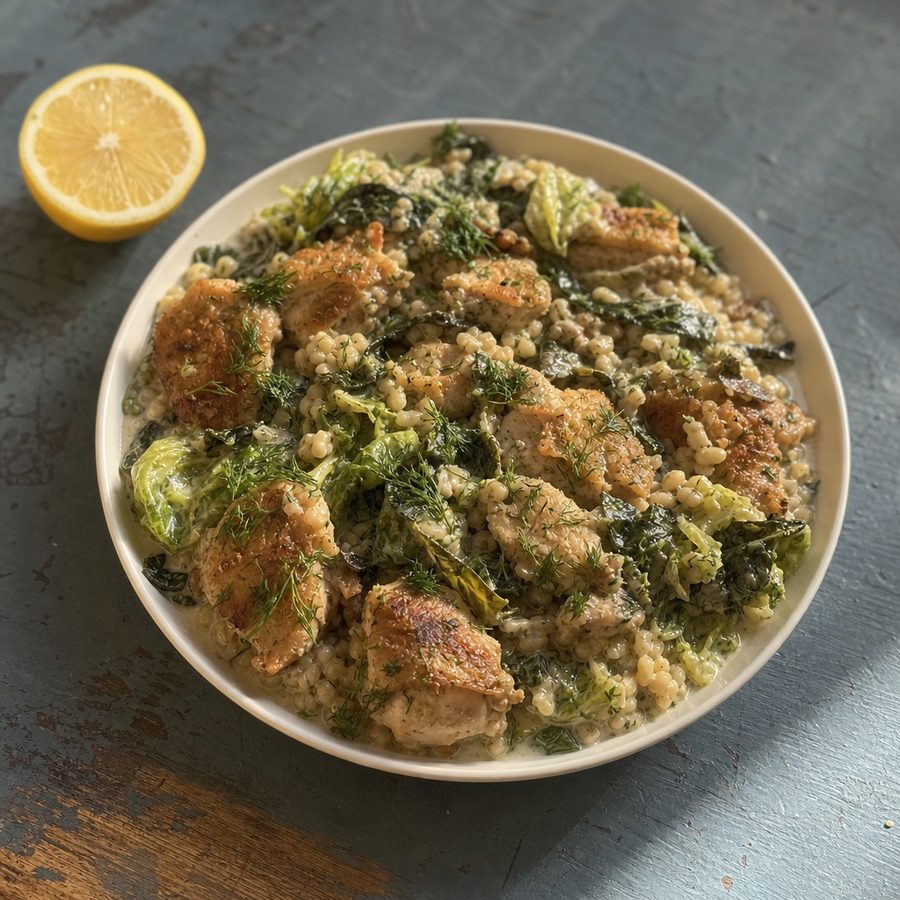
Chicken thighs braised slowly with leeks, scallions, collard greens, and romaine, then finished off the heat with an egg and lemon avgolemono and spooned over chewy barley.
Why You'll Love This Recipe
Fricassee in Greece has nothing to do with the French dish of the same name. It means meat braised with a great pile of greens and finished with avgolemono, the egg and lemon sauce that turns up in Greek kitchens the way a pan gravy does in American ones. The greens are the point. Whatever is growing goes in, which traditionally means lettuce, wild greens, and a bunch of scallions, and here means collards and romaine together because collards hold their texture through a braise while lettuce melts into the broth and thickens it.
Avgolemono looks intimidating and is not, as long as you respect one rule: the pan comes off the heat before the eggs go in, and it never goes back on. You beat the eggs with lemon juice, ladle hot broth into them slowly while whisking so they warm up gradually, then pour the whole thing back and swirl the pan. Thirty seconds later the broth has gone from thin and gray to pale ivory and thick enough to coat the chicken. Boil it and you get scrambled egg in soup, which is the only way this goes wrong.
I make this in the cold half of the year when a bunch of collards costs almost nothing and I want something bright rather than heavy. Barley underneath is a Cretan habit and it suits the sauce better than rice does, because the grains stay chewy and separate rather than soaking everything up. It takes a bit over an hour, most of it a quiet braise, and it is one of the few one-pot dinners that genuinely tastes of lemon at the end rather than at the beginning.
Ingredients
- 3 tbsp extra-virgin olive oil, divided
- 1 1/4 lb boneless, skinless chicken thighs, trimmed and cut into 2-inch pieces
- 2 leeks, white and pale green parts only, halved lengthwise and sliced thin
- 6 scallions, sliced, white and green kept together
- 4 garlic cloves, thinly sliced
- 1 2/3 cups chicken broth
- 1 bunch collard greens (about 7 oz of leaves once stemmed), rolled and cut into wide ribbons
- 1 small head romaine (about 5 oz), cut crosswise into 1-inch ribbons
- 1 cup chopped dill, thick stems removed, divided
- 1 tsp coarsely ground black pepper, divided
- 1/4 tsp fine sea salt
- 2 large eggs, at room temperature
- 3 tbsp lemon juice, from 2 lemons, plus wedges for the table
- 3 cups cooked pearl barley (from about 1 cup dry, simmered in unsalted water)
Instructions
- Brown the chicken: Pat the chicken pieces dry and season them with half the pepper. Warm 2 tbsp of the olive oil in a large heavy pot over medium-high heat and brown the chicken in a single layer, about three minutes a side, until golden in patches. It does not need to cook through. Lift it onto a plate and leave the fat behind.
- Sweat the alliums: Turn the heat to medium, add the last tablespoon of oil, and cook the leeks and scallions for six to eight minutes with a pinch of the salt, stirring often, until they are completely soft and have given up their water. Add the garlic and cook one minute more. Nothing here should brown, since the sauce at the end wants to stay pale.
- Braise: Return the chicken and any juices, pour in the broth, and bring it to a bare simmer. Cover and cook for twenty minutes over low heat, until the chicken gives easily when pressed with a spoon and the broth tastes of it.
- Wilt in the greens: Add the collard ribbons a handful at a time, letting each go limp before the next, then add the romaine, half the dill, the rest of the salt, and the rest of the pepper. Cover and cook eight to ten minutes more, until the collards are tender enough to cut with the side of a spoon and the lettuce has all but disappeared into the broth.
- Make the avgolemono: Take the pot off the heat and let it stop bubbling, about a minute. Whisk the eggs and lemon juice together in a bowl until frothy, then ladle in about a cup of the hot broth in a thin stream, whisking the whole time. Pour the warmed mixture back into the pot and swirl the pot rather than stirring it. The broth will turn ivory and thicken in under a minute.
- Serve over the barley: Spoon the barley into four wide shallow bowls and ladle the chicken, greens, and sauce over the top. Scatter the rest of the dill, add a lemon wedge to each bowl, and take it to the table straight away, since avgolemono is at its best in the first ten minutes.
Variations
- Lamb fricassee: Use cubed lamb shoulder and braise it for an hour and a half before the greens go in, which is the version served at Easter.
- Fennel and celery: Add a sliced fennel bulb and two stalks of celery with the leeks for a sweeter, more aromatic pot.
- Beans in place of barley: Stir a cup and a half of drained white beans into the braise with the greens and skip the grain entirely.
- Mint alongside dill: Half dill and half mint at the finish takes it toward the Peloponnese and away from the north.
- More lemon: Add the grated zest of one lemon to the egg mixture for a sharper, more perfumed sauce.
Storage & Leftovers
It keeps three days in a sealed container in the refrigerator, though the sauce loses its glossy texture overnight and settles into something looser. The flavor holds up completely, and the collards actually improve, so I make a point of not judging day two by how it looks.
Reheat it gently in a covered pan over low heat, stirring often, and stop as soon as it steams. This is the one dish in my kitchen where a boil is genuinely destructive, because the egg in the sauce will break and go grainy. The microwave is risky for the same reason, so use low power and short bursts if that is your only option.
The braise freezes for up to three months if you leave the avgolemono out, which is what I do when I am cooking for the freezer. Cook it through the greens stage, cool, and freeze. Thaw overnight, bring it back to a bare simmer, then take it off the heat and make the egg and lemon sauce fresh, which takes two minutes.
Notes & Tips
- Bring the eggs to room temperature: Cold eggs meeting hot broth is half of why avgolemono breaks. Set them on the counter when you start browning the chicken and they will be ready when you are.
- Temper slowly, whisk constantly: A thin stream of hot broth into the eggs while you whisk is the entire technique. Dumping a ladleful in at once cooks the eggs on contact.
- Swirl the pot, do not stir it: Stirring breaks the chicken and the greens apart. Holding the handles and swirling distributes the sauce and leaves the pieces whole.
- Wash the leeks properly: Grit sits between the layers and there is no getting it out of a finished sauce. Slice them first, then swish the slices in a bowl of cold water and lift them out.
- Add greens in stages: A pot crammed with collards all at once steams rather than braises. A handful at a time takes ninety seconds and keeps the temperature up.
- Cook the barley separately: Grain cooked in the braise soaks up the broth you need for the sauce. Boil it in its own pot and spoon the braise over it.
Nutrition & Mindful Eating
- The chicken, the pile of greens, and the barley underneath are each doing a distinct job. The thigh meat carries the protein and gives the broth its depth, the collards and lettuce supply the volume and the minerals, and the barley gives the bowl the chew and the substance that keeps it eating like a full dinner.
- Collard greens are the sturdiest of the cooking greens and hold their texture through a twenty-minute braise where softer leaves would vanish. They are also among the best plant sources of calcium there is, and the vitamin K that comes with it, which is a lot to get from a bunch that costs almost nothing.
- Chicken thigh stays tender through a long slow braise because of the connective tissue that a breast does not have, and that same slow cooking is what gives the broth its body. It brings dense protein along with the iron and zinc that darker poultry meat carries.
- Barley cooks into separate chewy grains and keeps that texture in the bowl even under a sauce. Its beta-glucan is a soluble fiber that gives the grain a faintly silky quality and is part of why a modest scoop makes the meal feel like a full plate.
- Dill, lemon, and scallion are the flavor signature here, and they go in at both ends of the cooking. Half the dill braises into the greens and turns soft and grassy, the rest goes over the top where it stays sharp, and the lemon in the sauce is what makes a pot of braised meat and greens taste bright.
- As you eat, notice how the lemon in the sauce keeps finding its way back through the richness of the braise, and take the first few spoonfuls slowly enough to taste the dill on its own.
Frequently Asked Questions
My sauce curdled. Can I save it?
Sometimes. Take it off the heat immediately and whisk hard, and if it is only slightly grainy it will smooth out. If it has fully scrambled, blend a cup of the broth with an immersion blender and stir it back in, which will not be perfect but is a great deal better than starting over. Next time, off the heat before the eggs go in and never back on.
What other greens work here?
Almost anything. Escarole, chard, mustard greens, dandelion greens, spinach, and the outer leaves of a head of lettuce all belong. Sturdy greens need the full ten minutes, tender ones need two or three, so add them in order of toughness rather than all at once.
Can I use chicken breast?
You can, with an adjustment. Cut it into large pieces, brown it, and add it back for only the last twelve minutes of the braise rather than the full twenty, since breast meat goes dry and stringy where thigh meat only gets softer.
Is there a way to make the sauce without eggs?
Not one that tastes like avgolemono, which is what this dish is. What you can do is skip the sauce entirely, finish with a great deal more lemon juice and olive oil, and serve it as a brothy braise. It is a good dinner and a different one.