
Greek Gemista: Peppers and Zucchini Stuffed with Rice and Herbs
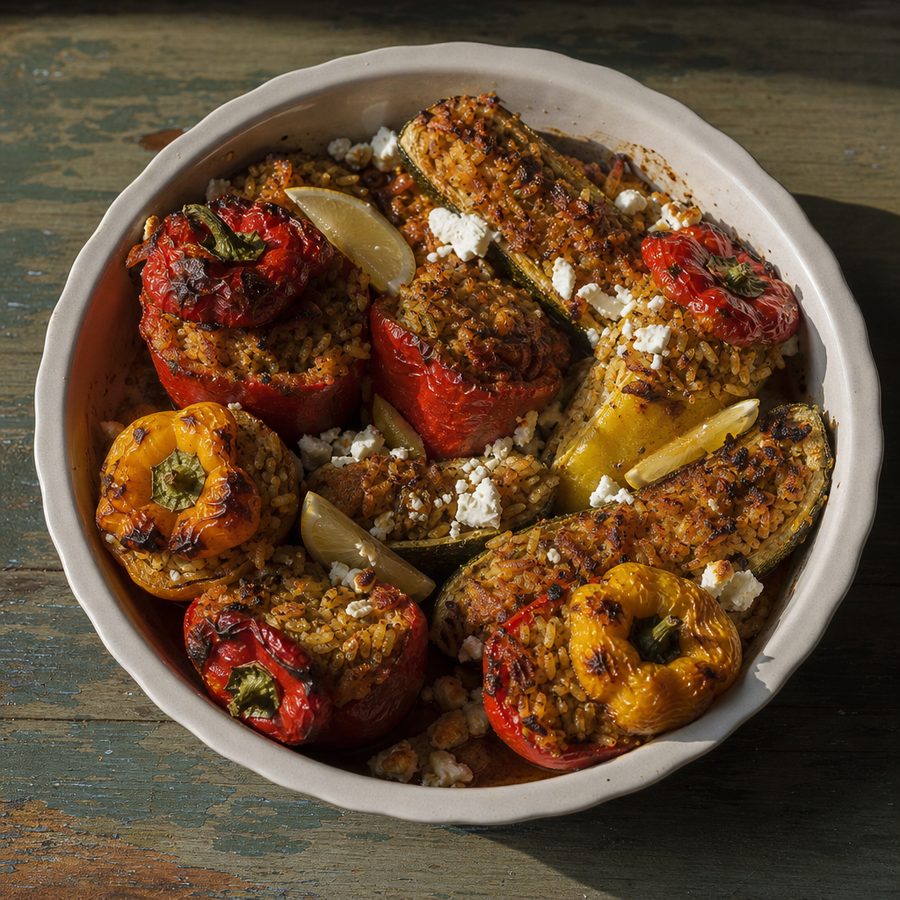
Bell peppers and hollowed zucchini filled with rice cooked into sweet onion, tomato, mint, dill, and parsley, baked in olive oil until the skins blister and the filling sets, finished with lemon and feta.
Why You'll Love This Recipe
Gemista is a summer dish in Greece, made when the vegetables are cheap and the kitchen is too hot to cook anything quickly, and it is one of the few baked dishes I am happy to eat at room temperature an hour after it comes out. The filling is rice, but it is really herbs: a half cup of parsley, a third of a cup each of mint and dill, all chopped and stirred through so the rice comes out flecked green. Without that quantity of herb it is just stuffed peppers. With it, the dish tastes like a garden.
The vegetables do most of the seasoning themselves. Onions cook down in olive oil until they are sweet, the scooped zucchini flesh goes in with them so nothing is wasted, and the tomato reduces into that mixture before the rice ever joins it. Everything gets tasted and adjusted before it goes into the shells, which matters, because once the peppers are stuffed and in the oven there is nothing more you can do. The pepper tops go back on like little hats for the first forty minutes, then come off so the rims can catch some color.
Sunday, the oven doing the work, and the house smelling like oregano for the rest of the afternoon: that is what this is for. It comes to the table with lemon wedges and a small bowl of crumbled feta, both of which each person adds for themselves, and it does not need anything else beside it. If there is a pepper left over, it is even better cold the next day, which is how most Greek cooks would tell you to eat it anyway.
Ingredients
- 4 large bell peppers, red and yellow, tops cut off and reserved, seeds and ribs removed
- 2 large zucchini, halved lengthwise and hollowed with a spoon, flesh chopped and reserved
- 2 1/2 cups cooked medium-grain white rice, cooled
- 1 1/4 cups no-salt-added crushed tomatoes, divided
- 1 large yellow onion, finely chopped
- 4 tbsp extra-virgin olive oil, divided
- 1 3/4 oz feta, crumbled, for the table
- 1/2 cup chopped flat-leaf parsley
- 1 1/2 tbsp lemon juice, plus wedges for the table
- 4 garlic cloves, minced
- 1/3 cup chopped fresh mint
- 1/3 cup chopped fresh dill
- 1 tsp dried Greek oregano
- 1/4 tsp fine sea salt
- 1/2 tsp freshly ground black pepper
Instructions
- Hollow the vegetables: Cut the tops off the peppers about half an inch down and keep them. Pull out the seeds and white ribs with your fingers. Halve the zucchini lengthwise and scoop out the middles with a teaspoon, leaving a shell about a quarter inch thick, then chop what you scooped out and set it aside. Heat the oven to 375°F.
- Build the filling base: Warm 2 1/2 tbsp of the olive oil in a skillet over medium heat and cook the onion with the salt for eight minutes, until soft and sweet. Add the chopped zucchini flesh and cook four minutes more, until the pan looks dry again, then add the garlic, oregano, and black pepper and stir for one minute.
- Cook in the tomato: Add 3/4 cup of the crushed tomatoes and cook for five minutes, stirring, until the mixture darkens and pulls away from the sides of the pan. Take it off the heat and stir in the cooked rice, the parsley, the mint, and the dill. Taste it now and adjust, since this is your last chance.
- Stuff and settle them in: Stand the peppers and zucchini boats in a baking dish where they support one another. Fill each one loosely, leaving about a half inch at the top, since the rice swells a little as it bakes. Set the pepper tops back on. Spoon the remaining tomatoes and 1/2 cup water around the base of the dish and drizzle everything with the rest of the olive oil.
- Bake covered, then uncovered: Cover the dish tightly with foil and bake for 40 minutes. Take the foil off, lift the pepper lids to one side, and bake 20 minutes more, until the pepper skins have wrinkled and blackened in patches, the zucchini gives completely when pressed, and the rice at the surface has crisped a little.
- Rest before serving: Let the dish stand for at least fifteen minutes out of the oven. The filling sets, the juices in the bottom thicken, and everything becomes easier to lift out in one piece. Sprinkle the lemon juice over, and bring the feta and lemon wedges to the table separately.
Variations
- With currants and cinnamon: Add a small handful of currants and a pinch of cinnamon to the filling for the sweeter, more perfumed version made in parts of northern Greece.
- Bulgur filling: Swap the rice for cooked bulgur, which gives a nuttier filling with more chew.
- Baked with potatoes: Tuck potato wedges into the gaps between the vegetables so they roast in the tomato and oil at the bottom of the dish.
- With white beans: Fold a cup of rinsed cannellini beans through the filling for a heartier plate.
Storage & Leftovers
These keep four days in the refrigerator in a covered dish and are one of the rare baked dinners that people genuinely prefer on day two. Spoon the pan juices over them before you cover the dish so the filling does not dry at the edges, and keep the feta separate.
Eat leftovers cold or at room temperature, which is how they are usually served in Greece, or warm them covered in a 325°F oven for fifteen minutes. The microwave makes the pepper skins slippery and the rice gluey, so I avoid it here even though it is faster.
Freezing works but changes the texture. The peppers soften further and give up water as they thaw, so freeze them in a single layer in a sealed container for up to two months, thaw overnight in the refrigerator, and reheat uncovered so the extra moisture can bake off.
Notes & Tips
- Fill loosely: Rice expands as it takes up the juices in the dish. Packed tight, the filling pushes the lids off and turns dense, while a loosely filled pepper comes out light with separate grains.
- Stand them up against each other: Choose a dish just big enough that the peppers hold one another upright. Too much space and they tip over, and the filling ends up in the pan.
- Keep the pepper tops: They trap steam for the first part of the bake and keep the rice from drying, then they come off and go back on the plate looking like the dish is wearing hats. Both jobs are worth doing.
- Salt the onion, not the filling: Seasoning the onion early draws its water out and concentrates its sweetness, and that sweetness spreads through the whole filling rather than sitting on top of it.
- Let it rest properly: Fifteen minutes out of the oven is the difference between lifting a whole stuffed pepper onto a plate and watching it fall apart on the spoon.
Nutrition & Mindful Eating
- Peppers, zucchini, rice, and a great many herbs are the whole of this dish, and they balance one another. The vegetables provide the sweetness and the bulk, the rice makes it a meal, and the herbs stirred through the filling give it a flavor that a plain rice stuffing never reaches.
- Bell peppers are among the richest vegetables in vitamin C, and red ones carry beta-carotene as well, which is where their color comes from. Baking them until the skins blister concentrates their sugars and makes them taste almost jammy.
- Zucchini is mostly water, which is why the shells collapse so willingly, and the flesh scooped from the middle goes back into the filling carrying potassium and a mild sweetness that keeps the tomato from taking over.
- Mint, dill, and parsley are used by the handful rather than the pinch, and at that quantity they are a vegetable in their own right, bringing vitamin K, vitamin A, and a green freshness that lifts everything under it.
- Olive oil is doing more than greasing the dish. It carries the fat-soluble vitamins from the peppers and herbs into a form your body can use, and it is what makes the finished filling taste round rather than thin.
- As you eat, take the first bite from the middle where the filling is softest and the herbs are strongest, and let a dish that took an hour in the oven be worth sitting down for.
Frequently Asked Questions
Can I use uncooked rice in the filling?
That is the traditional method, and it works if you use plenty of liquid: stir in 3/4 cup of uncooked medium-grain rice, add another cup of water to the dish, and bake covered for a full hour. Starting with cooked rice makes the timing far more forgiving, which is why I do it this way.
My peppers stayed hard. What went wrong?
Either the foil was not sealed or the oven ran cool. Peppers need trapped steam for the first stretch of the bake to soften all the way to the skin. Press a knife into the shoulder of one before you take the foil off, and if it resists, give it another ten minutes covered.
What else can I stuff?
Tomatoes are the classic partner to the peppers, hollowed the same way with the pulp chopped into the filling. Small eggplants and onions both work, and in Greece you will often see all of them in one enormous dish.
Does the amount of herbs seem like a lot?
It is a lot, and it is deliberate. The rice is a carrier here rather than the point, and if you cut the herbs by half you will taste rice and tomato instead of mint and dill. Chop them just before they go in so they stay bright.