
Greek Gigantes Plaki with Wilted Greens and Ricotta
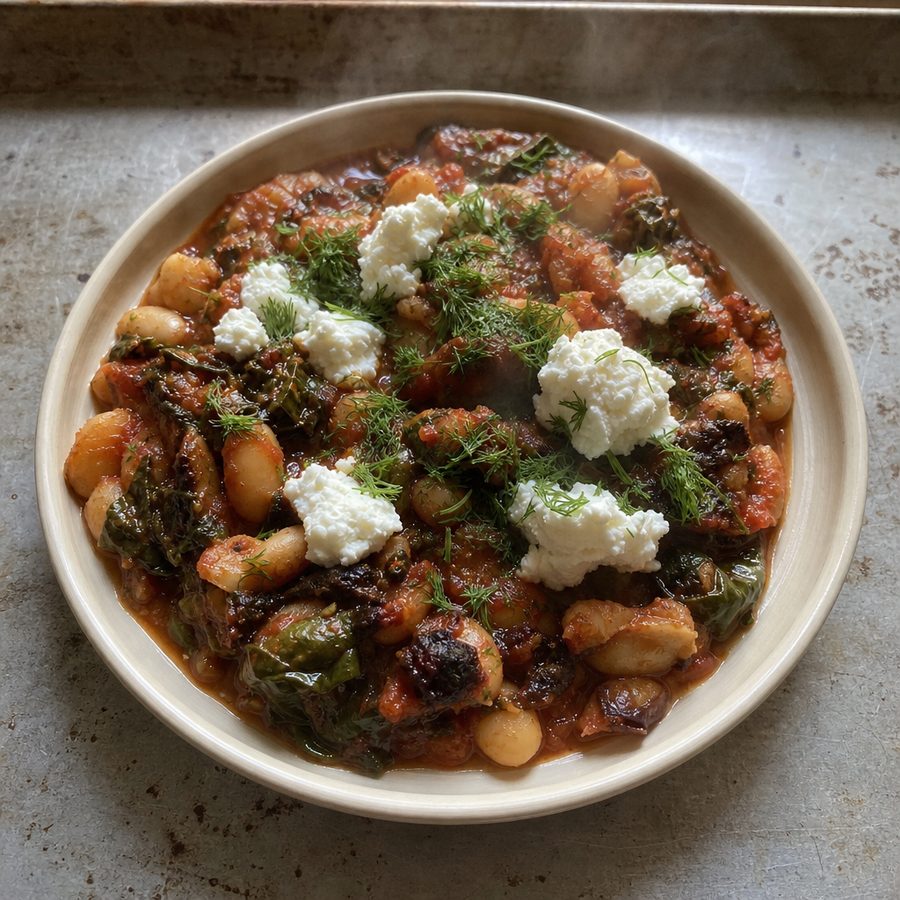
Large white beans baked slowly in a garlicky tomato sauce with oregano and dill, wide ribbons of collard greens folded through, and cool ricotta spooned over the top just before it goes to the table.
Why You'll Love This Recipe
Plaki means baked in tomato with garlic and herbs, and gigantes are the big flat white beans Greeks bake that way and eat all winter. It is a dish that asks almost nothing of you: soften an onion, stir everything together, and let the oven do fifty minutes of work while you do something else. What comes out is much more than the sum of a can of beans and a can of tomatoes, because the slow heat turns the sauce sweet and the beans go soft enough to crush against the roof of your mouth. Beans and a hot oven have carried Greek winters for a very long time, and this is why.
I fold greens into mine, which is not strictly traditional but is very Greek in spirit, since horta of one kind or another turns up on every table there. A pound of collards looks absurd going into the pan and cooks down to almost nothing, and what it leaves behind is a dark, faintly bitter thread running through all that sweetness. The ricotta is the last thing and it matters more than its size suggests: cool, milky spoonfuls against hot beans, the same trick a Greek cook plays with a slab of fresh cheese. Buy the biggest white beans you can find, since their size is half the pleasure of the dish.
This is a dinner for a cold evening and a good one to make ahead, since it is better on the second day than the first. It feeds four generously with bread on the table, and it stretches to six if there is a salad beside it. I make it on Sunday afternoons when the oven is already on, and then I am glad about it twice, once at dinner and again at lunch the next day when it has thickened into something you could eat with a fork. It travels well too, so it is usually what I bring when somebody asks me to bring something.
Ingredients
- Two 15 oz cans large white beans such as cannellini or gigantes, drained and rinsed
- 1 lb collard greens or dandelion greens, stems stripped out and leaves cut into wide ribbons
- 1 1/2 cups canned crushed tomatoes
- 3/4 cup ricotta
- 1 large yellow onion, chopped fine
- 5 garlic cloves, sliced thin
- 3 tbsp extra virgin olive oil
- 2/3 cup vegetable broth
- 2 tsp dried Greek oregano, crumbled between your fingers
- 3 tbsp chopped fresh dill
- 1/3 cup chopped fresh flat-leaf parsley
- 1 3/4 tbsp fresh lemon juice
- 1 tsp coarsely ground black pepper
Instructions
- Heat the oven and start the onion: Heat the oven to 375°F. Warm the olive oil in a large ovenproof skillet or a wide braising pan over medium heat, add the onion, and cook for seven to eight minutes, stirring now and then, until it is soft and translucent with no bite left. Add the garlic and the oregano and cook one minute more, until you can smell both.
- Wilt the greens: Add the collard ribbons in two or three handfuls, letting each batch collapse before the next goes in. This takes four to five minutes in total. They should go glossy and dark and reduce to about a quarter of what you started with, and the pan will look far less crowded than it did a moment ago.
- Build the sauce: Stir in the crushed tomatoes, the broth, and the black pepper, and bring it to a simmer. Let it bubble for three minutes so the tomato loses its tinny edge, then fold in the beans gently with a rubber spatula, keeping as many of them whole as you can. The pan should look loose and saucy at this stage, since the oven will tighten it.
- Bake it uncovered: Slide the pan into the oven, uncovered, and bake for forty-five to fifty minutes. It is ready when the sauce has pulled away from the sides and gone dark, the top layer of beans has begun to wrinkle and brown in patches, and the whole surface looks glazed rather than wet. Do not stir it while it bakes.
- Finish cool against hot: Let the pan sit for ten minutes off the heat so the sauce settles and the beans stop bubbling. Pour the lemon juice over the top, scatter on the dill and parsley, and drop the ricotta over the surface in rough spoonfuls. Take it to the table in the pan and let people break the cheese into the beans themselves.
Variations
- With feta: Crumble two ounces of feta over the top in the last ten minutes of baking so it softens and browns at the edges, and leave the ricotta out.
- Tomato and honey: Add a teaspoon of honey with the tomatoes, which is how some tavernas balance a very acidic can and sends the whole dish rounder and sweeter.
- Spiced: Add a half teaspoon of cinnamon and a pinch of ground cloves with the oregano for the warm, faintly sweet spicing you find in northern Greek bean dishes.
- With sardines: Lay drained sardines over the beans for the last five minutes of the bake, which turns a vegetable dinner into a heavier one without changing the method.
Storage & Leftovers
It keeps five days in a sealed container in the refrigerator and improves for the first two of them. The beans go on drinking up the sauce, the oregano settles into everything, and what was a saucy bake on the night becomes thick enough to spread on toast by day three.
Reheat portions covered in a 350°F oven for twelve to fifteen minutes, or in a pan over medium-low heat with a splash of water to loosen the sauce. Add the ricotta, the dill, and the lemon after reheating rather than before, since the cool cheese landing on hot beans is half of what makes the dish.
It freezes well for three months, which is unusual for a bean dish. Cool it completely, freeze it flat in sealed portions, and thaw overnight in the refrigerator. Freezing softens the beans further, so treat a thawed batch as the base for a thicker, more spreadable version and finish it the same way.
Notes & Tips
- Crumble the oregano as it goes in: Rubbing dried oregano between your palms breaks the leaf and wakes up the oils. Dropped in whole it tastes dusty, and this dish leans on it hard.
- Fold the beans, do not stir them: A spatula under and over keeps them whole. A spoon dragged through the pan splits their skins and the sauce turns cloudy and starchy in the oven.
- Leave the pan uncovered: The bake is really a reduction. A lid traps steam and you end up with beans sitting in liquid rather than beans glazed in sauce with browned edges.
- Add the greens in stages: A pound of collards will not fit in the pan at once. Two or three handfuls, each wilted before the next, gets everything in without dropping the pan temperature.
- Let it rest ten minutes: Straight from the oven the sauce is thin and the beans are too hot to taste. Ten minutes and it thickens around them, which is when the lemon and the cheese should go on.
Nutrition & Mindful Eating
- White beans, greens, and ricotta cover a lot of ground between them. The beans bring protein and a great deal of fiber, the collards add minerals and body for very little else, and the ricotta lands protein and calcium on top in a form that tastes like a treat rather than an addition.
- Collard greens cook down to a fraction of their volume, and what stays behind is concentrated. They are one of the better plant sources of calcium, and the form it comes in is absorbed well, which is not true of every green.
- Cannellini beans are the quiet engine here. Their soluble fiber is what makes a bowl of them sit so solidly, and they carry iron and folate along with it, particularly when there is lemon juice going over the top to help that iron along.
- Ricotta spooned on cool is fresh cheese made from whey, mild and milky, and it brings calcium and a little more protein without the salt edge that an aged cheese would put on the dish.
- Dried oregano, sliced garlic, and a hard scatter of dill are what make this taste Greek rather than simply like beans in tomato. Oregano in particular is among the most concentrated dried herbs in the spice drawer, which is why two teaspoons carry a whole pan.
- As you eat, break a spoonful of the cool ricotta into the hot beans and notice how the temperature changes each bite, and let the pan sit in front of you long enough to go back for the browned edges on purpose.
Frequently Asked Questions
Can I use dried beans?
Yes, and the texture is better for it. Soak half a pound of dried gigantes or cannellini overnight, then simmer them in unsalted water for an hour to an hour and a half, until tender but not collapsing. Save a cup of the cooking liquid to use in place of the broth, since it carries a lot of flavor.
What greens work here?
Collards hold up best to the long bake and stay in distinct ribbons. Dandelion greens are closer to what a Greek cook would use and bring more bitterness, chard wilts faster and goes softer, and kale sits somewhere in between. Whichever you use, strip the thick stems out first.
Mine came out watery. What happened?
Almost always a covered pan, or an oven that was not quite up to temperature. The lid stays off the whole time here, because the point of the bake is evaporation. If it still looks loose at the end of the hour, give it another ten minutes and let the top brown properly.
Is this a main dish or a side?
Both, depending on the pan. As written it is dinner for four with bread, and there is enough protein in the beans and the ricotta together to carry a plate on its own. Alongside roast fish or chicken it will stretch to eight as a side, in which case skip the ricotta.