
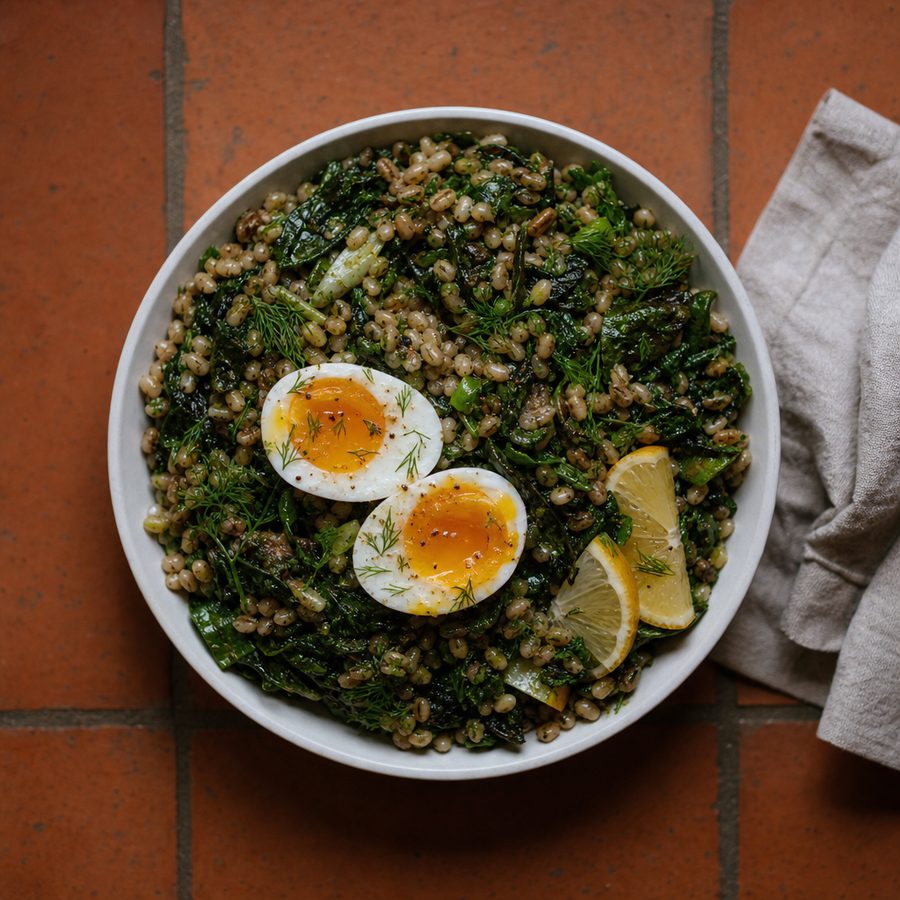
Greek Lemon Greens and Barley Bowl with Jammy Eggs
Collard ribbons and kale braised soft with garlic and olive oil, stirred through warm barley with a great deal of lemon, and topped with halved seven-minute eggs and dill.
Why You'll Love This Recipe
Horta is the Greek habit of boiling whatever wild greens are around, dressing them hot with olive oil and lemon, and calling it food, and it has fed people on that coast for a very long time. I make my version with collards because they are what is reliably good at my market in every season, and because they hold their texture through a long cook rather than dissolving. The kale goes in at the end for a bit of contrast. What surprises people is how sweet greens get when you actually give them time. Twenty minutes over low heat turns something you have to chew into something closer to silk.
Barley is the other half of it. Cretan cooking is full of barley, and the grain does something rice does not: it stays chewy and slightly springy no matter how long it sits in the pan juices, so the bowl has real texture instead of turning to porridge. The greens and their liquid soak into it, the lemon goes in at the very end so it stays sharp, and the dill lands cold on the hot bowl and fills the kitchen. The egg is the reason it is breakfast. Cut at seven minutes, the yolk is thick and orange and runs into the barley like a dressing.
This is a weekday breakfast built out of Sunday leftovers, and it is worth cooking the barley ahead on purpose. I keep a container of it in the refrigerator most weeks and it turns into this in about twenty five minutes flat. It is also a good thing to eat when the week has been heavy, because it is warm and savory without being rich, and it is one of the few breakfasts I know that tastes just as good at room temperature out of a jar at eleven in the morning.
Ingredients
- 1 large bunch collard greens (about 14 oz), thick ribs cut out and leaves rolled and sliced into thin ribbons
- 1 small bunch lacinato kale (about 5 oz), stemmed and torn into pieces
- 2 1/4 cups cooked pearl barley (from about 3/4 cup dry, simmered in unsalted water)
- 4 large eggs
- 3 tbsp extra-virgin olive oil, divided
- 5 scallions, white and green parts sliced thin
- 4 garlic cloves, thinly sliced
- 3 tbsp lemon juice, plus wedges for the table
- 3 tbsp chopped fresh dill
- 1 tsp dried Greek oregano
- 1/4 tsp fine sea salt
- 1/2 tsp coarsely ground black pepper
Instructions
- Boil the eggs first: Lower the eggs into boiling water with a spoon and set a timer for 7 minutes for a jammy yolk, or 8 if you like it just set. Move them straight into cold water when the timer goes, and leave them there while you cook the greens. Peel them starting at the wide end, where the air pocket is.
- Strip and cut the greens: Fold each collard leaf along the rib and cut the rib out, then stack the leaves, roll them into a cigar, and slice across into ribbons about a quarter inch wide. Strip the kale off its stems and tear it into rough pieces. Keep the two piles separate, because the collards need far longer.
- Soften the aromatics: Heat 2 tbsp of the oil in a wide, deep skillet over medium. Add the scallions and garlic and cook for 2 minutes, stirring, until the garlic is fragrant and just turning pale gold at the edges. Do not let it brown, since browned garlic turns bitter and this dish has nowhere to hide it.
- Braise the collards: Add the collard ribbons, the salt, the oregano, and 1/2 cup of water. Cover and cook over medium-low for 15 minutes, stirring twice, until the ribbons have gone dark and glossy and collapsed to about a third of their volume. They should give completely when you press one against the side of the pan.
- Add the kale and the barley: Stir in the kale and cook uncovered for 3 minutes, until it wilts but still looks green. Add the barley and the black pepper and toss everything over medium heat for 2 to 3 minutes, until the grain is hot through and has taken up most of the liquid left in the pan.
- Finish with lemon and build the bowls: Take the pan off the heat, pour in the lemon juice and the last tablespoon of oil, and stir once. Taste it: greens absorb acid fast and it usually wants another squeeze. Divide between four bowls, halve the eggs and set two halves on each, and finish with the dill and a lemon wedge on the side.
Variations
- With white beans: Fold half a cup of rinsed cannellini beans in with the barley so they warm through in the pan juices.
- Crumbled feta: Scatter a little crumbled feta over each bowl in place of the egg for a sharper, saltier finish.
- Bitter greens: Use dandelion greens for half the collards, which pushes the bowl properly bitter in the way a Greek cook would recognize.
- Toasted sesame: Finish with a tablespoon of toasted sesame seeds for crunch against all that softness.
Storage & Leftovers
The greens and barley keep four days in a sealed container in the refrigerator and are arguably better on day two, once the lemon and the oil have worked all the way through the grain. Store the eggs separately, still in their shells if you can, because a peeled boiled egg goes rubbery and picks up whatever else is in the container.
Reheat the barley and greens in a skillet over medium with a splash of water, tossing for three or four minutes until steam comes off the top. Add a fresh squeeze of lemon at the end, since acid fades in the cold and the bowl tastes flat without it. This also eats well straight from the refrigerator with cold eggs, more like a grain salad.
It freezes for two months, though the texture shifts: the greens stay good and the barley softens a little. Freeze it flat in sealed portions without the eggs, thaw overnight in the refrigerator, and reheat in a pan. Boil fresh eggs when you serve it, since a frozen yolk turns waxy and there is no fixing it.
Notes & Tips
- Cut the ribs out of the collards: The rib takes twice as long to soften as the leaf, so leaving it in guarantees a bowl with tough sticks in it. Fold, cut, and discard, or slice the ribs thin and start them five minutes early.
- Give the greens water and a lid: Collards need moist heat to break down, and a dry pan just toasts the edges. Half a cup of water under a lid steams them into submission and leaves you a small amount of dark, tasty liquid for the barley.
- Keep the garlic pale: Sliced garlic goes from gold to bitter in about thirty seconds. Get the greens into the pan while it is still blond, and the long braise will mellow it into sweetness.
- Add lemon off the heat: Acid cooked into greens goes dull and takes the bright green with it. Pull the pan off the burner, then pour it in, and you keep both the color and the sharpness.
- Seven minutes, then cold water: The yolk keeps setting from residual heat, so an egg left in a hot shell for another two minutes comes out chalky. Move them into cold water the moment the timer sounds.
Nutrition & Mindful Eating
- Greens, barley, and egg are three separate jobs in one bowl. The collards and kale bring the volume and the minerals, the barley brings chew and a soluble fiber that makes the bowl feel substantial, and the egg on top brings the protein that turns a plate of vegetables into breakfast.
- Collard greens are the quiet workhorse of this recipe. They carry a surprising amount of calcium in a form the body takes up well, along with vitamin K, and a long braise softens their fiber into something gentle instead of coarse.
- Barley is a chewy, old grain with a coating of beta-glucan, the soluble fiber that gives cooked barley its slightly slippery feel and is a large part of why a bowl of it sits so well.
- A seven-minute egg is doing more than sitting on top. The yolk melts into the grain and becomes the sauce, and it carries choline, vitamin D, and the lutein that gives it that deep orange color.
- Lemon, dill, and Greek oregano are the finish, and they are the difference between this and a plain bowl of grain. The acid goes in off the heat so it stays sharp, the dill arrives cold on something hot, and the oregano crushed between your fingers smells like the whole coast.
- As you eat, break the yolk into the barley and watch it coat the greens, and take the first few bites slowly enough to notice how sweet a long-cooked collard leaf actually is.
Frequently Asked Questions
Can I use other greens?
Yes, and that is the whole idea behind horta. Mustard greens bring a peppery bite, dandelion greens bring a real bitterness that the lemon handles well, and a bag of chopped collards from the produce aisle saves ten minutes of knife work. Adjust the braise time to the leaf: tender ones need five minutes, tough ones need twenty.
What if I do not have cooked barley?
Simmer 3/4 cup of pearl barley in plenty of unsalted water for 25 to 30 minutes, until it is chewy but not chalky, then drain. It can happen while the greens braise if you start the pot first. Farro works the same way and cooks in about the same time.
My eggs are impossible to peel.
Use eggs that are at least a week old, lower them into water that is already at a rolling boil rather than starting them cold, and chill them hard for at least five minutes before peeling. Crack the wide end first and peel under a thin run of cold water, which gets in under the membrane.
Is this good cold?
Very. Cold, it eats like a grain salad, and I often pack it that way with the eggs left whole on the side. It wants a little more lemon and a thread of oil when it comes out of the refrigerator, because both go quiet when they are chilled.