
Greek Pork and Celery in Egg-Lemon Sauce
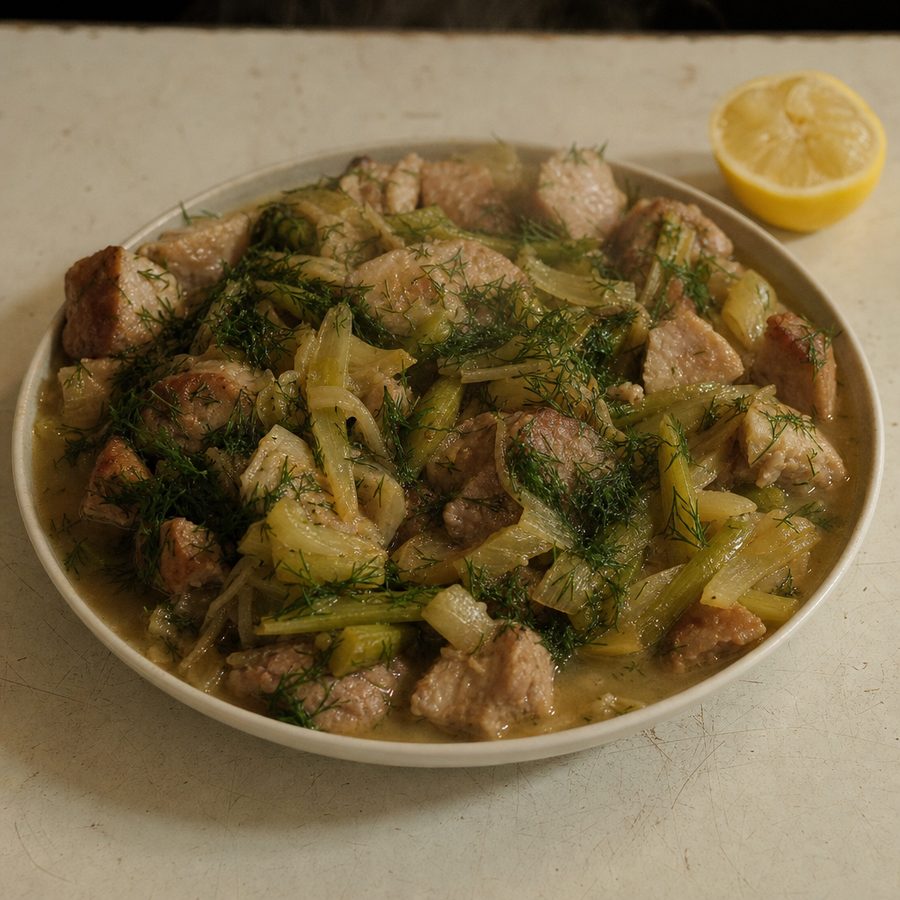
Chunks of pork braised slowly with a whole head of celery, leeks, and fennel until everything is soft, then finished off the heat with eggs beaten into lemon juice and a great deal of dill.
Why You'll Love This Recipe
Nobody outside Greece cooks celery this way and I have never understood why. We treat it as something to dice into the bottom of a pot and forget about, and here it is the point of the dish, a whole head of it cut into lengths and braised until it gives way completely. What it turns into is sweet, faintly bitter, and completely tender, somewhere near a cooked fennel. The pork goes in first and browns, the vegetables pile in on top, and the pot does the rest with almost no help from me for the better part of an hour.
The finish is what people remember. Off the heat, you beat three eggs until they are foamy, whisk in a lot of lemon juice, warm the mixture slowly with ladlefuls of the braising liquid, and pour it back. The sauce turns pale gold and thickens enough to coat everything, with no flour and no cream involved. Against that soft, rich sauce you get the sharpness of the lemon and then a great deal of dill, added at the very end so it stays green and grassy. Each bite is rich and sour at the same time.
This is a Sunday dish for me, or a cold Wednesday when I want the kitchen warm for an hour. It is unhurried but not fussy, and almost all of the work happens in the first fifteen minutes. It also reheats better than most braises, so I make it when I want two dinners out of one afternoon. Serve it in shallow bowls with a cut lemon on the table, because the amount of sourness people want varies more than you would think.
Ingredients
- 1 1/2 lb boneless pork sirloin or loin, cut into 1 1/2-inch chunks
- 1 whole head of celery (about 1 1/3 lb), stalks cut into 2-inch lengths, leaves reserved
- 1 medium fennel bulb, cored and cut into thick wedges
- 1 large leek, white and pale green parts only, sliced into thick rounds and washed well
- 8 oz spinach, thick stems removed
- 6 scallions, sliced
- 1 2/3 cups chicken broth
- 3 large eggs
- 1/4 cup plus 1 tbsp fresh lemon juice, from about 2 lemons
- 3/4 cup chopped dill, stems and all
- 4 garlic cloves, sliced
- 2 1/2 tbsp olive oil
- 1/4 tsp fine sea salt
- 1/2 tsp freshly ground black pepper
Instructions
- Brown the pork: Pat the pork chunks dry and season them with the black pepper and half the salt. Heat 1 1/2 tbsp of the olive oil in a Dutch oven over medium-high until it shimmers, then brown the pork in two batches, about 3 minutes a side, until each piece has real color on two faces. Move them to a plate. Do not crowd the pot or they will steam and stay gray.
- Soften the aromatics: Turn the heat to medium, add the remaining 1 tbsp of oil, and cook the leek, fennel wedges, and garlic for 6 to 7 minutes, stirring, until the leek has collapsed and the fennel is beginning to color at the cut edges. Scrape up anything stuck to the bottom of the pot as you go, since that is where most of the flavor is.
- Braise: Return the pork with its juices, add the celery lengths, the rest of the salt, and the broth, and bring it to a simmer. Cover and cook over low heat for 40 to 45 minutes, stirring once halfway. It is ready when a piece of celery gives with no resistance to a spoon and the pork pulls apart when you press it. There should be about a cup and a half of liquid left in the pot.
- Wilt the greens and stop the heat: Stir in the spinach and the scallions in two or three handfuls, letting each collapse before the next goes in, about 2 minutes. Take the pot off the burner entirely and let it stand 3 minutes. The liquid must stop bubbling before the eggs go anywhere near it, and this pause is the whole difference between a sauce and scrambled eggs.
- Make the egg and lemon sauce: Beat the eggs in a bowl until foamy and pale, then beat in the lemon juice. Ladle in about half a cup of the hot braising liquid in a thin stream while whisking hard, then repeat twice more, until the bowl feels warm rather than hot. Pour it all back into the pot, stirring, and set it over the lowest heat for 2 to 3 minutes, until the sauce thickens slightly and reads 160°F. Add the dill and the reserved celery leaves and serve.
Variations
- With white beans: Add a cup of drained cannellini beans in the last ten minutes for a heavier pot that stretches to six.
- Egg yolks only: Use five yolks in place of the three whole eggs for a deeper gold, richer sauce, which is how it is often done for a Sunday table.
- Lettuce and dill: Swap the spinach for two shredded romaine hearts, wilted in at the end, which is closer to the version made in the spring.
- Cinnamon and bay: Add a bay leaf and a small piece of cinnamon stick to the braise, then fish them out before the sauce goes in, for a warmer background note.
Storage & Leftovers
It keeps four days in a sealed container in the refrigerator and is one of the better second-day dinners I make, since the celery goes on softening and the sauce settles into it. Expect the sauce to set almost solid when cold, which is what egg does, and to loosen again the moment it warms.
Reheat over low heat with a splash of broth or water, stirring gently and stopping the moment it steams. An egg-thickened sauce will break if you let it boil, which looks like fine curds in a thin liquid. Fresh dill and a squeeze of lemon when it comes back up to temperature make it taste newly made.
I do not freeze this, because the egg and lemon separates on thawing and never quite comes back together. What works is freezing the braise before the sauce goes in, up to three months, then thawing overnight, warming it through, and doing the egg and lemon step fresh in the last five minutes.
Notes & Tips
- Cut the celery long: Two-inch lengths hold together through a forty-minute braise. Sliced thin, celery disintegrates and you lose the texture that makes this dish interesting.
- Wash the leek properly: Grit hides between the layers and there is nowhere for it to go in a braise. Slice first, then swish the rounds in a bowl of cold water and lift them out, leaving the sand behind.
- Steady the bowl: Set the bowl of beaten eggs on a damp folded towel so it cannot spin, and you will have one hand free for the ladle and one for the whisk.
- Save the celery leaves: The pale leaves from the center of the head taste like a cross between celery and parsley and make the best garnish this dish has. Chop them in with the dill.
Nutrition & Mindful Eating
- The pork, the celery, and the eggs each carry part of this dish. The pork brings the protein and the body, the celery and fennel cook down into the sauce and supply most of the fiber, and the eggs thicken everything at the end without any flour doing the work.
- Pork sirloin is a close-grained cut that pulls apart after a slow braise, and it carries a dense amount of protein along with thiamin, which pork supplies more generously than almost any other food.
- Celery braised for the better part of an hour turns sweet and completely tender, and a whole head of it puts a real amount of fiber and potassium into the pot while giving up its flavor to the sauce.
- Spinach wilted in at the end keeps its color and adds folate and magnesium, and it takes on the lemon in a way that the heavier vegetables underneath do not.
- The lemon and the dill both go in when the heat is off, which is deliberate. Cooked lemon turns round and mild, and cooked dill goes gray and flat, so both stay sharp and green by arriving last.
- As you eat, notice how completely the celery has changed and how the sauce coats the back of the spoon, and take the first few bites slowly enough to catch the dill before the lemon takes over.
Frequently Asked Questions
What cut of pork is best?
Sirloin and loin both work and stay firm enough to hold their shape. Shoulder is the richer choice and pulls apart into strands, though it wants an extra twenty minutes in the pot. Whichever you use, cut generous chunks rather than small cubes so they survive the braise.
Will my sauce curdle?
Not if you do two things. Take the pot fully off the heat and let it stop bubbling, and warm the eggs with at least three ladlefuls of hot liquid before they go back in. If it does break, whisk hard off the heat, and an immersion blender pulsed twice will smooth it out entirely.
Can I make it with chicken?
Yes, and it is quicker. Use boneless thighs, brown them the same way, and cut the braising time to about 25 minutes, cooking them through to 175°F. The celery still needs its full time, so give it a ten-minute head start in the pot before the chicken goes back in.
Is a whole head of celery really right?
It is, and it will look like far too much when you cut it. Celery loses a great deal of volume as it braises and it is the vegetable this dish is named for. Use the pale inner stalks and the leaves as well, which are the sweetest part and usually get thrown away.