
Green Herb Kuku with Walnuts and Cold Lemon Yogurt
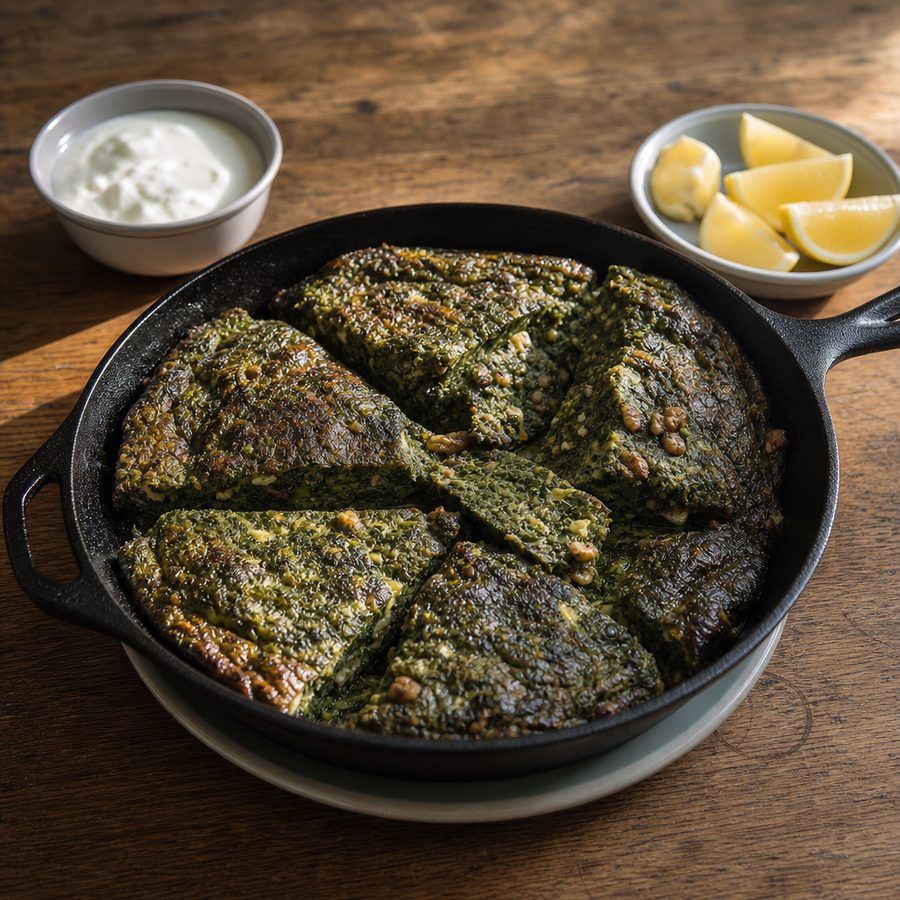
A Persian baked egg cake with far more herbs than egg, parsley, cilantro, dill, and mint packed in with kale and scallion, turmeric-stained and studded with walnuts, cut into wedges and served with cold yogurt.
Why You'll Love This Recipe
Kuku is the Persian answer to the frittata, and the difference is the proportion. Here the eggs are barely enough to hold the herbs together, so what you get is not a green-flecked omelette but a dense, almost cake-like slab that slices cleanly and tastes overwhelmingly of parsley and dill. The first time I made one I assumed I had miscounted the herbs. I had not. Chopping is genuinely most of the work, twenty minutes with a sharp knife or a few careful pulses in a food processor. Have your largest bowl ready, because the volume of green before the eggs go in is startling.
The turmeric does two things, coloring the batter a deep gold that reads almost olive once the greens go in, and adding a faint earthiness underneath all that freshness. Walnuts are traditional and worth toasting first, since they go soft in the batter and their flavor is most of what you notice. Almond flour is not traditional, but a couple of spoonfuls give the slab enough structure to cut into wedges without crumbling. The kale is my own addition, and it holds its shape better than the tender herbs do. Grated garlic stirred through raw softens as it bakes and keeps the whole slab from tasting merely green.
I bake it rather than frying it in a skillet of oil, which is the older method, because the oven gives an even set and browned edges without standing over it. It is dinner with a bowl of yogurt and a squeeze of lemon, and it is just as good at room temperature, which makes it useful for a night when people are eating at different times. It travels well, which is why wedges of it turn up at picnics wrapped in flatbread, and a piece packed for lunch holds its shape all morning. Cut cold from the refrigerator the next day, it is the thing I look forward to most.
Ingredients
- 8 large eggs
- 3 packed cups flat-leaf parsley leaves and thin stems, chopped fine
- 2 packed cups cilantro, chopped fine
- 1 packed cup fresh dill, chopped
- 1/2 packed cup mint leaves, chopped
- 8 scallions, sliced thin, white and green
- 1 bunch lacinato kale (about 7 oz), stems stripped, leaves sliced into fine ribbons
- 1/4 cup walnuts, toasted and chopped
- 1/4 cup almond flour
- 3 garlic cloves, grated
- 3/4 tsp ground turmeric
- 1/2 tsp ground black pepper
- 1 tbsp olive oil
- 1/2 cup plain Greek yogurt
- 1 1/2 tbsp lemon juice, plus wedges to serve
- 1/4 tsp fine sea salt
Instructions
- Chop everything fine: This is the work of the recipe and it cannot be rushed. Wash and dry the herbs thoroughly, then chop the parsley, cilantro, dill, and mint fine, stems and all as long as they are thin. Slice the scallions and cut the kale into the finest ribbons you can. A food processor will do it in short pulses; go too far and you get a wet green paste rather than distinct pieces.
- Wilt the kale: Heat the oven to 350°F and oil a 10-inch cast iron skillet or a similar baking dish with half the olive oil. Warm the rest of the oil in a pan over medium and cook the kale ribbons with the garlic for three or four minutes, just until the kale darkens and softens. Let it cool for a few minutes so it does not scramble the eggs.
- Mix the batter: Beat the eggs with the salt, pepper, and turmeric until completely uniform and slightly foamy. Whisk in the almond flour. Add the chopped herbs, the scallions, the cooled kale, and the walnuts, and fold until every leaf is coated. It will look like far too much green for the amount of egg, and that is exactly right.
- Bake: Scrape it into the prepared skillet and press the top flat with a spatula so it bakes evenly. Bake thirty to thirty five minutes, until the center is set and springs back when you press it and the edges have pulled slightly away from the pan and browned. A knife in the middle should come out clean, with no wet egg clinging to it.
- Rest, cut, and serve: Let it sit ten minutes in the pan before cutting, which lets it firm up so the wedges hold. Stir the lemon juice into the yogurt with a pinch of salt. Cut the kuku into four wedges, lift them out with a spatula, and serve with the cold yogurt and extra lemon on the side.
Variations
- Barberry and pistachio: Scatter a spoonful of dried barberries and chopped pistachios into the batter, which is how it is often made for a celebration.
- Fried in a skillet: The older method: cook it covered over low heat in an oiled pan for twenty minutes, then invert it onto a plate and slide it back in to brown the second side.
- Leek and chive: Swap the scallions for a finely sliced leek softened in the pan first, and add a handful of chopped chives for a rounder, sweeter version.
- Muffin-tin kukus: Divide the batter into a greased muffin tin and bake twenty minutes for individual portions that pack well.
Storage & Leftovers
Wrapped or in a sealed container, it keeps four days in the refrigerator and slices better cold than warm. Keep the yogurt in its own jar rather than spooned over the top, since it weeps against a warm surface and softens the browned edges you worked for.
It is genuinely good at three temperatures, so reheating is optional. If you want it warm, ten minutes in a 300°F oven brings it back without drying it, or thirty seconds in the microwave for a single wedge. Do not reheat it hot and fast; eggs this dense turn rubbery when pushed.
Wedges freeze for two months wrapped tightly in parchment and then foil. Thaw overnight in the refrigerator and warm gently. The texture tightens a little on freezing and the herbs lose some of their brightness, so a squeeze of fresh lemon over the thawed wedge does more than you would expect.
Notes & Tips
- Dry the herbs completely: A salad spinner, then a towel. Water clinging to the leaves is the single most common reason a kuku bakes up soggy, and there is a lot of leaf surface here to hold it.
- Use the stems: Parsley, cilantro, and dill stems carry as much flavor as the leaves and chop down fine enough to disappear. Only the thick woody ends need to go.
- Toast the walnuts first: Five minutes in a dry pan until they smell warm. Raw walnuts go soft and slightly bitter in the batter, and toasted ones keep a distinct flavor through the bake.
- Let the kale cool before it meets the eggs: Hot kale stirred into beaten eggs starts cooking them on contact and you end up with scrambled patches through the slab.
- Rest it before cutting: Ten minutes in the pan is the difference between clean wedges and a plate of green crumbs. It keeps cooking gently in the residual heat while it sits.
Nutrition & Mindful Eating
- Eggs, herbs, kale, and walnuts are doing four separate jobs in one pan. The eggs bind and carry the protein, the herbs and kale make up the actual volume of the dish and nearly all of its fiber, and the walnuts bring fat and crunch to a slab that would otherwise be uniformly soft.
- Parsley, cilantro, dill, and mint are treated as garnishes almost everywhere else, and used by the bunch they turn out to carry real amounts of vitamin K, vitamin C, and folate. That is the quiet argument for a dish that uses them as the main ingredient.
- Eggs bring the protein here along with choline, which is concentrated almost entirely in the yolk, and the lutein and zeaxanthin that give the yolk its color. They also set firmly enough to hold six cups of greens in one sliceable piece.
- Walnuts are among the few nuts that carry a meaningful amount of alpha-linolenic acid, a plant omega-3 fat, and toasting them brings out the flavor that stands up to this much herb.
- Turmeric colors the batter and adds a low earthy note under all that freshness. Its curcumin is fat-soluble and absorbed better alongside the eggs and walnuts than it would be on its own, and the black pepper in the batter helps as well.
- As you eat, notice which herb you taste first in each bite, since it changes from wedge to wedge, and let the cold yogurt slow you down between mouthfuls.
Frequently Asked Questions
That is a great deal of herbs. Is the quantity right?
It is, and it is what separates a kuku from a frittata. You want roughly six loosely packed cups of chopped greens against eight eggs. If it looks like a salad with egg poured over it before it goes in the pan, you have measured correctly.
Can I use a food processor for the chopping?
Yes, in short pulses, and dry the herbs first. Wet herbs turn to slurry almost immediately, and a slurry bakes into a flat green pudding rather than a slab with texture. Do the parsley and cilantro together, then the dill and mint separately, since they break down faster.
Mine came out wet in the middle.
Either the herbs went in wet or it needed longer. Spin or towel the greens properly, and trust the press test over the clock, since ovens vary. The center should spring back rather than dent. Another ten minutes will not hurt it; a wet middle will not set as it cools.
What can I use rather than dill?
More parsley is the simplest answer, though the dish loses a note it is known for. Tarragon in a smaller quantity gives you something in the same family, and fennel fronds if you have a bulb to use up are surprisingly close. Cilantro and parsley are the two I would not substitute.