
Griddled Delicata Squash with Crisped Ground Bison and Rosemary
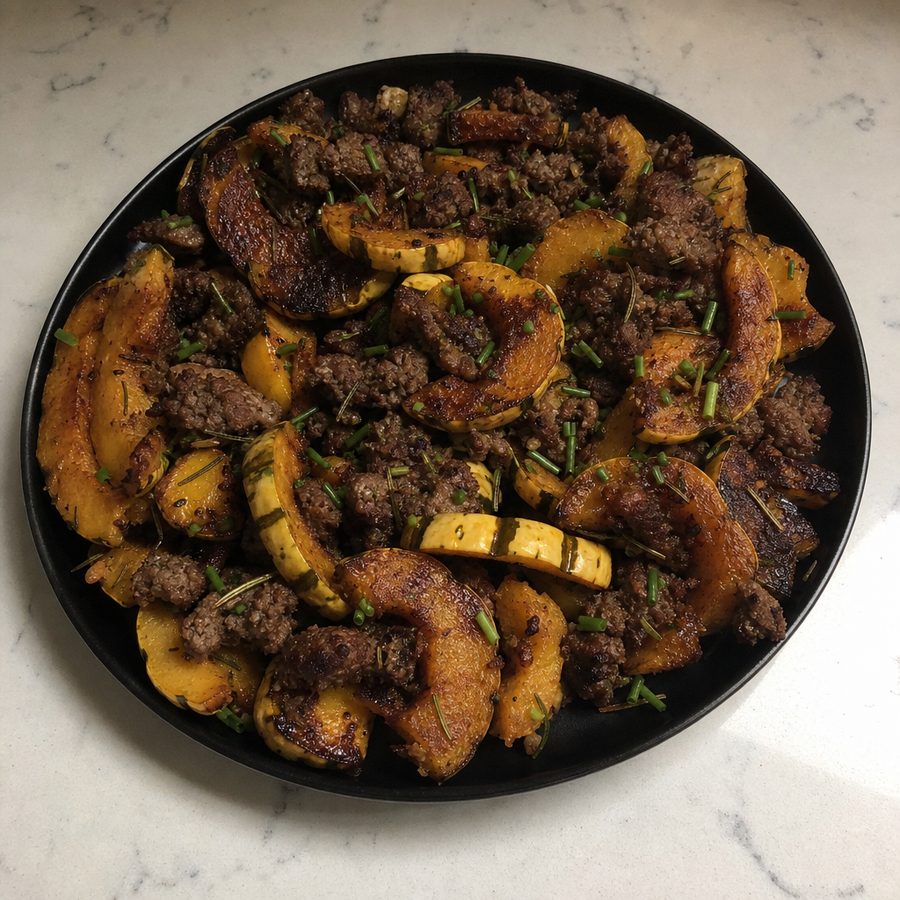
Half-moons of delicata squash griddled flat in a hot skillet until the cut faces caramelize, with ground bison browned hard beside them and a quick cider and maple glaze poured over both.
Why You'll Love This Recipe
Winter squash usually means the oven, forty minutes, and a sheet pan to scrub afterward. Delicata is the one that does not, because the skin is thin enough to eat and the halves cut into half-moons that lie flat in a skillet. Griddled that way they take about twelve minutes in total, and the cut faces caramelize into something sweeter than the oven ever gives you. I make this at the cold end of the year when squash is cheap and I want a hot savory plate without heating the oven before it is light out. One pan, two components, about twenty five minutes.
Both halves of this plate want the same thing, which is hard contact with hot metal and then a little patience. The squash goes in first in a single layer, and if your pan will not hold it all, cook it in two batches rather than piling it up, because crowded squash steams itself pale. Three or four minutes a side is enough to blacken the edges and take the flesh tender. The bison browns in the same pan afterward, pressed flat and left alone for four full minutes so one whole face crusts before you break it apart. That crust is most of the flavor in the finished pan.
Bison is worth buying for a dish like this. It is fine-grained, and the flavor is milder and a touch sweeter than most people expect from a red meat, and it cooks quickly, so I pull it the moment the pink is gone. The finish is where everything comes together. Rosemary is chopped fine and stirred into the hot fat where it blooms and turns the whole pan piney, then cider vinegar and maple syrup go in to lift the browned bits off the bottom into a glaze that coats the meat and the squash both. Chives go over the top and the skillet goes straight to the table.
Ingredients
- 2 delicata squash (about 1 3/4 lb), halved, seeded, and cut into 1/2-inch half-moons
- 1 1/4 lb ground bison
- 3 tbsp garlic-infused olive oil, divided
- 1 tbsp finely chopped fresh rosemary
- 1/2 cup beef broth
- 2 tbsp apple cider vinegar
- 1 tbsp pure maple syrup
- 1/4 cup thinly sliced chives
- 1/4 tsp cayenne
- 1 1/2 tsp fine sea salt, divided
- 1 tsp freshly ground black pepper
Instructions
- Cut the squash: Cut each delicata in half lengthwise and scoop out the seeds with a spoon. Lay the halves flat and slice them crosswise into 1/2-inch half-moons. Leave the skin on, since it is thin enough to eat once cooked and it holds each piece together in the pan.
- Griddle the squash: Heat 2 tablespoons of the garlic-infused olive oil in a large skillet over medium-high. Lay the half-moons in a single layer, season with half the salt, and cook 3 to 4 minutes without moving them, until the underside is deeply browned. Turn and cook 3 minutes more, until a knife slides in easily. Move them to a plate.
- Brown the bison hard: Add the bison to the same pan in one piece and press it flat against the bottom. Leave it alone for 4 minutes over medium-high, until the underside is dark and crusted, then break it into large rough pieces and cook 3 to 4 minutes more, until no pink remains and it reads 160°F (71°C).
- Bloom the rosemary: Stir in the rosemary, the cayenne, the remaining salt, and the black pepper, and cook 45 seconds, until the rosemary smells strong and faintly toasted. Dried out this way in hot fat, it flavors the whole pan rather than sitting on top of it.
- Glaze the pan: Pour in the broth, the cider vinegar, and the maple syrup, and scrape the bottom of the pan clean with a wooden spoon. Simmer 2 to 3 minutes, until the liquid thickens into a glaze that clings to the meat and no loose liquid is left pooling.
- Bring it together: Return the squash to the pan and turn it gently through the glaze, just long enough to warm it through, about 1 minute. Off the heat, add the last tablespoon of garlic-infused olive oil, scatter the chives over the top, and bring the pan to the table.
Variations
- Warmer spicing: Add 1/2 teaspoon of cinnamon with the rosemary for a sweeter, rounder pan that leans into the squash.
- Wilted greens: Stir two large handfuls of spinach into the glaze at the end and let them collapse before the squash goes back in.
- Something crunchy: Toast a quarter cup of pumpkin seeds in the dry pan before the squash goes in and scatter them over at the table.
- Over a grain: Spoon everything over a cup of warm millet or quinoa per plate for a heavier bowl.
- Different herb: Fresh thyme or chopped sage both work in place of the rosemary, and sage in particular suits the squash.
Storage & Leftovers
This keeps in a sealed container in the refrigerator for 4 days and travels well, which makes it a good Sunday cook for weekday mornings. The squash softens as it sits and the glaze thickens around it, so expect something jammier by the third day, and not a worse plate for it.
Reheat in a skillet over medium-high with a splash of broth for 4 to 5 minutes, leaving the squash still long enough to pick up a little color again. The microwave takes about 2 minutes and leaves it soft all the way through. Fresh chives and a splash of cider vinegar sharpen the whole thing back up.
Freeze the bison and the squash in separate flat sealed bags for up to 2 months. Cooked squash weeps water as it thaws, so plan on bringing it back in a hot dry pan rather than a microwave, which drives that moisture off and returns some of the caramelized edge to the cut faces.
Notes & Tips
- Leave the skin on: Delicata skin is thin, edible, and the thing holding each half-moon together. Peeling it costs you ten minutes and gives you pieces that fall apart in the pan.
- One layer, or two batches: Squash browns only where it touches metal. Pieces piled on top of one another steam themselves pale, and no amount of extra time fixes it afterward.
- Why garlic-infused olive oil works: The flavor of garlic dissolves into oil and the part of garlic that upsets a sensitive gut does not, so an infused oil brings the taste with none of the trouble. Save a spoonful for the very end, where you will smell it most.
- Four minutes, untouched: Ground meat pressed flat and left alone forms one crusted face, and that crust is where the flavor of the whole pan comes from. Stirring from the start gives you gray meat and gray flavor.
- Bloom the rosemary in the fat: Rosemary is resinous and its flavor is fat-soluble. Forty five seconds in the hot pan spreads it through everything, while the same rosemary added at the table only sits on top.
- Watch the glaze, not the clock: Pull the pan when the liquid coats the back of a spoon. Taken too far it turns sticky and dull, and a splash more broth loosens it straight back.
Nutrition & Mindful Eating
- Squash, bison, and the cider glaze work as three parts of one plate. The squash brings the sweetness and the bulk, the bison brings the dark savory crust and the protein, and the vinegar and maple pull the two together so neither sits on its own.
- Delicata squash has deep orange flesh, and that color is beta-carotene, the form of vitamin A that plants carry. Griddled hard, the cut faces caramelize into something almost candied, and the thin skin turns tender enough to eat, which is where a good part of the fiber lives.
- Bison is fine-grained and quick-cooking, and browned in big rough pieces it stays juicy inside a dark crust. It carries protein along with iron and zinc, which are the nutrients red meat reliably brings with it.
- Rosemary chopped fine and dropped into hot fat turns the whole pan piney and savory within a minute, and that resinous smell is most of what you notice when the skillet reaches the table.
- Cider vinegar and a spoonful of maple syrup go in at the end and reduce into a glaze that coats everything, sharp and sweet at the same time. Between the meat and the squash, a plate this size holds you through a long morning.
- As you eat, start with a piece of squash that took the most color and notice how much sweeter it is than the pale ones, and let the pan sit in front of you rather than eating standing at the stove.
Frequently Asked Questions
Can I use a different squash?
Acorn squash is the closest swap. Cut it into thin wedges, leave the skin on, and give it an extra 2 to 3 minutes a side, since it is firmer than delicata. Spaghetti squash does not work here, because it shreds rather than holding a flat face against the pan.
Can I use a different meat?
Ground beef and ground lamb brown the same way and want the same 7 to 8 minutes. Ground turkey needs closer to 9 minutes and an extra tablespoon of oil, since it releases less fat of its own into the pan. Cook poultry through to 165°F (74°C).
My squash went soft without browning. What happened?
The pan was crowded or the heat was too low. Squash gives up a lot of water, and if the pieces are touching, that water turns to steam and the faces never brown. Use your widest skillet, work in two batches, and resist the urge to turn them early.
Does this fit a low-FODMAP breakfast?
It does at about a cup of squash a plate. Delicata is one of the gentler winter squashes at that portion, bison has nothing in it to trouble a sensitive gut, and the savory backbone here is browned meat, rosemary, and garlic-infused olive oil rather than onion and garlic.