
Griddled Zucchini and Collard Greens with White Beans and Sesame
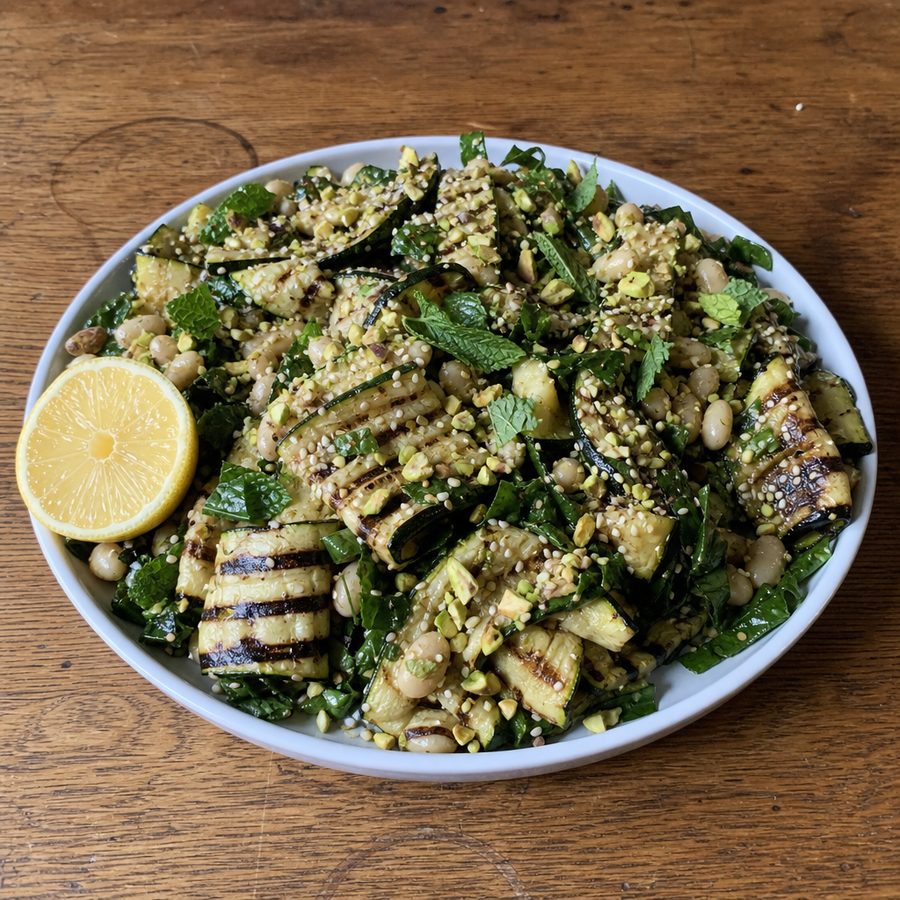
Thick zucchini planks griddled until they are striped and sweet, tossed with garlicky ribbons of collard greens, white beans, cumin, and lemon, and finished with toasted sesame seeds, pistachios, and mint.
Why You'll Love This Recipe
Zucchini has a reputation for being watery, and it earns that reputation every time somebody dices it small and stirs it in a moderate pan. Cut thick and given real heat, it does the opposite. The cut faces caramelize before the inside has time to release its water, so you get stripes of deep brown, a sweetness that surprises people, and a plank that still has some bite at the center. That is the whole reason this recipe exists, and it takes about six minutes once the pan is properly hot.
Collard greens are the other half of the plate and they are quicker than most people expect when the leaves are cut into narrow ribbons. Four or five minutes in garlic oil is enough to take them from squeaky to glossy and tender, and they hold their shape rather than collapsing. The white beans go in near the end, warm through, and pick up the cumin and paprika from the pan. Then everything gets tossed together on a platter while it is still hot, so the lemon juice sinks in rather than sitting on top.
I cook this when the vegetable drawer is full and I want dinner on the table in under half an hour, which in late summer is most weeknights. It works as a whole meal on its own, and it also sits happily next to something else on a bigger table. The pistachios and sesame seeds are not garnish, they are the texture, so do not skip them. Leftovers go into a container together and get eaten cold the next day with an extra squeeze of lemon, which is a lunch I look forward to.
Ingredients
- 3 medium zucchini, about 2 lb, cut on a slight angle into 1/2-inch planks
- 1 large bunch collard greens, about 10 oz, stems cut out and leaves stacked and sliced into 1/2-inch ribbons
- 1 can (15 oz) no-salt-added cannellini beans, drained and rinsed well, about 1 1/2 cups
- 5 cloves garlic, thinly sliced
- 3 tbsp olive oil, divided
- 2 tbsp lemon juice, from 1 lemon, plus wedges to serve
- 1 1/2 tsp ground cumin
- 1 tsp sweet paprika, or Aleppo-style pepper flakes
- 2 1/2 tbsp sesame seeds
- 1/4 cup shelled pistachios, roughly chopped
- 5 scallions, sliced thin on an angle
- 1/2 cup flat-leaf parsley, roughly chopped
- 1/4 cup fresh mint leaves, torn
- 1/4 tsp fine sea salt
Instructions
- Cut everything and toast the seeds: Slice the zucchini into 1/2-inch planks on a slight angle, strip the collard stems out and cut the leaves into narrow ribbons, and rinse the beans well. Toast the sesame seeds and pistachios in a dry skillet over medium heat for two to three minutes, shaking constantly until the sesame turns pale gold, then tip them onto a plate.
- Griddle the zucchini: Heat 2 tbsp of the olive oil in your widest skillet over medium-high until it shimmers. Lay the zucchini planks in a single layer, working in two batches if you need to, and leave them completely still for three minutes. Flip when the undersides are striped deep brown, cook two minutes more, then move them to a platter. They should be browned outside and still firm at the center.
- Wilt the collards in garlic oil: Lower the heat to medium and add the last tablespoon of oil, the garlic, cumin, paprika, and salt. Stir for thirty seconds, until the garlic is pale gold and the spices smell toasted. Add the collard ribbons a handful at a time with a splash of water, tossing as they collapse, and cook four to five minutes until they are glossy and tender with a little chew left.
- Warm the beans: Fold in the drained beans and cook two minutes, pressing a few of them lightly against the side of the pan so they thicken the oil and cling to the greens. Take the pan off the burner, stir in the lemon juice and half the scallions, and taste.
- Toss and finish: Tip the greens and beans over the zucchini on the platter and turn everything together gently, so the planks stay whole. Scatter the sesame seeds, pistachios, parsley, mint, and remaining scallions over the top and serve warm, with lemon wedges.
Variations
- Tahini drizzle: Whisk tahini with lemon juice and cold water until pourable and spoon it over the platter for a creamier, more sesame-heavy plate.
- Blistered tomatoes: Add a cup of halved cherry tomatoes to the pan with the beans and let them collapse into the greens.
- Chile and lemon zest: Grate lemon zest over the finished platter along with a good pinch of Aleppo-style pepper flakes for more perfume and heat.
- Feta on top: Crumble a little feta over the warm vegetables so it softens at the edges and goes salty against the lemon.
- Herb-heavy: Double the parsley and mint and add chopped dill, turning the platter into something closer to a warm herb salad.
Storage & Leftovers
This keeps three days in a sealed container in the refrigerator. The zucchini softens overnight and loses its stripes, which is a real change but not a bad one, and the collards and beans hold up perfectly. Keep the toasted sesame seeds and pistachios in a separate jar at room temperature and add them fresh, since anything toasted goes soft once it sits against wet vegetables.
I usually eat the leftovers cold, straight from the container with a squeeze of lemon and a little more olive oil, which turns it into something closer to a salad. If you would rather have it warm, a covered skillet over medium-low for three minutes is enough. Skip the microwave if you can, because zucchini that has been reheated hard goes limp all the way through.
Freezing does not suit this one. Zucchini is mostly water and comes back mushy, and the collards lose the little bit of chew that makes them worth eating. If you want a head start, cut the collard ribbons and slice the zucchini a day ahead and keep them in the refrigerator in separate bags, which takes the knife work out of the weeknight entirely.
Notes & Tips
- Cut the zucchini thick: Half-inch planks can take three minutes of hard heat and still hold their center. Thin slices go translucent and floppy before they ever brown.
- Do not salt the zucchini in the pan: Salt pulls water straight out of the cut faces, which is the opposite of what you want while they are browning. The salt goes in later with the greens.
- Cook in two batches: Two pounds of zucchini will not fit in one layer in most skillets. A crowded pan steams, and steamed zucchini cannot be rescued once it has gone soft.
- Ribbon the collards narrow: Half-inch ribbons cook in four minutes. Big torn pieces need twice that and end up chewy in the stem-end bits.
- Crush a few beans: Pressing five or six beans against the pan releases enough starch to thicken the oil into a loose sauce that clings to the greens.
- Toast the sesame seeds first: They go from pale to golden to burnt in about forty seconds. Do them in the dry pan before any oil goes in, and keep shaking.
Nutrition & Mindful Eating
- Zucchini, collards, and white beans divide the work on this platter. The zucchini gives it sweetness and bulk, the collards bring the dark leafy body and most of the calcium, and the beans add enough plant protein and starch to make it eat like a full dinner rather than a side.
- Collard greens are sturdy enough to take four minutes of real heat without falling apart, and among leafy greens they are notably generous with calcium and vitamin K, which is a good reason to cut them into ribbons and use the whole bunch.
- Cannellini beans have a thin skin and a soft, almost creamy inside, so a few pressed against the pan thicken the oil into a sauce. They carry soluble fiber and potassium along with the starch that gives the plate its weight.
- Sesame seeds and pistachios toasted in a dry pan are the crunch here, and sesame in particular brings a surprising amount of calcium for something scattered by the tablespoon.
- Garlic, cumin, paprika, lemon, and torn mint are what keep a platter of green vegetables interesting from the first bite to the last, and the acid going in off the heat is what makes the whole thing taste bright rather than flat.
- As you eat, run your fork through the striped edges of the zucchini and the glossy collards and notice how much texture is in a plate of vegetables, then let the last few bites be slow enough to tell whether you are actually still hungry.
Frequently Asked Questions
My zucchini went soggy. What went wrong?
Almost always heat and crowding. Zucchini releases water fast, and if the pan is not hot enough or the planks are touching, that water pools and the vegetable boils in it. Use your widest skillet, cook in two batches, and do not move the planks for the first three minutes.
Can I use kale in place of the collards?
Yes, and it is quicker. Lacinato kale torn into wide pieces needs about three minutes rather than five, and it goes a touch sweeter. Collards are sturdier and hold a real texture against the zucchini, which is why they are the default here, but use whatever sturdy green is best at your store.
Is this filling enough to be dinner on its own?
It is, in the way a big plate of vegetables and beans is filling: satisfying rather than heavy. If you want more on the plate, a cup of warm bulgur underneath turns it into a fuller bowl and soaks up the garlic oil, and a spoonful of yogurt on the side makes it richer.
How do I strip collard stems quickly?
Fold each leaf in half along the stem, hold the stem end, and run a knife down the fold to release the leaf in two pieces. Then stack six or seven of those, roll them into a fat cigar, and slice across. The whole bunch takes about two minutes once you have the rhythm.