
Halibut with Braised Leeks and Parsnip
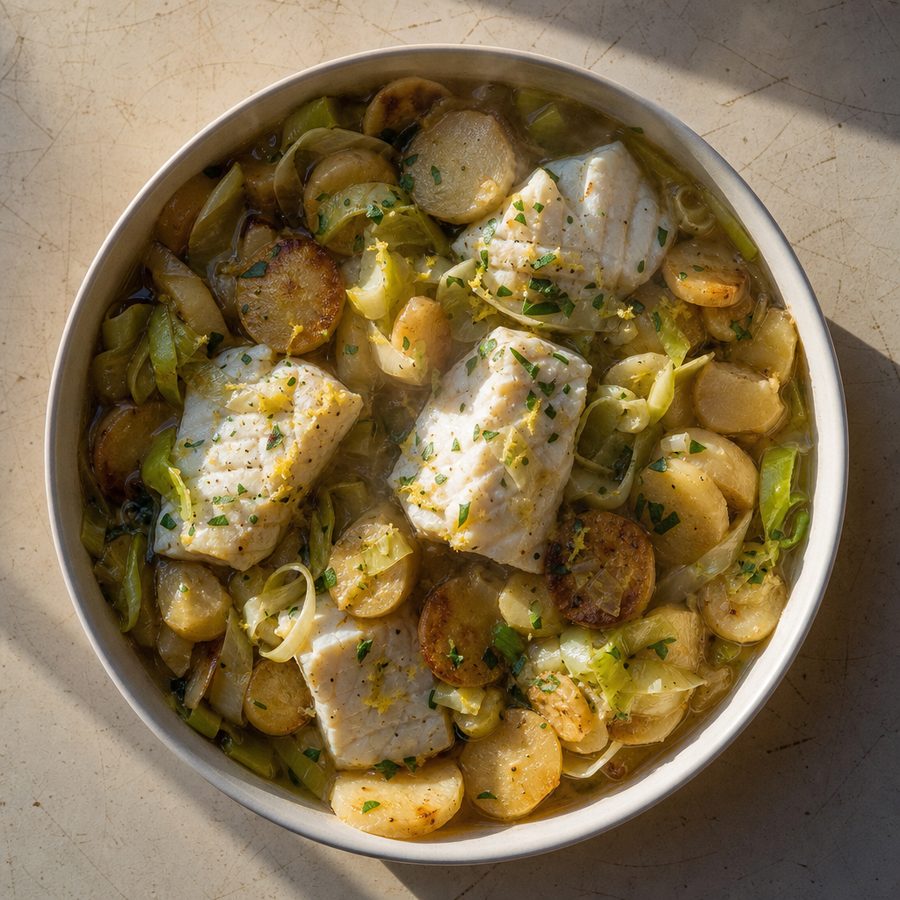
Thick halibut fillets steamed over slow-braised leeks and browned parsnip, finished with lemon and parsley for a savory breakfast that eats like a real meal.
Why You'll Love This Recipe
Third week of an elimination phase, patience for anything sweet gone, and what is wanted is a plate that looks like food a person would order. This is that plate. Halibut is a splurge fish, so this is a slow Saturday sort of morning, or the day after you bought a piece that was too good to walk past. It uses one skillet and about half an hour, most of which is the parsnip browning while you do something else in the kitchen. If your last several breakfasts have been fruit and coconut, this one will feel like the first proper meal in days.
The order of the pan matters more than any technique here. Parsnip goes in first, cut side down in hot oil, and then stays put until the faces are deep gold, because parsnip carries enough natural sugar to caramelize properly and turn nutty rather than merely soft. The leeks follow and slump into that same fat, and a splash of broth with the lid on turns them into something closer to a sauce than a vegetable. By the time the halibut goes on top the pan already tastes sweet and savory, so the fish has nothing to do but steam gently for eight minutes and pick up what is underneath it.
Halibut is dense and close-grained, which is why it stays in thick pieces when you break it apart and why it eats more like a piece of chicken than like a delicate white fish. That density is also why the plate holds you. There is a real amount of protein in a fillet this size, and the parsnip underneath brings enough fiber to keep the morning steady rather than sharp. Lemon and parsley go on at the very end, off the heat, where they stay bright instead of turning dull. It is a breakfast that ends and then stays ended, which is more than most of them manage.
Ingredients
- 4 halibut fillets, about 1 inch thick (1 1/2 lb total)
- 1 lb parsnips (about 4 medium), peeled and cut into 1/2-inch coins
- 2 large leeks, white and pale green parts only, halved and sliced
- 4 cloves garlic, thinly sliced
- 3 tbsp olive oil, divided
- 1 cup chicken broth
- 2 tbsp fresh lemon juice, plus zest of 1 lemon
- 3 tbsp chopped fresh parsley
- 1 tsp fresh thyme leaves
- 3/4 tsp fine sea salt, divided
Instructions
- Prep the vegetables: Peel the parsnips and cut them into half-inch coins, quartering any thick ends lengthwise so that every piece is roughly the same size. Halve the leeks lengthwise, fan the layers under cold running water to wash out the grit, since sand settles deep between the layers and will not rinse out once they are sliced, and slice them about a quarter inch thick.
- Brown the parsnip: Heat 2 tablespoons of the olive oil in a large skillet over medium-high until it shimmers. Add the parsnip in a single layer with a quarter teaspoon of the salt and leave it alone for 4 to 5 minutes, until the underside is deep gold, because parsnip only browns where it stays in steady contact with the pan. Turn the pieces and cook 4 minutes more.
- Braise the leeks: Lower the heat to medium, add the remaining tablespoon of oil, the leeks, the garlic, and the thyme, and cook for 3 minutes until the leeks slump and smell sweet. Pour in the broth and cover, since the leeks need liquid trapped under a lid to go silky rather than frying dry, and simmer for 6 to 8 minutes, until the leeks are silky and the parsnip gives easily to a knife.
- Steam the halibut: Pat the fillets dry and season them with the remaining salt. Set them on top of the vegetables, cover the pan, and steam over medium-low for 8 to 10 minutes, since gentle steam is what keeps halibut in thick sheets instead of drying it out. The fish is done when it turns opaque all the way through and the thickest part reads 130°F (54°C), or separates into thick sheets under gentle pressure.
- Finish and serve: Take the pan off the heat and let it sit, covered, for 2 minutes, so that the broth settles and the fish finishes on the heat already in the pan. Add the lemon juice and zest, scatter the parsley over everything, and taste the broth for salt. Serve each fillet with a spoonful of the leeks and broth from the bottom of the skillet.
Variations
- Fennel and lemon: Swap one leek for a sliced fennel bulb and braise it alongside for an anise note that suits the lemon.
- Root mix: Use half parsnip and half celeriac or turnip when you want the pan more savory and less sweet.
- Greens on top: Wilt a few handfuls of watercress or spinach into the broth in the last minute so there is something green under the fish.
- Coconut braise: Replace half the broth with canned coconut milk for a richer pan that clings to the parsnip.
- Smoked shortcut: Skip the fish step and fold flaked smoked trout through the hot vegetables off the heat for a breakfast that takes 15 minutes.
Storage & Leftovers
Leftovers keep in a sealed container in the refrigerator for up to 3 days. Store the fish on top of the vegetables rather than mixed through them, since halibut breaks down quickly once it is stirred and the pieces are the best part of the plate.
Reheat gently in a covered skillet over low heat with a spoonful of water or broth, about 4 minutes. A microwave drives the moisture out of halibut faster than almost any other fish and turns a good fillet chalky in under a minute, so the stovetop is worth the extra pan.
Freezing is not worth it here. Cooked halibut goes dry and cottony on thawing and the braised leeks turn to threads. If you want a head start, brown the parsnip and braise the leeks up to 2 days ahead and cook the fish fresh on the morning you want it.
Notes & Tips
- Buy the fillet thick: A 1-inch fillet steams evenly and stays juicy. Thin tail pieces go from raw to dry in about 90 seconds and there is no saving them.
- Wash the leeks properly: Grit hides between the layers and cannot be fixed once it is in the broth. Halve them lengthwise first, then fan the layers under cold water.
- Give the parsnip room: Stacked pieces steam and stay pale. Use the widest skillet you own or brown in two batches, which costs 5 minutes and changes the whole dish.
- Keep the lid on for the fish: The steam trapped under the lid is what cooks the top of the fillet. Lifting it to look every minute adds time and dries the surface.
- Use a thermometer once: Halibut is expensive enough to be worth checking. At 130°F (54°C) it is opaque and juicy, and by 145°F (63°C) it is firm and dry, which is a small window to guess at.
- Lemon off the heat: Acid added to a hot pan goes flat and slightly bitter. Off the burner it stays sharp, and you will reach for the salt less.
Nutrition & Mindful Eating
- Halibut, parsnip, and leek make a full plate between them. The fish brings the substance, the parsnip brings sweetness and fiber, and the leeks braised in broth pull the two together so nothing on the plate is eating alone.
- Halibut is firm and close-grained and holds together in thick white sheets, and it is one of the few foods that carries vitamin D naturally, which most of us get more of in summer than we do in February.
- Parsnip tastes sweeter than it is, and the fiber in it is part of why a plate built on a root vegetable sits so steadily through a morning rather than fading an hour after you eat.
- Leeks turn silky and mild as they braise, and they carry the kind of fiber your gut bacteria feed on. Cooking them this slowly is also what makes them gentle on stomachs that find raw onion difficult.
- Lemon zest and parsley go on at the last second for a reason. Both fade with heat, and both give you a lift of freshness that means the pan tastes finished with very little salt in it.
- As you eat, notice how the fish separates into sheets rather than flakes, and let the sweetness of the parsnip underneath slow you down enough to finish the plate sitting rather than standing.
Frequently Asked Questions
Can I use a cheaper fish?
Yes. Cod, haddock, and pollock all steam the same way at the same weight, though they are softer and will flake rather than hold in sheets. Keep the timing the same and check them a minute or two early, since a thinner fillet cooks faster than a thick halibut steak.
My parsnip burned before it cooked through. What went wrong?
The pan was too hot or the pieces were too big. Parsnip has more sugar than most roots, so it colors before it softens. Medium-high heat, half-inch coins, and the lid going on with the broth are what get the middles tender before the outsides go past gold.
Can I make this ahead for a weekday?
Brown the parsnip and braise the leeks the night before and refrigerate them in the pan you cooked them in. In the morning, reheat that base with a splash of broth, lay the fish on top, and you are eating in about 10 minutes. Cook the halibut fresh.
Does this work for an AIP elimination phase?
It does. There are no grains, legumes, dairy, eggs, nuts, seeds, or nightshades in it, and the seasoning is garlic, thyme, lemon, and salt rather than a spice blend. Leeks and garlic sit differently with different people, so go by your own tolerance for alliums.