
Halibut Skewers with Peppers, Bay, and Lemon Bulgur
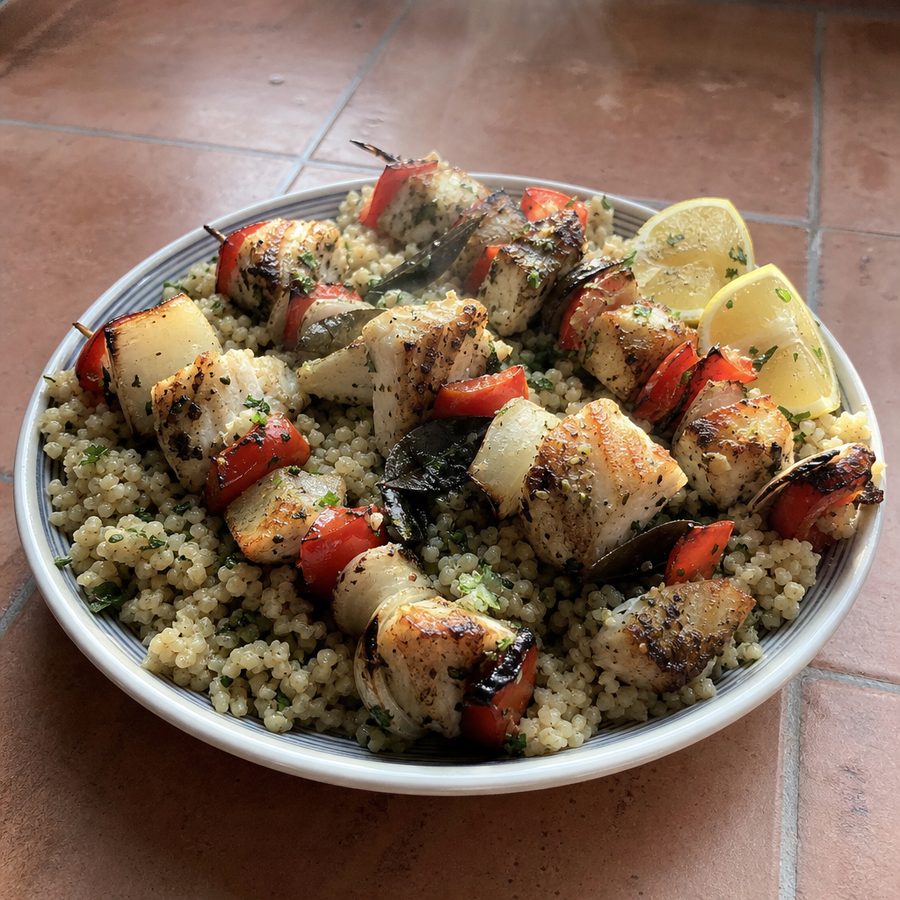
Cubes of halibut threaded with red pepper, onion, and bay leaves, broiled hard until the edges catch, and served over bulgur dressed with lemon, parsley, and mint.
Why You'll Love This Recipe
Fish on a skewer is a coastal habit worth stealing, and it solves a problem people run into with halibut, which is that a whole thick fillet is easy to overcook without noticing. Cut into cubes it cooks in six or seven minutes and you can see exactly what is happening on every side. I run these under the broiler because it is faster than heating a grill and works in February, and the bulgur soaks quietly on the counter while they cook. Start to finish this is under half an hour, and most of that is standing at the counter threading skewers, which is the kind of job you can hand to a child.
The bay leaves are not decoration. Tucked between the cubes they sit right against the hot metal, scorch a little, and release an oil that goes into the fish from both sides. It is the same idea as a bay leaf in a braise, except it happens in seven minutes rather than three hours. Halibut is the right fish for this because it is firm enough to stay on the stick, but any dense white fish works. The peppers and onion go on the same skewers so their juices run down over the fish as everything cooks, which is one more reason not to pack the pieces too tightly.
Underneath, the bulgur does more than fill the plate. It is dressed while still warm with lemon, olive oil, and grated garlic, then loaded with more parsley and mint than seems reasonable, so it eats somewhere between a grain and a salad. Spoon the juices off the foil over it and the whole plate comes together, since everything that ran out of the fish and the peppers ends up in the grain rather than down the drain. I make this when I want dinner to feel like an occasion without any of the work an occasion usually takes. It also holds at room temperature for an hour without suffering, which matters if people wander in at different times.
Ingredients
- 1 lb 7 oz skinless halibut, cut into 1 1/4-inch cubes
- 2 1/2 cups cooked fine bulgur, from about 1 cup dry
- 2 red bell peppers (about 9 oz), cut into 1 1/4-inch squares
- 1 1/4 cups cherry tomatoes (about 7 oz)
- 1 medium red onion, halved and cut into 1-inch petals, plus a few thin slices for the top
- 3 tbsp olive oil, divided
- 3 1/2 tbsp lemon juice, from 2 lemons, divided, plus wedges for the table
- 3 cloves garlic, grated
- 3/4 cup flat-leaf parsley, finely chopped
- 1/3 cup fresh mint leaves, torn
- 12 dried bay leaves, snapped in half if they are large
- 1 1/2 tsp sweet paprika
- 1 tsp dried oregano
- 3/4 tsp coarsely ground black pepper
- 1/3 tsp fine sea salt
Instructions
- Start the bulgur: Put 1 cup fine bulgur in a bowl with 1/4 tsp of the salt, pour over 1 1/2 cups boiling water, cover the bowl with a plate, and leave it alone. It will be tender and fluffy in about 12 minutes, which is exactly as long as everything else takes. If you are working from precooked bulgur, warm it through and skip to the dressing.
- Season the fish: Toss the halibut cubes with 2 tbsp of the olive oil, the paprika, the oregano, the black pepper, the remaining salt, and 1 1/2 tbsp of the lemon juice. Fold gently with your hands so the cubes stay square. Season it now and thread immediately, since a long soak in acid starts to firm the surface of the fish.
- Thread the skewers: Heat the broiler with a rack 5 inches beneath it and line a sheet pan with foil. Thread eight skewers, alternating halibut, pepper, onion petal, and a bay leaf, pushing the pieces close but not tight. Leave a little air between them or the sides that touch will steam. Tuck a cherry tomato onto each end.
- Broil hard, turn once: Set the skewers on the pan and broil for 4 minutes, until the corners of the fish and the pepper edges have blackened in spots. Turn them over and give them 3 to 4 minutes more, until the halibut is opaque through and flakes at a gentle press, around 130°F (54°C) at the center of a cube. Pull them the moment they get there, since cubes carry heat from every side and race past the FDA figure of 145°F (63°C) faster than a whole fillet would.
- Dress the bulgur: Fluff the bulgur with a fork and fold in the remaining olive oil and lemon juice, the grated garlic, the parsley, and most of the mint while it is still warm. Taste it. It should be sharp, since it is about to sit under fish.
- Serve off the pan: Spread the bulgur on a platter, lay the skewers across it, and pour every drop from the foil over the top. Scatter the thin onion slices and the rest of the mint, and put lemon wedges on the table. Discard the bay leaves as you eat around them.
Variations
- Yogurt marinade: Fold half a cup of thick yogurt into the seasoning before you thread, for a softer surface that browns in blotches.
- Zucchini on the skewer: Alternate half-moons of zucchini with the peppers so there is something that goes silky against the firm fish.
- Chile and garlic oil: Warm the last tablespoon of olive oil with a sliced garlic clove and a pinch of cayenne, then pour it over the skewers as they come off the pan.
- Chickpeas rather than bulgur: Dress two cans of drained chickpeas with the same lemon and herbs for a plate that needs no soaking at all.
- Walnut and pepper sauce: Blend a handful of walnuts with a roasted red pepper, lemon, and garlic, and spoon it under the skewers.
Storage & Leftovers
The bulgur keeps four days in a sealed container and only gets better, since the lemon and olive oil work their way through the grain overnight. Add the fresh herbs again before serving the leftovers, because the first batch will have gone dark and lost its lift by the second day.
Cooked halibut keeps two days. Slide the cubes off the skewers before you store them, and keep them separate from the bulgur so they do not sit in acid. Eat them cold over the grain with more lemon, which is genuinely how I prefer the leftovers.
Freezing is not worth it here. Halibut that has been cooked and frozen comes back dry and cottony, and the peppers collapse. The one thing that does keep is the dressed bulgur, which freezes in flat portions for two months and thaws into a good base for whatever you cook next.
Notes & Tips
- Cut the cubes big: An inch and a quarter is the size that survives the broiler. Smaller pieces dry out before the outside has a chance to color.
- Do not pack the skewer: Pieces pressed hard against each other steam where they touch. A few millimeters of air between them is what gives you browned faces all the way around.
- Snap the bay leaves: Breaking each leaf before it goes on opens the cut edge to the heat, and that is where the perfume comes from. Whole flat leaves give up much less.
- Dress the bulgur warm: Warm grain pulls the lemon and olive oil into itself. Wait until it cools and the same dressing will only coat the outside.
- Line the pan with foil: Half the flavor ends up as juice on the sheet pan, and foil lets you pour all of it over the bulgur rather than scrubbing it off.
- Season the fish last: Salt and lemon sitting on halibut for twenty minutes start to cure the surface. Mix, thread, and broil in one continuous run.
Nutrition & Mindful Eating
- Fish, grain, and vegetables come off the same pan in sensible proportion here. The halibut carries the protein, the bulgur gives the plate its bulk and its chew, and the peppers, onion, and tomatoes cook down into something sweet that runs into the grain.
- Halibut is a firm, close-grained white fish with a mild flavor and a lot of protein for its weight, and it brings selenium and magnesium along with it. Its low fat content is also why it wants a hot fast cook and a quick exit.
- Bulgur is cracked whole wheat that has already been parboiled, so it needs nothing more than hot water and a covered bowl, and the bran that makes it a whole grain is where its fiber comes from.
- Red bell peppers turn sweet and slack under a broiler while their color deepens, and they carry more vitamin C than most people expect from something that is not citrus, along with the carotenoids that make them red in the first place.
- Parsley and mint go into the bulgur by the handful rather than the pinch, which is what makes it taste like a salad as much as a grain. Bay scorching on the skewer is the other half of the smell, and lemon squeezed at the table pulls all of it forward.
- As you eat, pull a cube off the skewer and notice the bay in it before you reach the fish, then let the herby bulgur underneath slow you down between mouthfuls.
Frequently Asked Questions
What other fish holds up on a skewer?
Swordfish is the traditional choice on the Aegean coast and is the sturdiest of all. Monkfish, cod loin, and mahi mahi all work, and salmon is excellent though it cooks a minute faster. Avoid thin flaky fillets like sole or tilapia, which fall apart the moment you turn them.
Do I need to soak wooden skewers?
Yes, twenty minutes in water, and it is the one step worth planning ahead. Under a broiler an unsoaked skewer will scorch and can snap when you turn it. Flat metal skewers solve the problem permanently and stop the cubes from spinning.
Can I cook these on a grill or a grill pan?
Both work well. A charcoal grill is the best version of this recipe by some distance. On a ridged grill pan, get it very hot, oil the ridges, and turn the skewers a quarter turn every two minutes so all four sides mark.
How do I know when halibut is done?
The cubes turn from glassy to solid white and a corner flakes when you press it with a fingernail. Halibut has very little fat to protect it, so it goes from perfect to chalky in about ninety seconds. Pull the pan when the center of the biggest cube still looks barely translucent.