
Hard-Roasted Beets and Turnips with Duck Breast
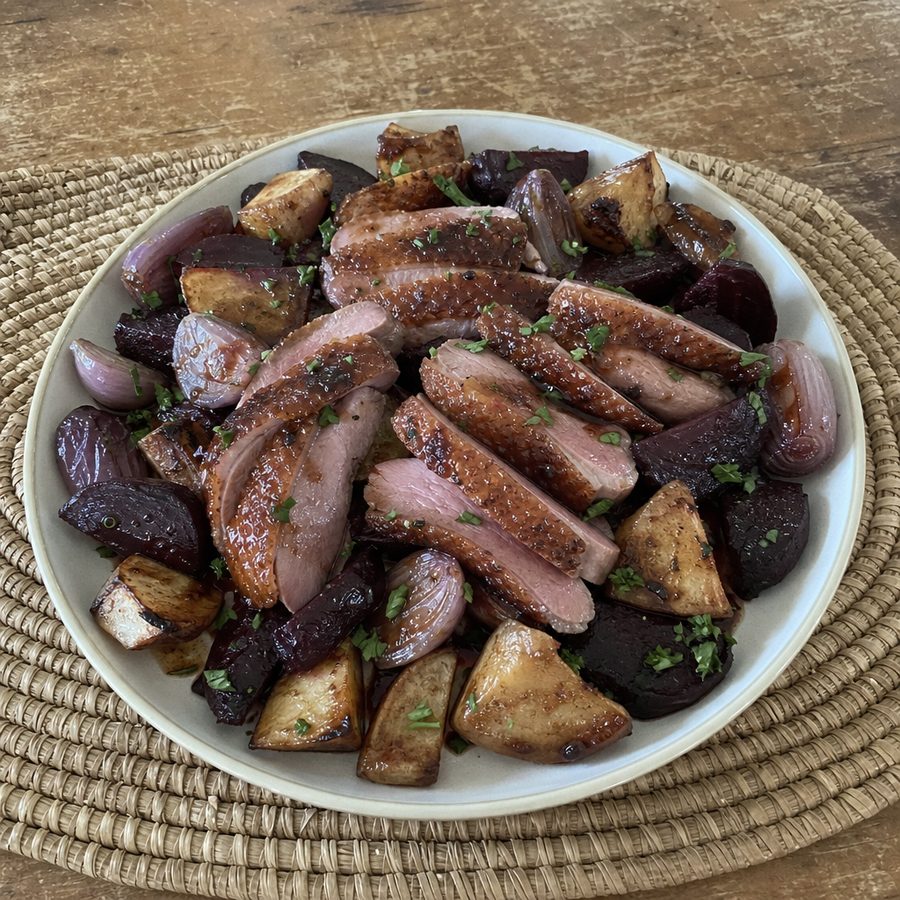
Beets and turnips roasted at high heat until their edges shrink and caramelize, with sliced duck breast rendered crisp in a skillet and an orange and balsamic glaze poured over.
Why You'll Love This Recipe
Roasting beets in foil is what most of us were taught, and it gives you a soft, wet, faintly earthy vegetable that needs a sauce to be interesting. Cut them into wedges instead, throw them onto a hot pan with oil and salt, and leave them alone until the edges go almost black, and you get something else entirely: chewy at the corners, sweet the way a roasted plum is sweet, with none of the muddy flavor people say they dislike. Turnips go on the same pan because they stay sharp and peppery in the middle, which keeps all that sweetness in check. This is a dinner I make in November, when the root bins are full and I want the oven on for an hour.
The duck is easier than it looks and it is the reason this is a dinner rather than a side. The breasts start skin side down in a cold, dry skillet over medium-low heat, and over 12 or so minutes the fat renders out slowly and the skin turns to a thin crisp sheet. Rushing that with a hot pan is the mistake, because the skin seizes and the fat stays under it in a soft layer. Pour off the rendered fat as it collects, keep it for another day, and once the skin is done the meat needs only a few minutes on the other side to reach medium-rare.
The glaze takes two minutes and uses the same skillet. Orange juice and balsamic go into the hot pan, they lift the browned bits and cook down into a few glossy spoonfuls, and that goes over the roots rather than over the meat. Two breasts sliced thin across four people looks modest on the board and eats like plenty, because the pan of roots underneath is doing the heavy work. Any leftovers turn into an excellent cold plate: the beets are better the next day and the duck is very good straight from the refrigerator with a little of the parsley.
Ingredients
- 1 1/2 lb beets (about 5 medium), peeled and cut into 1-inch wedges
- 1 lb turnips (about 4 medium), peeled and quartered
- 2 large boneless duck breasts with skin (about 1 1/3 lb total)
- 4 shallots, peeled and halved lengthwise
- 2 tbsp olive oil
- 1 orange, zested and juiced
- 2 tbsp balsamic vinegar
- 4 cloves garlic, smashed
- 1 tbsp fresh thyme leaves
- 1/4 cup chopped fresh parsley
- 1 1/2 tsp fine sea salt, divided
Instructions
- Heat the pan and cut the roots: Put a large heavy roasting pan or a rimmed baking pan into the oven and heat both to 450°F (230°C). Peel the beets and cut them into 1-inch wedges, peel the turnips and quarter them, and halve the shallots lengthwise through the root so the layers hold together.
- Roast the vegetables hard: Toss the beets, turnips, shallots, and garlic with the olive oil, the thyme, and 1 teaspoon of the salt. Spread them on the hot pan in a single layer, listening for the sizzle, which is the sound of the cut faces searing on contact rather than slowly sweating, and roast for 35 to 40 minutes, turning once at the halfway point, until the edges are dark and shrunken and a knife slides through a beet wedge easily.
- Render the duck skin: While the roots roast, score the duck skin in a crosshatch about a quarter inch apart, cutting through the fat but not into the meat, and season both sides with the remaining salt. Lay the breasts skin side down in a cold dry skillet and set it over medium-low heat, because fat only renders out slowly, and a hot pan would seize the skin shut before it ever gave anything up, and cook for 12 to 15 minutes, pouring off the fat two or three times as it collects, until the skin is thin, deep gold, and crisp.
- Finish the meat: Turn the breasts and cook for 3 to 5 minutes on the flesh side, until the thickest part reads 135°F (57°C) for medium-rare. Move them to a board skin side up and rest for 10 minutes, since the juices need that time to settle back into the meat instead of running out onto the board. Duck is a red meat and is meant to be pink in the middle.
- Make the glaze: Pour all but a thin film of fat out of the skillet, so that the glaze reduces to something glossy rather than splitting into a slick, set it over medium heat, and add the orange juice and balsamic vinegar. Scrape the browned bits up and simmer for 2 to 3 minutes, until the liquid is glossy and has reduced to a few spoonfuls.
- Serve: Slice the duck across the grain about a quarter inch thick, since cutting with the grain leaves long fibers that eat tough no matter how well the breast was cooked. Tip the roasted roots onto a platter, lay the slices over them with any juices from the board, spoon the glaze over the vegetables, and finish with the orange zest and the parsley.
Variations
- Add carrots: A half pound of thick carrot batons roasts in the same time and gives the pan a third color and a softer sweetness.
- Rosemary rather than thyme: A tablespoon of chopped rosemary on the roots is more assertive and stands up better to the balsamic.
- Peppery finish: Scatter watercress or arugula over the hot pan just before the duck goes on so it wilts slightly under the slices.
- Cherry glaze: Simmer a handful of pitted cherries into the orange and balsamic until they collapse for a darker, fruitier sauce.
- Duck fat roast: Save the rendered fat from the skillet and use it in place of the olive oil the next time you roast the roots.
Storage & Leftovers
Leftovers keep for up to 4 days in the refrigerator. Store the duck and the roots separately, because the beets will stain the meat magenta overnight, and lay the duck slices flat rather than piling them so the crisp skin has a chance of staying crisp.
The roots reheat well in a 425°F (220°C) oven for 8 to 10 minutes, which brings the edges back. I would not reheat the duck at all. Sliced cold over the warm vegetables with a little parsley it makes a very good second dinner, and gentle heat turns it gray and firm.
Roasted beets and turnips freeze acceptably for up to 2 months, though they come back softer and lose the chewy edges that make this dish what it is. If you are freezing anything, freeze the duck, tightly wrapped, and roast a fresh pan of roots to go under it.
Notes & Tips
- Preheat the pan itself: Cold metal steams the cut faces before they can brown. Roots hitting a hot pan sear on contact, and you should hear it happen.
- Give them space: Two pans are better than one crowded one. Piled vegetables release steam and go soft rather than caramelizing at the edges.
- Score only the fat: Cut through the skin and fat but stop before the meat. Cutting into the flesh lets the juices run out during the long render.
- Start the duck in a cold pan: This is the single thing that separates crisp duck skin from chewy duck skin. Cold pan, medium-low heat, and patience.
- Keep the rendered fat: Strain it into a jar and refrigerate it for up to a month. It is the best fat in the kitchen for roasting vegetables.
- Wear an apron: Beet juice at this heat gets everywhere. Cut them last, on a board you do not mind staining, and rinse the board immediately.
Nutrition & Mindful Eating
- The roasted roots, the duck, and the glaze are balanced against each other on purpose. The beets bring sweetness and bulk, the turnips keep that sweetness from taking over, and the duck sliced across the top brings the protein and the fat that make it hold together as a dinner.
- Beets roasted at high heat concentrate rather than soften, and the deep red betalain pigments that stain your fingers are part of what they carry along with folate and fiber. Roasting rather than boiling also keeps that color in the vegetable rather than in the cooking water.
- Turnips stay slightly peppery in the middle even after 40 minutes in a hot oven, which is exactly what a pan of sweet beets needs. They are a cruciferous root, in the same family as cabbage and broccoli, and they bring vitamin C along with a good amount of fiber.
- Duck breast is a dark, close-grained meat that eats richer than chicken, and it carries iron, zinc, and B vitamins in a form your body takes up easily. Rendering the skin slowly draws most of the fat out into the pan, so what reaches the plate is meat with a thin crisp layer on top.
- Orange juice and balsamic reduced in the duck pan make a few spoonfuls of glaze that go over the vegetables, and the zest goes on raw at the very end because the aromatic oils in it fade fast under heat. That sharp citrus against sweet beets is what keeps the plate from going flat.
- As you eat, notice the chewy caramelized corner of a beet wedge against the soft center, and let a dish this bright on the plate be a reason to look at your food before you start on it.
Frequently Asked Questions
Can I use chicken rather than duck?
Bone-in chicken thighs are the closest thing. Roast them skin side up on a separate pan at 450°F (230°C) for 35 minutes so the skin crisps, then make the glaze in a skillet with a spoonful of the chicken fat. The dish loses some richness and stays very good.
My duck skin was flabby underneath. What happened?
The pan was hot when the duck went in. Starting cold and going slowly is what pulls the fat out from under the skin, and it takes longer than feels right. Score the fat properly as well, since unscored skin traps the fat rather than releasing it.
Can I roast the vegetables ahead?
Yes, and this is how I handle company. Roast them up to 4 hours ahead, leave them on the pan at room temperature, and give them 8 minutes in a 450°F (230°C) oven while the duck rests. Cook the duck and the glaze at the last minute.
Is this appropriate for an AIP elimination phase?
It is. Beets, turnips, shallots, garlic, orange, and herbs are all in play, the fat is olive oil and rendered duck fat, and there is no nightshade, dairy, grain, or seed anywhere in it. Check that your balsamic vinegar lists nothing but grapes.