
Hard-Roasted Roots with Whipped Feta and Seed Crunch
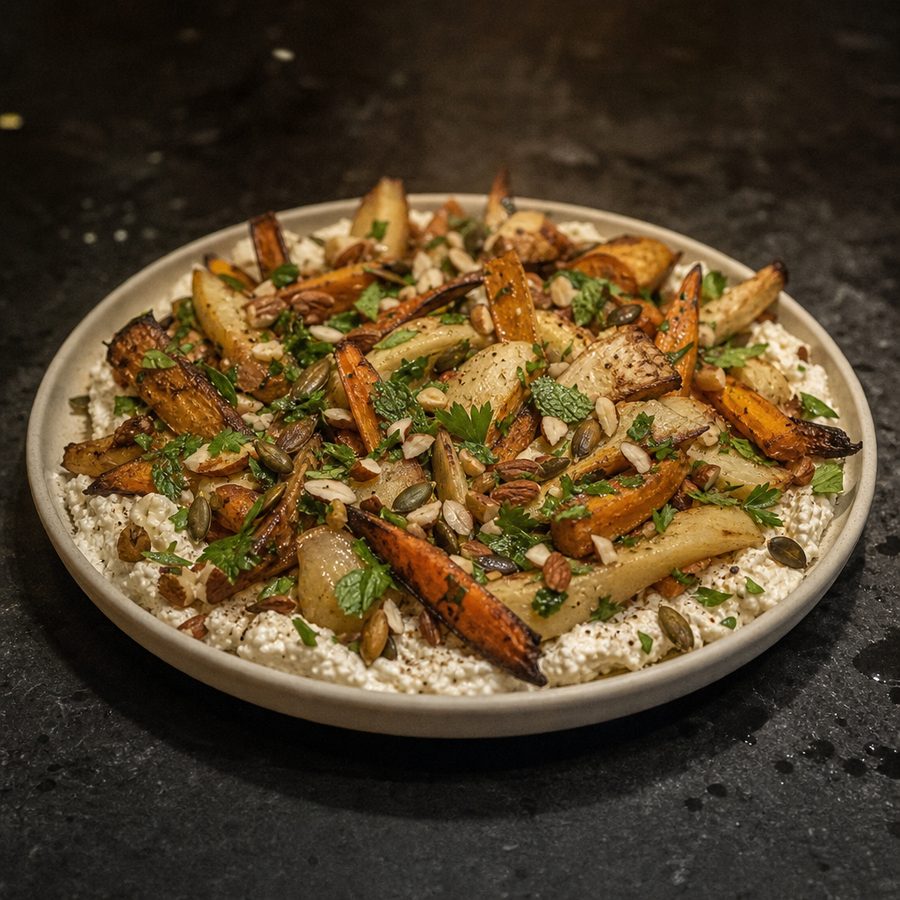
Carrots, parsnips, and turnips roasted until the cut edges go dark and sweet, piled over whipped feta and finished with toasted pumpkin seeds, almonds, and herbs.
Why You'll Love This Recipe
A vegetable drawer full of roots can look like a real meal rather than a side dish that lost its way, and this is how. It is a Tuesday in November, the oven is on anyway, and forty-five minutes later there is a platter on the table that people reach across each other for. The whipped feta is what turns it into dinner. It goes down first, cold and thick, and the vegetables go on hot straight from the pan, so the two meet somewhere in the middle and the edges of the feta go soft. I have served this to people who eat meat at every meal and nobody asked where the chicken was.
High heat and room on the pan are the entire technique. Roots hold a lot of water, and if you crowd them they steam, stay pale, and never get the chance to caramelize at the cut faces, which is where all the sweetness in this dish lives. Two sheet pans, a hot oven, and one turn partway through is what gets you those blistered dark edges. The cumin and crushed coriander go on raw with the oil so they toast as the vegetables roast, and a spoonful of maple syrup added near the end lacquers the outsides. Garlic-infused olive oil does the savory work underneath all of it, which is why the tray tastes seasoned rather than merely sweet.
Whipped feta takes two minutes in a food processor and changes what this meal is. Feta and skyr go from crumbly to glossy with a little lemon juice and oil, and the result is thick enough to hold a spoonful of hot vegetables without sliding around the plate. That is where most of the protein comes from, along with the pumpkin seeds and almonds toasted in a dry skillet until they smell nutty. Cold and creamy underneath, hot and sweet on top, something crunchy over all of it, and a lot of herbs. Leftovers get folded together into a bowl the next day and still taste like they were made on purpose.
Ingredients
- 1 lb carrots (about 6 medium), peeled and halved lengthwise
- 1 lb parsnips, peeled, halved lengthwise, thick ends quartered
- 1 lb turnips (about 3 medium), peeled and cut into 1-inch wedges
- 3 tbsp garlic-infused olive oil, divided
- 2 tsp ground cumin
- 2 tsp coriander seeds, lightly crushed
- 1 tbsp maple syrup
- 8 oz feta, drained and broken into chunks
- 1 cup plain skyr
- 2 tbsp fresh lemon juice, plus the zest of 1 lemon
- 1/2 cup pumpkin seeds
- 1/3 cup raw almonds, roughly chopped
- 1/4 cup chopped fresh parsley
- 2 tbsp chopped fresh mint
- 1 tsp fine sea salt, divided
- 1/2 tsp black pepper
Instructions
- Heat the oven and cut the vegetables: Heat the oven to 425°F (220°C) and set two racks in the upper and lower thirds. Peel the carrots and parsnips and halve them the long way, quartering any thick parsnip ends so that every piece is about a finger thick and everything on the pan finishes together. Peel the turnips and cut them into 1-inch wedges.
- Season and spread out: Toss the vegetables with 2 tablespoons of the garlic-infused olive oil, the cumin, the crushed coriander, 3/4 teaspoon of the salt, and the black pepper. Divide between two sheet pans and spread them into a single layer with space between the pieces, because a crowded pan traps the water coming off the vegetables and they steam and stay pale.
- Roast hard: Roast for 35 to 45 minutes, swapping the pans between racks and turning the vegetables once at the halfway mark. They are ready when the cut faces are deep brown in patches and a knife slides through a turnip with no resistance. Drizzle the maple syrup over both pans and give them 4 more minutes, since syrup added at the start would be black long before a turnip went tender.
- Whip the feta: While the vegetables roast, put the feta, skyr, lemon juice, and the last tablespoon of oil in a food processor and run it for a full 2 minutes, scraping down once, because feta breaks down in stages and anything shorter leaves it grainy. It will look grainy at first and then turn glossy and thick, like a soft frosting. Taste, and add lemon zest to sharpen it.
- Toast the seed crunch: Toast the pumpkin seeds and almonds in a dry skillet over medium heat for 4 to 5 minutes, shaking often, until the pumpkin seeds start to pop and the almonds smell nutty. Take them off the heat and out of the pan, since the metal holds enough heat to carry almonds from nutty to burnt in under a minute, then stir in the remaining 1/4 teaspoon salt and the rest of the lemon zest, and let them cool a little.
- Build the platter: Spread the whipped feta over a wide platter in a thick layer with the back of a spoon. Pile the hot vegetables on top so some of the feta still shows at the edges, scatter the seeds and nuts over everything, then the parsley and mint. Serve straight away, so that the vegetables are still hot against the cold feta, which is the whole point of the platter.
Variations
- Warm spice: Trade the coriander for a teaspoon of cinnamon and a pinch of cayenne when you want the tray closer to a tagine.
- Goat cheese base: Whip goat cheese in place of half the feta for a tangier, softer base that spreads more thinly.
- Herb oil finish: Blend parsley and mint with olive oil and lemon and spoon it over the top so the platter reads green as well as gold.
- Add a grain: Spoon the whole thing over warm quinoa or millet when you want the meal to stretch to six.
- Roast in wedges: Cut the carrots and parsnips into thick coins rather than batons for more surface area and a chewier, sweeter result.
Storage & Leftovers
Store the vegetables and the whipped feta in separate containers in the refrigerator for up to 4 days. Kept apart, the roots stay firm at the edges and the feta stays thick. Once they sit together overnight the vegetables give up water and the feta loosens into something closer to a dressing.
Reheat the vegetables on a sheet pan at 425°F (220°C) for 8 to 10 minutes rather than in the microwave, which softens the caramelized faces you worked for. Take the feta out while the oven heats so it loses its chill. Add the seeds and herbs fresh, since both go limp on a second day.
The roasted vegetables freeze for up to 2 months and come back best roasted from frozen at 450°F (230°C) for about 15 minutes. Do not freeze the whipped feta, since skyr splits on thawing and the texture goes chalky and grainy in a way that no amount of beating will fix.
Notes & Tips
- Use garlic-infused oil on purpose: The flavor of garlic is fat-soluble and the parts that upset sensitive guts are not, so the oil carries the taste and leaves the rest behind. It is the single most useful bottle in this kind of cooking.
- Cut for surface, not for looks: Flat cut faces brown, round sides do not. Halve everything the long way and lay the flat side down on the pan.
- Salt the vegetables, not the feta: Feta is already salty and skyr carries it further. Season the tray properly and taste the whipped base before you add anything to it.
- Give the processor the full two minutes: Feta goes through a grainy stage that looks like it has failed. Keep it running and it turns glossy without warning.
- Reheat in the oven: Leftovers come back well on a hot sheet pan for 8 to 10 minutes. A microwave turns the dark edges soft and the plate loses the thing that made it good.
- Feeding the rest of the table: Roast a few chicken thighs on a third pan at the same temperature for anyone who wants meat with dinner, and set out olives and lemon wedges so people can build their own plate.
Nutrition & Mindful Eating
- Roasted roots, whipped feta, and toasted seeds each do a different job here. The vegetables bring the sweetness and the fiber, the cheese and skyr bring the salt and the protein, and the seeds keep a soft plate from eating all one way.
- Carrots roasted until the edges blacken taste closer to candy than to anything raw, and that deep orange running through them is where the beta-carotene comes from.
- Parsnips carry more natural sugar than most roots, which is why they caramelize so readily, and they bring a soft fiber that makes a vegetable dinner sit steadily rather than fading an hour later.
- Feta whipped with skyr goes thick and tangy, and between them they hold the calcium and most of the protein on this plate. The skyr keeps it spoonable while the feta does the seasoning.
- Pumpkin seeds and almonds toasted in a dry pan give the magnesium and the fat that make this feel like a full meal, and the crunch is what you notice first every time.
- As you eat, notice how the cold feta and the hot vegetables change each other on the way to your mouth, and take the platter slowly enough that the crunch of the seeds still registers on the last bite.
Frequently Asked Questions
Can I use different root vegetables?
Yes. Rutabaga, kohlrabi, and celeriac all roast at the same temperature, though rutabaga takes about 10 minutes longer and wants slightly smaller pieces. Keep the total weight about the same and cut everything to a similar thickness so the pan finishes at one time.
My vegetables came out soft and pale rather than browned. What went wrong?
Almost always crowding. Roots release a lot of steam, and if the pieces touch, that steam has nowhere to go and the sugars never concentrate. Use two pans even when one looks like it might do, and resist turning them more than once.
Can I make any of it ahead?
The whipped feta holds for 4 days and is better on day two, so make it in advance. The seed crunch keeps for a week in a jar at room temperature. Roast the vegetables the same evening if you can, since that is the part that fades.
Is this really enough for dinner?
It is. There is a pound each of three vegetables here and close to a pound of cheese and skyr between four people, so it eats like a main course rather than a starter. It also fits a low-FODMAP pattern, using garlic-infused oil for savoriness and firm cheese in a portion that sits well.