
Mackerel with Roasted Parsnips, Turnips, and Watercress
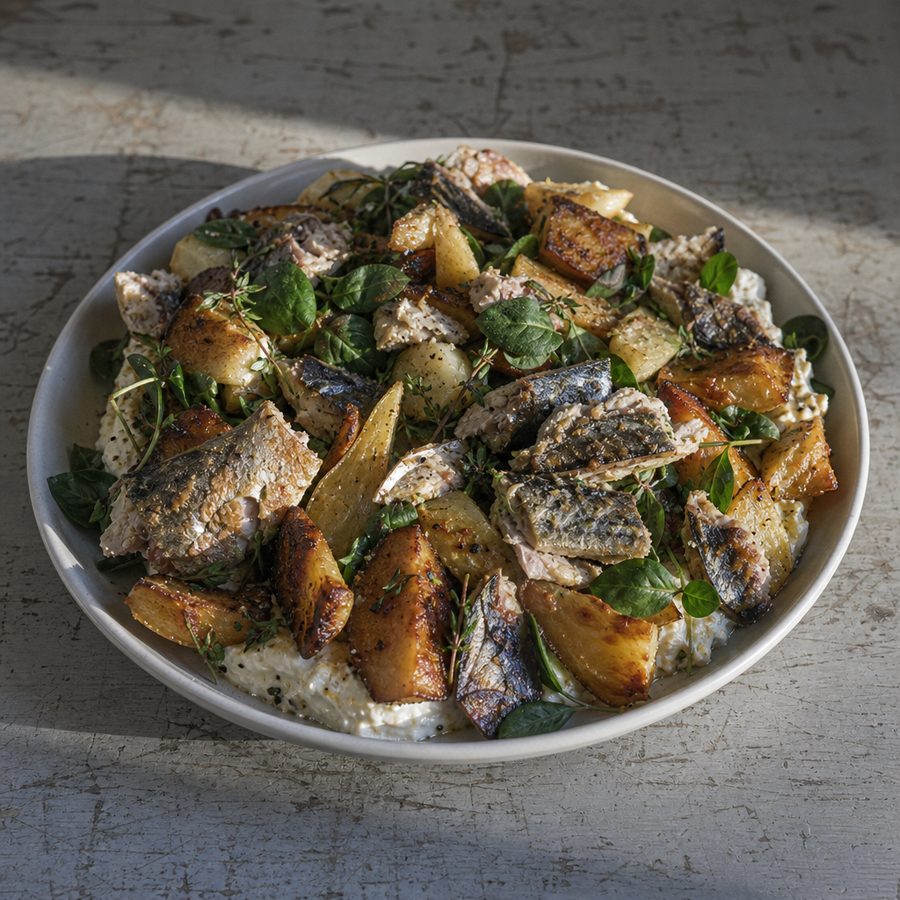
Parsnips and turnips roasted until the cut edges caramelize, tumbled with cold peppery watercress over a lemon and thyme ricotta, with broiled mackerel broken over the top.
Why You'll Love This Recipe
This is a winter plate that I put together the first year I got serious about root vegetables, and it has stayed on the January rotation ever since. Parsnips are the reason: cut into batons and given a very hot tray, they go sweeter than any other vegetable I cook, with dark toffee-colored edges and a soft middle. Turnips roasted alongside them stay watery and sharp, which is exactly the contrast the plate needs, and the leeks fall apart into sweet strands somewhere between the two. The fish goes under the broiler for six minutes at the very end.
Eating it is a study in temperature and richness. There is warm and cold on the same fork, since the watercress goes on off the heat and only the leaves touching hot vegetables collapse. The ricotta smeared underneath turns loose where the tray juices reach it and stays cool and thick at the edges of the platter. And mackerel is a strongly flavored, oily fish, so a small amount of it seasons the whole plate rather than sitting on it, especially with lemon zest and mustard in the mix to cut across all that.
I cook this when the vegetable drawer is full of things nobody is excited about, which is most of February. It also happens to be a good dish to put in the middle of a table, since everything sits on one platter and people help themselves. If mackerel is too assertive for the people you feed, a fillet of trout does the same job more gently, and the roots and the ricotta are the part I would never change.
Ingredients
- 2 mackerel fillets (about 6 oz total)
- 4 medium parsnips (about 12 oz), peeled, cored if woody, and cut into 2-inch batons
- 4 small turnips (about 10 oz), scrubbed and cut into wedges
- 2 leeks, white and pale green parts only, cut into 1-inch lengths
- 4 packed cups watercress, thick stems trimmed
- 1/2 cup ricotta
- 5 garlic cloves, left whole in their skins
- 2 1/2 tbsp olive oil, divided
- 1 lemon, zested and juiced
- 2 tsp dijon mustard
- 6 sprigs fresh thyme, leaves stripped
- 1/2 tsp coarsely ground black pepper
- 1/4 tsp fine sea salt
Instructions
- Heat the oven properly hot: Heat the oven to 425°F with a large rimmed sheet pan inside it. A hot pan is what starts the caramelizing on contact, and vegetables laid on a cold tray sweat for the first ten minutes before they ever begin to brown.
- Toss and roast the roots: Toss the parsnip batons, turnip wedges, leeks, and whole garlic cloves with 2 tbsp of the olive oil, the black pepper, and half the salt. Pull the hot pan out, tip everything onto it in a single layer with the cut faces down, and listen for the sizzle. Roast for twenty five minutes without touching it.
- Turn and finish the roasting: Turn the vegetables with a spatula, scraping up anything stuck, and scatter the thyme leaves over them. Roast ten to fifteen minutes more, until the parsnips are deep brown at the tips and give completely when pressed and the turnips are tender with a little resistance left in the middle. Squeeze the soft garlic out of its skins and stir it back through.
- Make the lemon ricotta: While the vegetables roast, stir the ricotta with the lemon zest, 1 tbsp of the lemon juice, and a grind of pepper until it loosens and turns spreadable. Spread it across the bottom of a large platter in a thick, uneven layer and leave it at room temperature so it does not seize when the hot vegetables land.
- Broil the mackerel: Move an oven rack to the top position and turn on the broiler. Pat the mackerel dry, rub it with the last half tablespoon of oil and the rest of the salt, and set it skin side up on a foil-lined pan. Broil for five to seven minutes without turning, until the skin blisters and darkens in patches and the flesh at the thick end turns from glassy to opaque.
- Build the platter: Whisk the dijon with the remaining lemon juice and spoon it over the hot roasted vegetables in the pan, tossing once. Tumble them over the ricotta, scatter the watercress through while everything is still hot so it half wilts, and break the mackerel into large pieces over the top. Serve straight away.
Variations
- Celeriac and carrot: Swap the turnips for chunks of celeriac and a couple of thick carrots, which roast in the same time and make the platter earthier.
- Trout: Use a trout fillet in place of the mackerel for a gentler, sweeter fish that broils in about the same time.
- Warm spice: Toss the roots with a teaspoon of cracked coriander seed before roasting for a citrusy note that suits the parsnips.
- Herbed ricotta: Fold chopped dill and chives into the ricotta along with the lemon for a greener, fresher base under the vegetables.
Storage & Leftovers
The roasted vegetables keep four days in a sealed container in the refrigerator and are one of the more useful leftovers there is. Store the ricotta, the watercress, and the fish separately, because the greens collapse and the ricotta goes watery once it sits against warm vegetables overnight.
Reheat the roots in a dry skillet over medium-high for four or five minutes, spread flat and left alone for the first two so the caramelized faces come back. An oven at 400°F for ten minutes works too. The microwave softens them into something closer to a mash, which is fine but is not this dish.
The roasted vegetables freeze for two months in flat sealed portions, though they lose some of their edge. Thaw overnight and reheat on a hot tray rather than in a pan. Cooked mackerel does not freeze well, so plan on broiling that fresh.
Notes & Tips
- Preheat the sheet pan: Vegetables that hit hot metal start browning immediately. The same vegetables on a cold pan release water first and steam themselves, and no amount of extra time in the oven undoes that.
- Cut faces down, and give them room: Every flat surface touching the pan is a surface that caramelizes. Crowd the tray and you get pale, soft roots, so use two pans if you have to.
- Roast the garlic in its skin: Peeled cloves burn to bitterness in a 425°F oven. Left whole in the papery skin they steam into something sweet and spreadable that you squeeze back into the vegetables at the end.
- Watch the broiler the whole time: Mackerel goes from blistered to burnt in under a minute. Stand at the oven door and pull it the moment the skin darkens in patches.
- Let the ricotta come to room temperature: Cold ricotta straight from the refrigerator seizes into a stiff white layer under hot vegetables. Sat on the counter for twenty minutes and loosened with lemon, it goes soft and melts a little where the heat lands.
Nutrition & Mindful Eating
- The roots, the greens, and the fish each do something the others cannot. Parsnips and turnips bring fiber and enough sweetness to make the platter satisfying, the watercress adds a sharp raw note and a good deal of calcium for a leaf, and a small amount of mackerel gives the whole plate its richness.
- Parsnips are sweeter than any other root once they have been through a hot oven, because roasting concentrates their sugars, and they carry a generous amount of soluble fiber along with vitamin C and folate.
- Mackerel is an oily fish with more omega-3 fat than almost anything else at the counter, and it is one of the few foods that supplies vitamin D in real quantity. Its strong flavor is the reason a small amount is enough to season a platter this size.
- Ricotta is soft, mild, and slightly sweet, and it brings calcium and protein to a plate built mostly on vegetables. Loosened with lemon juice and zest, it turns into a sauce without any cooking at all.
- Watercress has the peppery bite of the mustard family and gives it up the moment it hits heat, which is why it goes on last. Along with the dijon and the lemon, it is what keeps a platter of sweet roasted roots from tipping over into cloying.
- As you eat, look for the dark toffee-colored tips on the parsnips and the places where the ricotta has gone loose against them, and notice how much a small amount of a rich fish changes the whole plate.
Frequently Asked Questions
Do I need to core the parsnips?
Only the big ones. A parsnip thicker than about two inches at the shoulder usually has a woody core that stays fibrous no matter how long it roasts. Quarter it lengthwise and cut the pale center out with a paring knife. Small parsnips need nothing.
My mackerel smelled very strong. Was it off?
Mackerel is an oily fish and it always smells more assertive than white fish, but it should smell of the sea rather than sour or sharp. Buy it the day you cook it if you can, look for bright clear eyes on whole fish and firm flesh on fillets, and if in doubt ask the counter when it came in.
Can I use something other than watercress?
Arugula is the closest match and has the same pepper. Baby mustard greens work too. What you want is a green sharp enough to stand against a sweet roasted parsnip, so a mild lettuce will be lost here.
Can the vegetables be roasted ahead?
Yes, and I often do. Roast them up to two days early, keep them refrigerated, and crisp them back on a hot tray for ten minutes while the broiler heats. Make the ricotta and broil the fish fresh and the plate tastes made to order.