
Maple-Mustard Pork Tenderloin with Roasted Rutabaga and Carrots
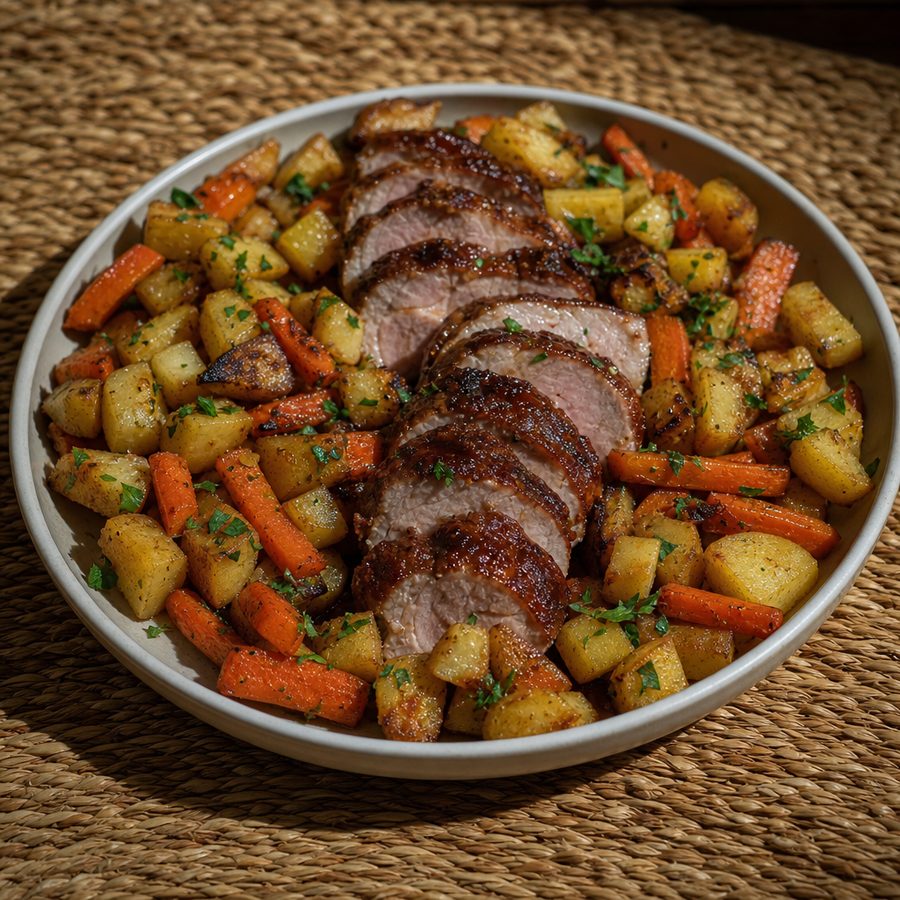
Pork tenderloin roasted on one sheet pan with rutabaga and carrots, brushed with a mustard and maple glaze, and finished with rosemary and parsley.
Why You'll Love This Recipe
Monday and Tuesday get handled before they start, on a Sunday, in one hot oven. Two tenderloins and a tray of roots go into a hot oven, and thirty-five minutes later there is enough for four plates that reheat without turning sad. Pork tenderloin is the cut I recommend to people who tell me they do not much like pork, because it is fine-grained and mild and it cooks fast enough to belong on a weeknight. The kitchen ends up smelling like rosemary and browning sugar from the rutabaga, which is not what most people expect from a root vegetable they have only ever seen mashed.
The order matters, and it is the part people get wrong. The rutabaga and carrots go in first, alone, for fifteen minutes, because they need longer than the pork does and because a crowded pan steams everything into pallor. Sear the tenderloins hard in a skillet while that happens, all four sides, until the outside is properly brown. That crust is where the savory depth in this dish lives and there is no shortcut to it. The glaze goes on only in the last ten minutes, since mustard and maple burn if they sit in a hot oven any longer than that, and burnt maple tastes like ash rather than caramel.
Sliced thin and eaten warm, this is a real plate of food. Cold, packed into a container with the roots and a spoonful of the pan juices, it is the lunch I would rather have than anything I could buy near an office. A single tablespoon of maple across four servings is not sweetness so much as it is what makes the glaze cling, and the cider vinegar stirred into the pan at the end is what keeps the whole tray from tasting one note. Pull the pork at 145°F (63°C) and let it rest. Ten extra minutes in the oven is the difference between juicy and dry, and there is no fixing it afterward.
Ingredients
- 2 pork tenderloins (1 1/2 lb total), silverskin trimmed
- 1 small rutabaga (about 1 lb), peeled and cut into 3/4-inch cubes
- 6 medium carrots (about 12 oz), cut into 2-inch batons
- 3 tbsp olive oil, divided
- 2 tbsp dijon mustard
- 1 tbsp maple syrup
- 1 tbsp apple cider vinegar
- 1 tbsp chopped fresh rosemary
- 2 tsp fresh thyme leaves
- 1 tsp coarsely ground black pepper, divided
- 3 tbsp chopped fresh parsley
- 1 1/2 tsp fine sea salt, divided
Instructions
- Heat the oven and cut the vegetables: Heat the oven to 425°F (220°C) with a rack in the upper third. Peel the rutabaga deeply with a paring knife, since the waxed skin and the fibrous layer under it never soften, and cut it into 3/4-inch cubes. Cut the carrots into 2-inch batons, halving any thick ones lengthwise so the pieces cook evenly.
- Roast the roots first: Toss the rutabaga and carrots on a large rimmed sheet pan with 2 tablespoons of the olive oil, 1/2 teaspoon of the salt, the thyme, and half the black pepper. Spread them into a single layer with space between the pieces and roast for 15 minutes, until the undersides are beginning to color.
- Sear the pork: While the roots roast, pat the tenderloins dry and season them all over with 3/4 teaspoon of the salt and the remaining pepper. Heat the last tablespoon of oil in a heavy skillet over medium-high and sear the pork about 2 minutes a side, turning it four times, until every surface is deep brown.
- Mix the glaze: Stir the dijon mustard, maple syrup, rosemary, and the last 1/4 teaspoon of salt together in a small bowl. It should be thick enough to cling to the back of a spoon rather than run off it.
- Roast together: Pull the sheet pan out, push the vegetables to the edges, and lay the seared tenderloins down the middle. Roast for 10 minutes, then brush the glaze over the pork and roast 8 to 12 minutes more, until the thickest part reads 145°F (63°C) and the glaze has darkened and set.
- Rest, deglaze, and serve: Move the pork to a board and let it rest for 10 minutes. Stir the cider vinegar into the juices and sticky glaze left on the sheet pan, scraping with a spatula, and turn the vegetables through it. Slice the pork half an inch thick, scatter the parsley over everything, and spoon the pan juices on top.
Variations
- Sage and orange: Swap the rosemary for chopped sage and add the zest of an orange to the glaze for a sweeter, more autumnal tray.
- Turnip and parsnip: Use turnip or parsnip in place of the rutabaga when it is hard to find, keeping the weight and the cut the same.
- Sharper glaze: Double the mustard and skip the maple for a tray that tastes bracing and savory rather than sweet.
- Greens at the end: Toss two large handfuls of arugula through the hot vegetables just before serving so they wilt in the pan juices.
- Cold plate: Slice the pork thin, fan it over the cold roots, and spoon lemon juice and olive oil over the top for a lunch box you eat straight from the refrigerator.
Storage & Leftovers
Sliced pork and roasted roots keep in a sealed container in the refrigerator for up to 4 days. Store the slices in a single layer under a spoonful of the pan juices, which is what keeps the cut faces from drying, and keep the vegetables beside them rather than mixed through.
Reheat covered in a 300°F (150°C) oven for about 10 minutes, or in a skillet over medium-low with a splash of broth. A microwave will do it in 90 seconds, though pork tenderloin firms up quickly at that heat, so pull it while the center is barely warm and let it finish on the counter.
Cold, this is arguably better than reheated. Slice the pork thin, pile it over the roots, and add a little more mustard and vinegar to wake it up. The roasted vegetables freeze acceptably for up to 2 months, but the pork turns grainy on thawing and is not worth the freezer space.
Notes & Tips
- Trim the silverskin: The silver membrane running along the tenderloin does not render and will pull the meat into a bow as it cooks. Slide a thin knife under it and take it off in strips.
- Sear before roasting: Twenty minutes in the oven is not long enough to brown a tenderloin. The skillet does that job in six, and the crust is most of the flavor.
- Glaze late: Mustard and maple in a 425°F (220°C) oven for more than ten minutes turn bitter. Brushed on at the end they set into a glossy coat.
- Peel the rutabaga with a knife: The wax and the tough layer beneath it stay chewy no matter how long they roast, and a vegetable peeler leaves both behind.
- Use a thermometer: 145°F (63°C) followed by a ten-minute rest is juicy. 160°F (71°C) is dry, and the window between the two is about four minutes.
- Deglaze the sheet pan: The sticky brown patches where the glaze met the metal are the best-tasting thing on the tray. A spoonful of vinegar and a spatula lift them into the vegetables.
Nutrition & Mindful Eating
- Pork, rutabaga, and carrot come off the same pan as one thing. The meat gives the plate its substance, the rutabaga turns sweet and tender where it sat against the metal, and the carrots go chewy at the tips so there are two textures in every forkful.
- Pork tenderloin is fine-grained and mild, and it slices into clean rounds rather than pulling into strings. It is the cut thiamin is known for, it carries selenium and B6 alongside it, and protein this dense is what makes a plate of sliced meat hold you through an afternoon.
- Rutabaga is the vegetable most people are least sure what to do with, and dry heat is the answer. Roasting concentrates its sugars so it comes out sweet and faintly peppery, and it brings fiber and vitamin C to a tray built mostly on meat.
- Carrots cut into thick batons stay in the oven long enough to caramelize at the ends without collapsing, and the beta-carotene that gives them their color is what the body converts into vitamin A.
- Dijon, maple, rosemary, and a spoonful of cider vinegar are the whole seasoning, and the acid stirred through the pan juices at the end is what stops a sweet glaze from sitting heavy. You taste the mustard first and the rosemary a second later.
- As you eat, notice how the sweet edges of the rutabaga sit against the peppery crust on the pork, and give yourself long enough at the table to feel the meal land rather than eating it standing over the pan.
Frequently Asked Questions
Can I use pork chops?
Yes. Boneless loin chops about an inch thick work at the same weight and want the same 145°F (63°C) finish, though they will take a few minutes less in the oven. Sear them the same way, since the browning is doing most of the flavor work in this dish.
My rutabaga was still hard when the pork was done.
The cubes were too big or the pan was crowded. Rutabaga is denser than a potato and needs a true 3/4-inch cube with real space around it. If it happens, lift the pork out to rest and give the vegetables another 8 to 10 minutes on their own.
Can I make this ahead?
Roast the vegetables and sear the pork up to a day ahead, refrigerate them separately, and finish the pork with the glaze when you want it. From cold that is about 20 minutes in a 425°F (220°C) oven. It also portions well into four containers straight off the pan.
Does this work on a low-FODMAP lunch plan?
It does. The savoriness comes from the seared crust, the roasted roots, mustard, rosemary, and vinegar, so nothing about the dish depends on onion or garlic. Rutabaga and carrot are both comfortable at these portions, and garlic-infused olive oil in place of the plain oil adds that flavor back if you want it.