
Millet Breakfast Scrapple with Sage and Black Pepper
Cooked millet simmered in broth with ground turkey and sage until it is thick enough to set, chilled overnight in a loaf pan, then sliced and fried crisp in ghee.
Why You'll Love This Recipe
I make this on a Sunday when I can tell the week ahead is going to be loud, because it is the rare breakfast that gets better for being made two days early. The whole thing is one pot and a loaf pan. Cooked millet goes into broth with ground turkey and sage, you stir it while it thickens, and then it sits in the refrigerator overnight and firms up on its own. In the morning you cut three thick slices, lay them in hot ghee, and leave them alone for six minutes a side. That is the entire weekday effort, and what comes out of the pan has a real crust on it.
Scrapple is an old thrift dish, and the part worth borrowing is the method rather than the parts of the pig. What makes a loaf set is starch, so the millet has to cook well past tender, until the grains lose their edges and the whole mass pulls away from the side of the pot. Sage, black pepper, ground coriander, and a small amount of cloves go in while everything is still loose, because that seasoning has to live inside the loaf rather than sit on top of it. Dijon goes in off the heat at the end, for a sharpness that survives the frying and keeps the turkey tasting like something.
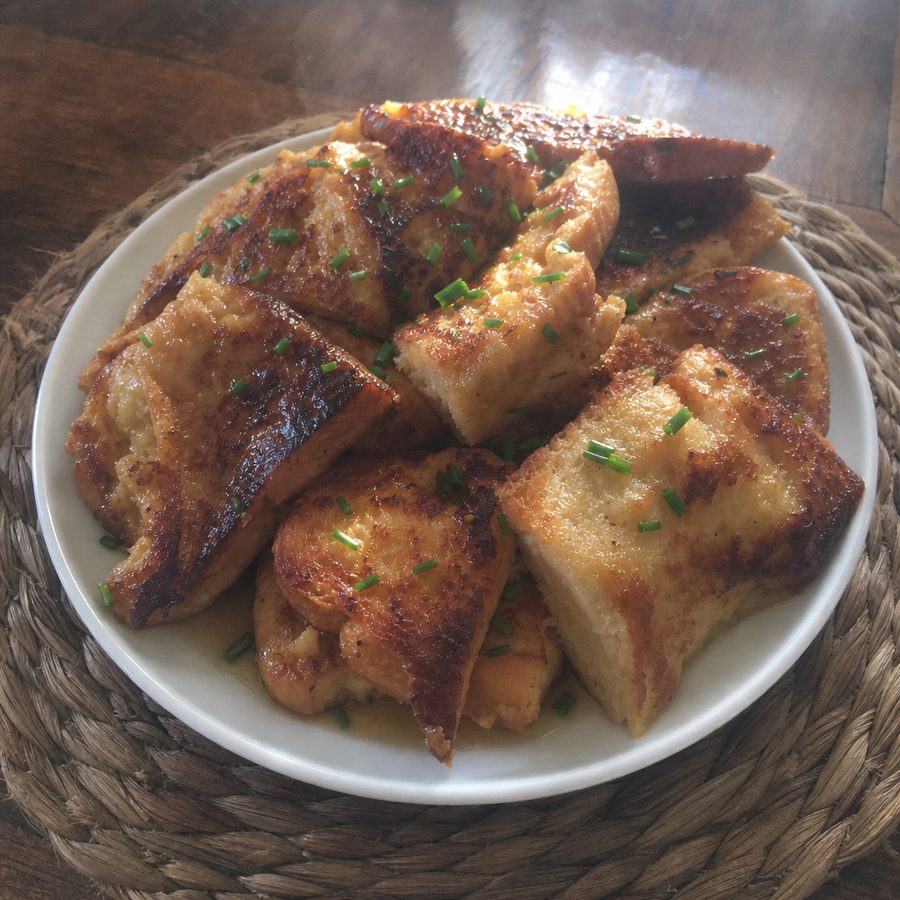
The eating is all about contrast. A slice left alone in the pan builds a dark, brittle crust while the middle stays soft and almost creamy, so every bite gives way twice. Maple syrup over the top is not a flourish, it is how scrapple is served where it comes from, and that sweetness against the sage and the coarse black pepper is the whole reason the dish works. Chives go on at the last second for color and a little bite. Three slices and a cup of coffee carries me well past the middle of the morning, and the turkey is doing most of that work.
Ingredients
- 3 cups cooked millet
- 1 lb ground turkey
- 3 cups chicken broth
- 2 tbsp finely chopped fresh sage
- 1 tsp ground coriander
- 1/8 tsp ground cloves
- 1/4 tsp cayenne
- 2 tsp coarsely ground black pepper
- 1 1/4 tsp fine sea salt, divided
- 1 tbsp dijon mustard
- 2 tbsp garlic-infused olive oil
- 3 tbsp ghee, for frying
- 2 tbsp pure maple syrup, for serving
- 3 tbsp thinly sliced chives
Instructions
- Cook the turkey with the seasoning: Put the ground turkey in a wide heavy pot over medium heat along with the sage, coriander, cloves, cayenne, black pepper, and 3/4 teaspoon of the salt. Break it into small pieces with a wooden spoon and cook for 6 to 8 minutes, until no pink remains, the meat reads 165°F (74°C), and the bottom of the pot is beginning to brown.
- Add the broth and the millet: Pour in the broth and scrape the bottom of the pot clean, then stir in the cooked millet and the remaining salt. Bring it up to a simmer over medium heat. It will look far too loose at this point, which is exactly right, because everything from here is evaporation.
- Cook it down until it holds a line: Simmer uncovered for 20 to 25 minutes, stirring every few minutes and pressing the millet against the side of the pot as you go so the grains break down. It is ready when a spoon dragged across the bottom leaves a line that stays open for a second and the mixture comes away from the sides in one soft mass.
- Season it off the heat and fill the pan: Off the heat, stir in the dijon mustard and the garlic-infused olive oil. Line an 8x4-inch loaf pan with parchment, leaving an overhang on the long sides, and scrape the mixture in. Press it level and hard with the back of a wet spoon so no air pockets are left, then cool on the counter for 30 minutes.
- Chill it overnight: Cover the pan and refrigerate for at least 6 hours, and overnight if you can. This step is not optional. A warm loaf has no structure and will collapse into a hash the moment it meets a hot pan, while a cold one cuts like a firm polenta and holds its shape.
- Slice thick and fry to a crust: Lift the loaf out by the parchment and cut it into 12 slices about 3/4 inch thick. Melt the ghee in a large skillet over medium heat and lay the slices in without crowding them. Fry for 5 to 6 minutes a side without moving them, until a dark crust forms and each slice releases on its own. Serve with maple syrup poured over and chives scattered on top.
Variations
- Beef and thyme: Use ground beef in place of the turkey and swap half the sage for fresh thyme, then pour off the excess fat before adding the broth.
- A sharper plate: Skip the maple syrup and serve each slice with a spoonful of sauerkraut and a smear of dijon.
- Hotter loaf: Raise the cayenne to 3/4 teaspoon and add 1 teaspoon of smoked paprika with the other seasonings.
- Maple in the loaf: Stir 1 tablespoon of maple syrup into the pot off the heat so the sweetness runs through every slice.
- Smaller squares: Set the mixture in a parchment-lined 8-inch square pan for a thinner slab, cut it into 12 squares, and fry them 4 minutes a side.
Storage & Leftovers
The uncut loaf keeps in the refrigerator for 4 days wrapped tightly in its parchment, and it slices more cleanly on the second day than on the first. Fried slices keep for 3 days in a sealed container, though they give up their crust as they go cold and want a hot dry pan to get it back.
Reheat fried slices in a dry skillet over medium heat for about 3 minutes a side, or in a toaster oven at 375°F (190°C) for 8 minutes. The microwave warms them through and leaves them soft to the edge, which is a lesser thing than the crust you worked for, so save it for the mornings you are truly out of time.
The loaf freezes well before frying. Cut it into slices first, freeze them flat on a tray, then stack them with parchment between and bag them for up to 2 months. Fry straight from frozen over medium-low heat, adding about 3 minutes a side so the middle comes up to temperature before the crust goes too dark.
Notes & Tips
- Cook it further than feels right: The single thing that decides whether you get slices or a skillet of hash is how much liquid you drove off. Stop when the spoon leaves a line on the bottom of the pot that does not close up.
- Chill it all the way through: Six hours is the minimum and overnight is better. A loaf that is cold in the center cuts cleanly and frays at the crust, which is where the crisp comes from.
- Why garlic-infused olive oil works: The flavor of garlic dissolves into fat, and the part that upsets a sensitive gut does not, so the oil carries the taste and leaves the trouble behind in the bottle. Stir it in off the heat, where the smell is loudest.
- Thick slices, hot pan: Cut at 3/4 inch. Thin slices dry through before a crust forms and thick ones stay creamy in the middle, which is the texture you are after.
- Leave them alone: Millet releases from the pan when it is ready and not a moment sooner. If a slice sticks, it needs another minute, not a spatula and more force.
- Wet the spoon: Dip the back of your spoon in cold water before pressing the mixture into the loaf pan. It stops the millet from dragging and gives you a flat surface to cut from.
Nutrition & Mindful Eating
- Millet, turkey, and sage carry this between them. The millet cooks down far enough to set on its own, the turkey gives every slice its substance, and the sage and coarse black pepper are what keep something this plain from tasting flat.
- Millet is a small round grain that goes soft and mildly sweet when it is cooked this far past tender, and it brings magnesium along with a gentle whole-grain carbohydrate. Simmered in broth rather than water, it takes on savory flavor all the way to the middle of the loaf.
- Ground turkey stays fine textured and mild here because it simmers in the pot rather than searing hard, and it carries the protein along with selenium and vitamin B6. Whatever it gives up in the pot goes straight into the millet around it.
- Sage, coriander, black pepper, and a pinch of ground cloves are the old scrapple seasoning, and they smell strongest in the first minute after the slices hit the ghee. Maple syrup poured over plays against them the way it does with anything peppery.
- Slices this dense eat like a real breakfast rather than something grabbed on the way out, and the protein in the turkey is doing most of that work with the millet behind it.
- As you eat, notice the crust cracking under the fork and how soft the middle still is underneath it, and give the plate a few unhurried minutes before the day starts asking things of you.
Frequently Asked Questions
Can I use a different ground meat?
Yes. Ground chicken behaves almost identically and wants the same timing. Ground beef makes a darker, richer loaf, and you should pour off some of the fat before the broth goes in or the slices fry greasy. Ground lamb with sage is strong and good if you like that.
My slices fell apart in the skillet. What went wrong?
Almost always one of three things. The mixture was not cooked down far enough, the loaf was not fully cold, or the slices were cut too thin. Cook until a spoon leaves an open line, chill overnight, cut at 3/4 inch, and then leave the slices completely alone until the crust releases them.
Can I make this ahead for weekday mornings?
That is what it is for. Cook the loaf on the weekend, keep it whole and wrapped for up to 4 days, and cut off only what you want each morning. Frying three slices takes about 12 minutes from cold, and the maple and chives go on at the plate.
Does this fit a low-FODMAP breakfast?
It does. Millet at this amount per serving sits comfortably in the range most people handle, and the savory backbone is sage, black pepper, coriander, dijon, and garlic-infused olive oil rather than onion or garlic cloves, so nothing gets stripped out of the recipe. Maple syrup does the sweetening at the table.