
Mussels with Charred Cabbage, Butter Beans, and Dill
Cabbage wedges seared dark in a hot pan, then butter beans and a splash of broth added and mussels piled on top to steam open, finished with lemon, dill, and cracked pepper.
Why You'll Love This Recipe
Mussels almost always arrive in a broth you drink with a spoon, and this is the version where the liquor goes into something instead. Charred cabbage and butter beans sit under them and soak up every drop, so what you get at the bottom of the pan is the best part of the dish rather than a puddle. It changes how the meal eats. You are not fishing shells out of a bowl of soup, you are eating a pan of vegetables that happen to taste overwhelmingly of the sea, with the mussels on top as the reason.
Cabbage cut into wedges through the core and left completely alone in a hot pan is a trick worth learning on its own. Four minutes on one cut face gives you a black, blistered surface and a wedge that has gone sweet and floppy at the outer leaves while staying firm at the spine. Butter beans go in next, crushed a little against the pan so some break down and thicken what liquid there is. Then the mussels go on top, the lid goes on, and you leave it. Four minutes later almost all of them are open, and lemon, dill, and a great deal of cracked pepper go over the top.
Twenty minutes and people on the way is the situation this was made for, because it looks like a great deal more work than it is and it goes to the table in the pan. Mussels are cheap, they cook faster than anything else in the shop, and a bag of them keeps two days in the refrigerator under a damp towel. The only real work is scrubbing them, which takes five minutes at the sink. Late autumn through early spring is when mussels are best, and it is also when a plate of charred cabbage sounds most appealing.
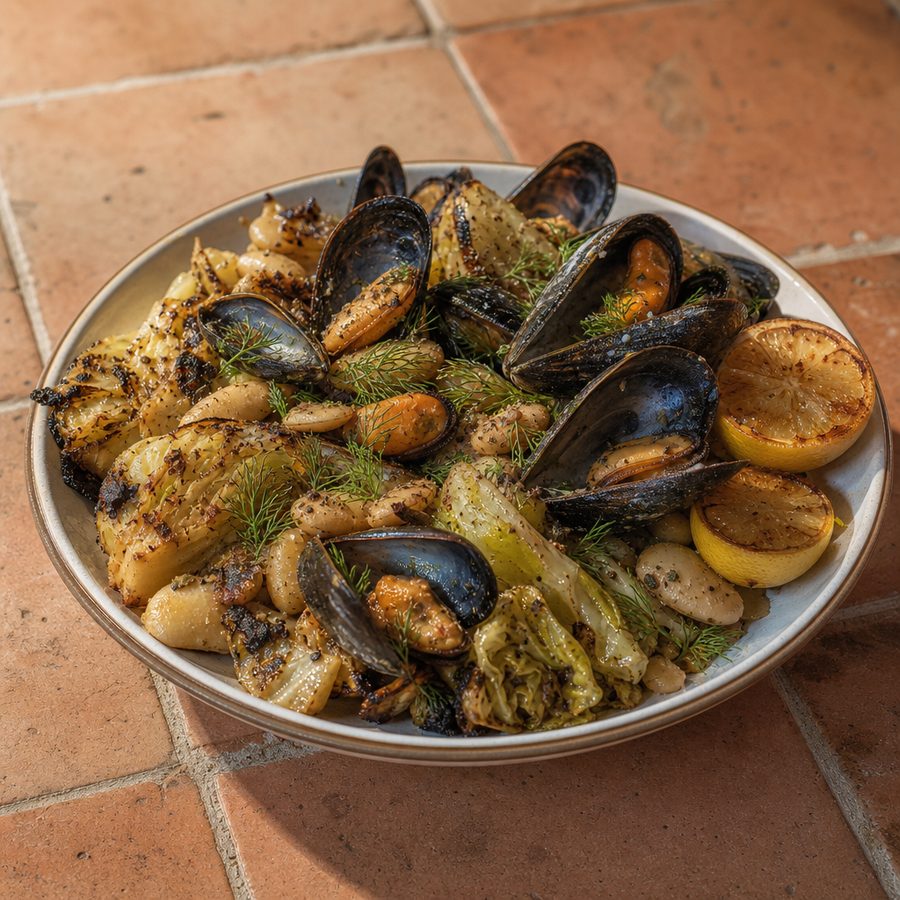
Ingredients
- 2 3/4 lb mussels in the shell, scrubbed and debearded
- 1/2 large head green cabbage (about 1 1/4 lb), cut through the core into 8 thin wedges
- 1 1/2 cups butter beans, drained and rinsed
- 3 scallions, sliced thin
- 4 garlic cloves, sliced thin
- 1/3 cup dill fronds, roughly chopped
- 1 3/4 tbsp olive oil
- 2 tbsp lemon juice, plus wedges to serve
- 1/2 cup vegetable broth
- 1 tsp smoked paprika
- 1 tsp coarsely cracked black pepper
Instructions
- Clean the mussels: Tip the mussels into a colander and scrub the shells under cold running water, pulling away any beard that hangs from the straight edge with a firm tug toward the hinge. Discard any that are cracked, and any wide-open one that does not close when you tap it on the counter. Leave them in the colander in the sink.
- Char the cabbage: Heat the olive oil in a wide, heavy pan with a lid over medium-high until it shimmers. Lay the cabbage wedges in on one cut face and leave them completely untouched for four minutes. When you lift one it should be blackened in patches and deeply browned across the rest. Turn onto the second cut face and give it three minutes more.
- Add the beans and aromatics: Scatter the butter beans, garlic, scallion whites, and smoked paprika around and between the wedges, pressing a few beans against the pan with the back of a spoon so they split. Cook for one minute, until the garlic is fragrant and the paprika has coated everything.
- Steam the mussels on top: Pour in the broth, let it come to a fast simmer, and pile the mussels over the vegetables in an even layer. Cover the pan tightly and cook for four to five minutes without lifting the lid more than once. They are done when nearly all the shells have opened wide and the meat inside has shrunk and turned from beige to deep orange.
- Finish and serve from the pan: Take the pan off the heat and discard any mussel that has stayed firmly shut. Squeeze the lemon juice over everything, scatter the dill, scallion greens, and cracked pepper across the top, and bring the pan to the table. Spoon the cabbage and beans out first so the liquor at the bottom goes onto every plate.
Variations
- Fennel and tarragon: Swap the cabbage for two thick-sliced fennel bulbs, charred the same way, and finish with tarragon in place of the dill.
- Chile and cilantro: Add two sliced chiles with the garlic and finish with cilantro and lime, which pushes the pan somewhere hotter and sharper.
- Clams: Use three pounds of small clams in place of the mussels, steaming them for six to eight minutes since they open more slowly.
- Tomato in summer: Add a cup of halved cherry tomatoes with the beans and let them burst into the broth before the mussels go on.
Storage & Leftovers
Cooked mussels keep one day in the refrigerator and no longer, picked out of their shells and stored covered in whatever liquid is left in the pan. That is the safest and the best way to hold them, and they are worth eating cold the next day, folded through the leftover cabbage and beans with more lemon.
The cabbage and butter beans keep three days on their own and reheat well in a hot dry pan for three or four minutes, where the charred edges wake up again. If you know you will have leftovers, pull the mussel meat out of the shells while the pan is still warm, since it comes away far more easily than it does cold.
Do not freeze this. Mussels that have been cooked and frozen turn tough and grainy, and cabbage that has been charred loses the texture that was the point of charring it. What you can do ahead is cut the cabbage and slice the aromatics in the afternoon, which brings the active cooking down to about fifteen minutes.
Notes & Tips
- Cut cabbage through the core: The core is what holds a wedge together through the char and the turn. Cut it out and you have a pan of loose leaves rather than eight wedges.
- Leave the wedges alone: Four full minutes on the first face with no peeking. Every lift interrupts the contact that builds the char, and the cabbage will only steam in the meantime.
- Debeard toward the hinge: Pulling the beard toward the pointed end tears the mussel. A firm tug in the other direction takes it out cleanly and the mussel survives it.
- Keep the lid on: Mussels cook in steam, and every look costs you most of it. One check at four minutes is all you need to see whether they have opened.
- Crush a few beans: Pressing four or five against the pan releases enough starch to thicken the liquor into something that clings to the cabbage instead of pooling.
Nutrition & Mindful Eating
- Mussels, butter beans, and cabbage work as one thing here. The mussels bring the protein and the salt-sweet liquor, the beans give the pan its body and most of its fiber, and the cabbage supplies the char that makes all of it taste cooked rather than boiled.
- Mussels are unusually dense in protein for a shellfish and are one of the strongest food sources of vitamin B12 and manganese, along with iron in a form that is easy to absorb. They also cook in four minutes, which is part of why they belong on a weeknight.
- Butter beans are large, floury, and mild, and crushing a few of them thickens the liquid in the pan. They carry fiber and slow-digesting starch, and the ones that stay whole keep a creamy interior that soaks up everything around them.
- Cabbage charred hard turns sweet as its sugars caramelize, and it holds vitamin C and vitamin K along with the sulfur compounds that give the cabbage family its character. Cooking it in wedges rather than shreds means it keeps some crunch at the spine.
- Dill, lemon, and cracked pepper are what stop this from tasting heavy. The dill goes on raw so its oils are still sharp, the lemon cuts the richness of the liquor, and the pepper is coarse enough to turn up as distinct bites.
- As you eat, chase the liquor at the bottom of the pan with a piece of cabbage and notice how much of the sea is in it, and let a meal you eat with your hands take the time that eating with your hands deserves.
Frequently Asked Questions
How do I tell if a mussel is safe to cook?
Before cooking, a live mussel is either closed or closes when you tap it. Throw away any that stay gaping, and any with a cracked shell. After cooking, the rule reverses: the ones that have opened are the ones you eat, and any that has stayed clamped shut goes in the bin.
Can I use frozen mussels?
Cooked frozen mussels on the half shell will work, though they need only two minutes of steaming to warm through and they give up much less liquor, so the cabbage underneath will be drier. Add an extra splash of broth if you go that way. Fresh mussels in the shell are what make this dish taste the way it does.
My cabbage burned rather than charred.
There is a line between the two and it is mostly about pan temperature. Medium-high rather than high is right, and the wedges want to hiss steadily rather than crackle. A little genuine black at the edges is what you are after and it tastes sweet, while an even black across the whole face means the pan was too hot.
What do I do with the liquid at the bottom?
Spoon it over every plate, which is the entire reason the cabbage and beans are underneath. If there is more than the vegetables can hold, tip the pan and pour it into a small jug so people can add it themselves.