
Savory Parmesan and Thyme Oat Scones
Craggy savory scones built on ground oats and almonds, bound with flaxseed gel and cold butter, folded with parmesan, thyme, and chives, and baked as one round cut into wedges.
Why You'll Love This Recipe
I want to be straight with you about what these are before you make them. They are the short, craggy kind of scone, dense and tender rather than tall and flaky, and they are savory rather than sweet. Two of them with something hot to drink is a real breakfast, and they are what I make when I want food I can hold in my hand that still tastes like cooking happened. The dough comes together in one bowl in about fifteen minutes, bakes as a single round scored into wedges, and gives you eight pieces to work through over the week. They travel in a bag better than anything else in this chapter.
The structure question is the one worth explaining. A scone usually gets its binding from an egg, and here three things share that work. Three tablespoons of ground flaxseed stirred into warm water turn gelatinous in about ten minutes and give the dough something to hold onto. The ground oats bring their own soluble fiber, which goes sticky when it is wet, in exactly the way you need. And cold skyr adds moisture and tang while its protein firms up in the heat. Cold butter does the rest, staying in flakes through the folding and steaming apart in the oven so the crumb comes out tender rather than tight.
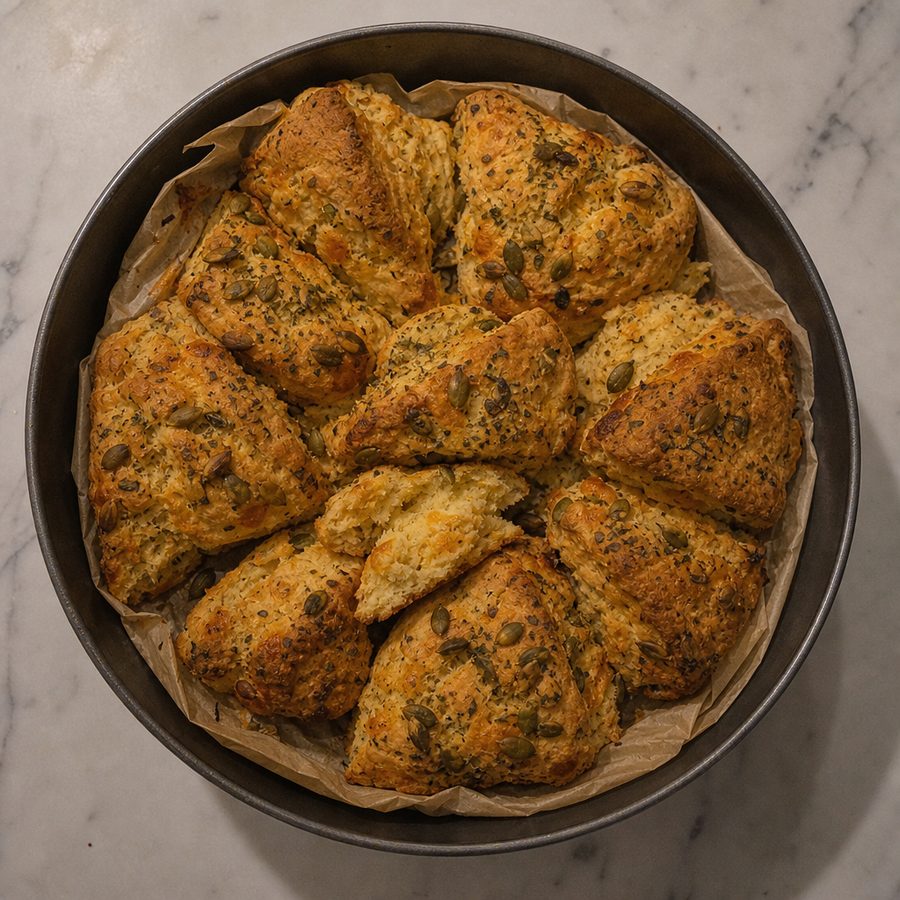
Flavor is where a savory scone earns its keep. Parmesan grated fine runs all the way through the dough and over the tops, where it browns and turns almost crisp against the edges of each wedge. Thyme and chives go in raw at the folding stage so they stay green, black pepper is cracked coarse enough that you find it in a bite, and a tablespoon of garlic-infused olive oil brushed over the round does the browning job a wash would usually do. Pumpkin seeds pressed into the surface toast while it bakes. I eat them warm on the first day and split and toasted every day after that.
Ingredients
- 2 cups gluten-free rolled oats, divided
- 1/2 cup whole raw almonds
- 3 tbsp ground flaxseed
- 6 tbsp cold butter, cut into small cubes
- 3/4 cup plain skyr, cold
- 3/4 cup finely grated parmesan (about 2 oz)
- 2 tbsp fresh thyme leaves
- 1/4 cup thinly sliced chives
- 1/4 cup pumpkin seeds, for the tops
- 1 tbsp garlic-infused olive oil, for brushing
- 3/4 tsp fine sea salt
- 1 1/2 tsp coarsely ground black pepper
Instructions
- Make the flaxseed gel: Stir the ground flaxseed into 1/3 cup of warm water and leave it for 10 minutes, until it thickens into a loose gel that falls slowly from a spoon. Do not rush this step. Watery flax will not hold the dough together and the wedges will crumble on the tray.
- Grind the oats and almonds: Heat the oven to 375°F (190°C) and line a sheet pan with parchment. Put 1 1/2 cups of the oats and all the almonds in a food processor and run it for 45 to 60 seconds, until you have a coarse flour with a few larger flecks left in it. Tip that into a large bowl with the remaining whole oats, the salt, and the black pepper.
- Cut in the cold butter: Add the cold cubed butter and rub it into the dry mixture with your fingertips, or pulse it in the processor, until the largest pieces are about the size of a pea. Stop while you can still see flakes of butter. Those flakes are what make the crumb tender, and warm hands will melt them into the flour.
- Fold in the cheese, herbs, and wet mixture: Stir through the parmesan, thyme, and chives. Add the flaxseed gel and the cold skyr and fold with a spatula until the dough just comes together and no dry patches remain. It will be thick, tacky, and heavier in the bowl than a wheat dough. Do not knead it.
- Shape the round and score it: Turn the dough onto the parchment and press it into a round about 7 inches across and 1 inch thick, smoothing the sides with damp hands. Cut it into 8 wedges with a bench scraper or a large knife and pull them apart by about half an inch. Brush the tops with the garlic-infused olive oil and press the pumpkin seeds into the surface.
- Bake and cool on the tray: Bake 28 to 32 minutes, until the tops are golden, the edges are firm, and the cut faces look dry rather than glossy. Cool on the tray for 15 minutes before you move them. These set as they cool, and a hot wedge will break apart in your hand.
Variations
- Cheddar and chive: Swap the parmesan for sharp cheddar and double the chives for a softer, richer wedge.
- Sun-dried tomato and oregano: Fold 1/3 cup of chopped sun-dried tomatoes and 2 teaspoons of dried oregano in with the cheese.
- Rosemary and pepper: Use 2 tablespoons of chopped rosemary in place of the thyme and raise the black pepper to 2 teaspoons.
- Drop scones: Skip the round altogether and drop eight spoonfuls straight onto the tray for craggier edges and a bake about 5 minutes shorter.
- Seedy tops: Use sesame or sunflower seeds in place of the pumpkin seeds, or scatter everything bagel seasoning across the brushed tops.
Storage & Leftovers
Cooled completely and kept in a sealed container, the scones hold at room temperature for 2 days and in the refrigerator for 5. The butter and cheese taste best on the first day, and a cold wedge straight from the refrigerator eats dry, so plan on warming those rather than eating them as they come.
Warming is really toasting. Split a scone and give it 4 to 5 minutes in a toaster oven at 350°F (175°C), or 2 minutes face down in a dry skillet, which crisps the cut side while the middle softens. A little butter on the hot cut face is worth the trouble.
They freeze well for up to 3 months. Freeze the wedges flat on a tray first, then bag them with parchment between, and reheat from frozen at 350°F (175°C) for about 10 minutes. Do not thaw them on the counter, which leaves the crumb damp and heavy.
Notes & Tips
- What holds these together with no egg in the dough: Three things share that job. Ground flaxseed soaked in warm water turns into a gel that behaves much the way a beaten egg does, the ground oats bring soluble fiber that goes sticky once it is wet, and the protein in the skyr firms up in the oven's heat. Give the flax its full ten minutes and the dough will hold.
- Why garlic-infused olive oil works: The flavor of garlic is fat-soluble and the part that upsets a sensitive gut is not, so the oil carries the taste and leaves the trouble behind in the bottle. Brushed over the tops it also does the browning that a wash would usually be there for.
- Keep the butter cold and visible: Stop rubbing while you can still see pea-sized flakes. Those flakes turn to steam in the oven, and that steam is what keeps the crumb tender rather than tight.
- Grind most of the oats, keep some whole: Oat flour gives the scone a fine crumb that cuts cleanly, and the half cup left whole gives you something to chew. All whole oats and the round will not hold; all flour and it eats like a cracker.
- Do not knead it: This dough has no gluten to develop and nothing to gain from handling. Fold it until it comes together and then stop, because the more you work it the denser it bakes.
- Cool before you move them: Fifteen minutes on the tray is the difference between eight wedges and a pile of crumbs. Anything bound by seeds and starch firms up as it cools.
Nutrition & Mindful Eating
- Oats, almonds, and parmesan carry these between them. The ground oats give the crumb its body, the almonds bring fat and a soft nuttiness through the middle, and the cheese seasons the dough all the way through rather than sitting on top of it.
- Oats bring the soluble fiber called beta-glucan, the same thing that thickens a pot of porridge on the stove. In a scone it shows up as a dough that turns tacky in the bowl and a crumb that holds together in your hand.
- Almonds ground in with the oats bring vitamin E and unsaturated fat into the dough, and that fat is a good part of why these stay tender for days rather than going dry by the second morning.
- Parmesan is aged long enough to grate into dry threads, so it flavors the dough thoroughly and browns into the tops and the cut edges. It brings calcium along with the savory depth that the aging itself creates.
- Thyme, chives, and coarsely cracked black pepper go in raw at the folding stage so they stay sharp, and the pumpkin seeds toast on top while the round bakes. Two wedges with something hot to drink hold you through a long morning.
- As you eat, break a wedge open while it is still warm and catch the smell of thyme and toasted cheese before you taste anything, then slow down enough to let two of them feel like a meal rather than a snack.
Frequently Asked Questions
Can I use a different cheese?
Cheddar works and melts more, which gives you a softer crumb and browner edges. Feta crumbled in stays in salty pockets rather than spreading through. Parmesan is here because it is dry, so it seasons the dough thoroughly and does not add the moisture a softer cheese brings.
My scones fell apart when I moved them. What went wrong?
They were still warm, or the flax gel was too thin. This dough sets as it cools, so give the round a full 15 minutes on the tray before you lift any wedges, and make sure the flaxseed sat in warm water long enough to go properly gelatinous first.
Can I mix the dough the night before?
Yes. Shape and score the round, brush the tops, cover it, and refrigerate overnight, then bake it straight from cold and add 3 or 4 minutes. Cold dough actually bakes better here, because the butter stays in flakes longer once it is in the oven.
Does this fit a low-FODMAP breakfast?
It does, at two wedges. Oats, almonds, and flaxseed are all comfortable at these amounts, parmesan is aged long enough to carry very little lactose, and the browning on top comes from garlic-infused olive oil rather than a garlic clove, so nothing gets stripped out of the recipe.