
Persian Herb Kuku with Walnuts and Lemon Skyr
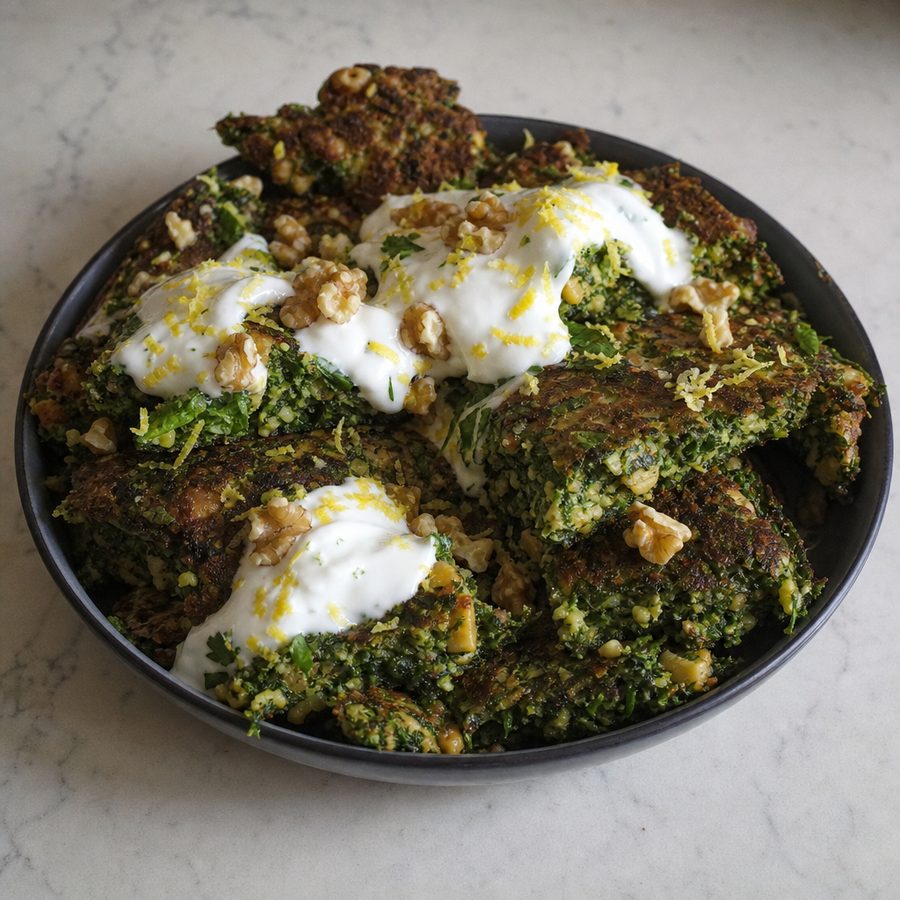
A thick skillet omelet packed with chopped parsley, cilantro, dill, chives, and spinach, bound with egg and ground flaxseed, studded with toasted walnuts, and cut into wedges under a spoonful of cold lemon skyr.
Why You'll Love This Recipe
I make this on mornings when the herb drawer is full and everything in it is one day from turning. A kuku takes more green than seems reasonable, four cups chopped, and that is the whole point of the dish: the eggs are the binder and the herbs are the food. It comes together in one skillet in under half an hour, it cuts into four thick wedges, and it is just as good at room temperature two hours later as it is straight from the pan. Persian cooks have been making it for centuries for exactly that reason, and it travels to a picnic better than any other egg dish I know.
The texture is what surprises people. A kuku is not fluffy the way a French omelet is fluffy. It sets dense and almost cakey, dark green through the cut face, with a browned underside that pulls away from the pan in one piece. Ground flaxseed goes into the batter and does the job flour does in some versions, drinking up the water the spinach releases so the wedges hold their shape on the plate. Toasted walnuts give you something to bite, turmeric turns the edges gold, and the whole thing tastes green and grassy in a way scrambled eggs never manage.
Repetitive breakfasts are what this is aimed at. It is savory, it is herb-forward, and it eats like real food rather than something you assemble standing up. I make it Sunday, cut it into wedges, and eat the rest cold through the week with the lemon skyr spooned over at the last second so it stays cold against the omelet. It also does honest work as a light supper with a tomato salad, which is how most of my Persian friends serve it, and nobody in my house has ever complained about being handed breakfast at seven in the evening.
Ingredients
- 8 large eggs
- 1 1/4 cups plain skyr, divided
- 2 packed cups flat-leaf parsley leaves and thin stems, finely chopped
- 1 packed cup cilantro, finely chopped
- 5 oz baby spinach, chopped
- 1/2 cup chopped fresh dill
- 1/2 cup snipped chives
- 4 scallions, thinly sliced
- 6 tbsp ground flaxseed
- 1/3 cup walnut halves, toasted and roughly chopped
- 1 tbsp olive oil
- 2 garlic cloves, grated
- 1 tbsp lemon juice, plus zest of 1 lemon
- 1/2 tsp ground turmeric
- 1/2 tsp fine sea salt
- 1/2 tsp freshly ground black pepper
Instructions
- Chop the greens: Wash and dry the parsley, cilantro, dill, and chives thoroughly, then chop them fine, thin stems and all, and pile them into a large bowl with the sliced scallions and chopped spinach. Wet herbs steam rather than set, so give them a spin in a salad spinner or a hard press in a towel first. You want about four packed cups of green when it is all in the bowl.
- Build the batter: Beat the eggs with 150 g of the skyr, about two thirds of a cup, until no streaks of white remain, then whisk in the ground flaxseed, garlic, turmeric, salt, and pepper. Let it sit two minutes so the flaxseed swells and thickens. Fold in the herbs and the walnuts, working from the bottom of the bowl, until every leaf is coated.
- Set the base: Warm the olive oil in a 10-inch nonstick or well-seasoned skillet over medium heat until it shimmers, then scrape in the mixture and press it flat with a spatula. Cook uncovered for three minutes to build the crust, listening for a steady quiet sizzle rather than a spatter.
- Cover and cook through: Turn the heat to medium-low, cover the pan, and cook for nine to eleven minutes. It is done when the center is firm to a light press and a knife slid into the middle comes out clean. Lift an edge with a spatula and look underneath: you want deep brown, not black, and the whole round should slide when you shake the pan.
- Rest, cut, and dress: Slide the kuku onto a board and give it two minutes to settle so it cuts cleanly. Stir the remaining skyr with the lemon juice, the lemon zest, and a pinch of salt. Cut the kuku into four wedges and spoon the cold skyr over each one just before it goes to the table.
Variations
- Barberry and walnut: Stir two tablespoons of dried barberries into the batter with the walnuts for the sharp little bursts of sourness that many Persian cooks consider essential.
- Leek and fenugreek: Swap the scallions for a cup of finely sliced leek softened in the pan first, and add a tablespoon of dried fenugreek leaf for a deeper, slightly bitter edge.
- Muffin tin kuku: Divide the batter among a greased twelve-cup muffin tin and bake at 375°F for sixteen to eighteen minutes for portable rounds that pack well.
- Green chile and lime: Add a seeded, minced serrano to the herbs and finish with lime zest rather than lemon for a sharper, hotter wedge.
Storage & Leftovers
Wedges keep four days in a sealed container in the refrigerator, and this is one of the rare egg dishes that does not go rubbery overnight. Store the lemon skyr separately in its own small jar and spoon it on cold at the last minute, since it thins out and weeps if it sits on the warm omelet.
Eat leftovers cold or at room temperature, which is how a kuku is usually served in Iran, or warm a wedge in a dry skillet over medium-low for two minutes a side to bring the crust back. The microwave works in a pinch at fifty percent power for forty seconds, though the edges soften.
Freeze wedges individually wrapped for up to two months. Thaw overnight in the refrigerator and crisp in a dry pan, since going straight from frozen to heat pushes water out of the spinach and leaves the middle wet. Make the lemon skyr fresh on the day you eat it.
Notes & Tips
- Dry the herbs properly: Water is the enemy of a kuku. Herbs that go in damp release into the batter and give you a wet, pale middle rather than a dense green one, so spin them or press them in a clean towel.
- Chop by hand if you can: A food processor bruises herbs and turns them to paste, which makes the finished kuku dark and muddy. A sharp knife and five minutes gives you distinct green flecks all through the wedge.
- Let the flaxseed sit: Two minutes in the egg is all it takes for ground flaxseed to swell and thicken. Skip that rest and the batter runs thin in the pan and takes several minutes longer to set.
- Keep the heat moderate: High heat browns the base before the center has any chance to firm up. A steady medium-low under a lid is what gives you a browned underside and a cooked middle at the same moment.
- Toast the walnuts first: Four minutes in a dry pan before they go into the batter is the difference between walnuts that taste like the pan and walnuts that taste like themselves.
Nutrition & Mindful Eating
- Eggs, skyr, herbs, and walnuts are all pulling in the same direction here. The eggs and the skyr carry the protein that makes a wedge of this eat like a full breakfast, the herbs and spinach bring the fiber and the green flavor, and the walnuts add fat and crunch to a soft dish.
- Parsley, cilantro, dill, and chives are used here in the quantity you would normally use a vegetable, which is what makes this dish worth talking about. At four cups they contribute real fiber along with vitamin K, and their flavor is the reason the kuku tastes grassy and bright rather than simply eggy.
- Ground flaxseed swells in the egg and thickens the batter, and the soluble fiber that does that thickening is the same fiber that makes flax worth keeping in the freezer. It also brings alpha-linolenic acid, the plant form of omega-3 fat.
- Skyr is strained until it is thick and slightly sour, which is why a spoonful of it cuts through a rich wedge so well, and that straining is also what concentrates its protein and calcium.
- Turmeric colors the edges gold and gives the kuku a faint earthiness that sits under the herbs, and toasted walnuts give the soft interior something to push back with. A dish this dense holds you well into the middle of the morning, with the eggs and skyr doing most of that work.
- As you eat, notice how the grassy herbs and the cold sour skyr play against each other on the same forkful, and give yourself long enough at the table to feel the meal land.
Frequently Asked Questions
Can I use dried herbs?
Not for the bulk of it. The volume of fresh green is the dish, and dried herbs give you a fraction of the weight and a dusty flavor. If you are short one herb, make up the difference with more parsley or another handful of spinach, both of which are easy to find year round.
My kuku fell apart when I cut it. What went wrong?
Usually it was cut too soon, or the herbs went in wet. Give it the full two minutes off the heat before a knife touches it, and dry the greens properly first. A pan that is too wide also spreads the batter thin, so stay with a 10-inch skillet for this quantity.
Do I have to flip it?
No. The covered pan cooks the top through by trapping steam, which is gentler and far less dramatic than inverting a heavy skillet. If you want a browned top as well, slide the pan under a broiler for ninety seconds at the end and watch it the whole time.
What else can I put on top?
A spoonful of the lemon skyr is the version I make most, but chopped tomato and cucumber with olive oil is traditional and good, and so is a scatter of extra walnuts. Pickled vegetables of almost any kind are welcome against something this green and rich.