
Potato, Cheddar, and Chive Breakfast Squares
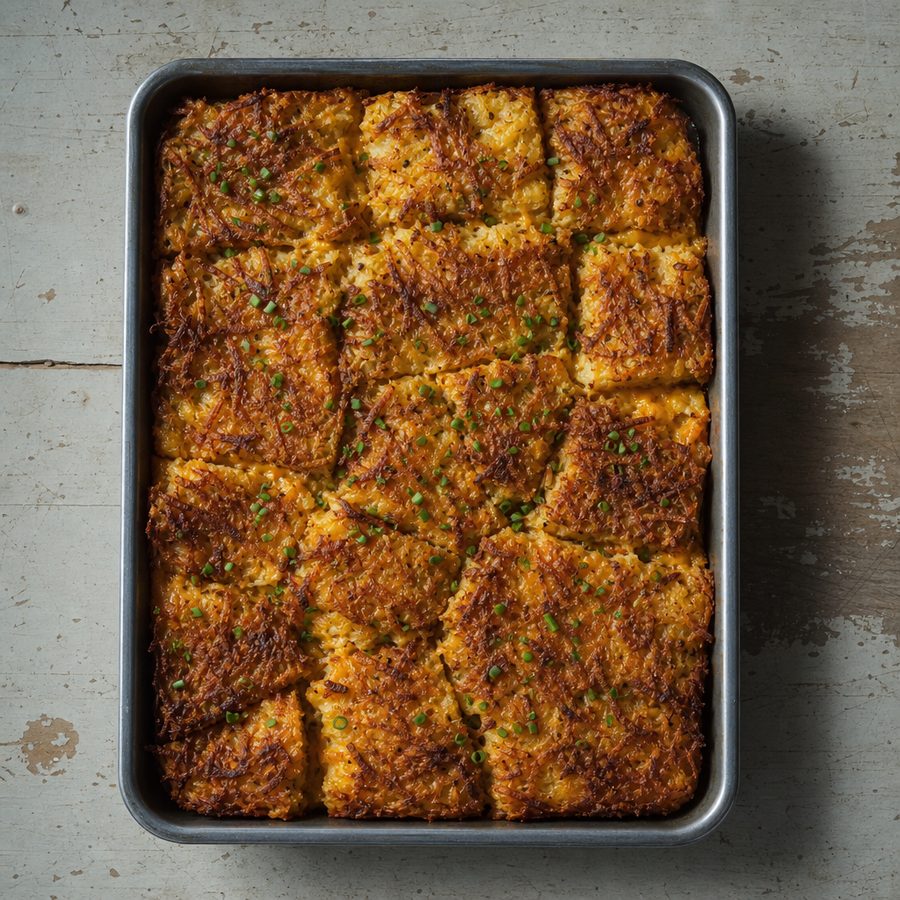
Shredded yukon gold potato bound with mashed russet and flaxseed, pressed into a sheet pan with cheddar and chives, and baked until the top is brown and crisp.
Why You'll Love This Recipe
This is the pan I bake on Sunday when I already know the week is going to get away from me. It comes out of the oven as one slab, cools for fifteen minutes, and cuts into eight squares that live in the refrigerator and reheat in about the time it takes to make coffee. There is no egg holding it together, which people assume means it will fall apart in the pan. It does not, because the potato does that job itself. Half of it goes in shredded for texture and half goes in boiled and mashed, and the starch in the mash glues the shreds to one another the way a batter would.
Two things decide whether this works. The first is squeezing the shredded potato until it stops dripping, and I mean really wringing it out in a clean kitchen towel, because water left in the shreds steams the pan and gives you a soft gray slab rather than a brown one. The second is the garlic-infused olive oil, which goes into the mixture and over the pan. The oil carries the taste of garlic, and the part of garlic that troubles sensitive stomachs does not dissolve into fat, so it stays behind in the pan the garlic was cooked in. Thyme and smoked paprika sit underneath and keep the squares tasting savory.
The contrast is what makes the pan worth heating up for. The top and bottom go brown and a little crisp, the middle stays soft and creamy, and the cheddar melts down through the shreds in pockets rather than sitting in a flat layer. A square has real substance to it, and two of them with a piece of fruit is a breakfast that cost you ninety seconds on a Tuesday morning. Cold from the refrigerator it is good too, denser and more like a potato cake, which is honestly how I eat the last one standing at the counter on Friday before I go anywhere.
Ingredients
- 1 1/2 lb yukon gold potatoes, scrubbed and left unpeeled
- 12 oz russet potato, peeled and cut into 1-inch chunks
- 3 tbsp ground flaxseed
- 3 tbsp garlic-infused olive oil, divided
- 4 oz sharp cheddar, coarsely grated
- 1/3 cup finely grated parmesan
- 1 tbsp fresh thyme leaves
- 1 tsp smoked paprika
- 1/4 cup thinly sliced fresh chives
- 1 1/2 tsp fine sea salt, divided
- 1 tsp freshly ground black pepper
Instructions
- Boil the potato for the mash: Put the russet chunks in a pot of well-salted water, bring to a boil, and cook 12 to 14 minutes, until a knife slides through with no resistance. Drain, return them to the dry pot over low heat for a minute to steam off the surface water, then mash smooth and set aside to cool.
- Make the flaxseed gel: Stir the ground flaxseed into 1/2 cup of warm water in a small bowl and leave it for 10 minutes. It thickens into something loose and gelatinous that slides slowly off a spoon. That texture is the whole point, so give it the full ten minutes before you use it.
- Shred and wring out the yukon golds: Heat the oven to 400°F (200°C) and brush a 9x13-inch pan with 1 tablespoon of the garlic-infused olive oil. Shred the unpeeled yukon golds on the large holes of a box grater, pile them into a clean kitchen towel, and twist hard over the sink. Keep twisting until no more water runs, usually two rounds.
- Mix it by hand: Combine the shredded potato, the cooled mash, the flaxseed gel, 2 tablespoons of the oil, the cheddar, thyme, smoked paprika, 1 1/4 teaspoons of the salt, and the pepper in a large bowl. Work it with your hands rather than a spoon, until every shred is coated and a squeezed handful holds together.
- Press and bake: Press the mixture into the pan in an even layer about 3/4 inch thick, packing it down firmly with the back of a spatula so no loose shreds stand up to burn. Scatter the parmesan and remaining salt over the top. Bake 40 to 45 minutes, until deep gold and pulling slightly from the sides.
- Cool, then cut: Let the pan sit on a rack for at least 15 minutes. This is not optional, since the starch has to set before the squares will hold their shape and a slab cut hot will crumble along the knife. Cut into 8 squares and scatter the chives over just before serving.
Variations
- Bacon in the mix: Render 4 slices of bacon, chop them, and work them into the mixture with the cheddar, using a spoonful of the fat in place of some of the oil.
- Greens folded through: Wilt 4 packed cups of chopped kale or swiss chard, squeeze them as dry as the potato, and add them at the mixing stage.
- Goat cheese and dill: Swap the cheddar for 4 oz of goat cheese in rough lumps and use dill in place of the thyme for a softer, tangier square.
- Smoky and hot: Add a finely diced poblano and 1/2 teaspoon of chipotle powder to the mixture before pressing it into the pan.
- Rosemary and parmesan crust: Leave out the cheddar, double the parmesan, and add 1 tablespoon of chopped fresh rosemary for a firmer, drier square.
Storage & Leftovers
Cooled squares keep in a sealed container in the refrigerator for 4 days, with parchment between the layers so they do not stick to one another. They firm up considerably once cold, which makes them much easier to lift and move than they were warm. The chives fade by the third day, so keep a few back and add them fresh.
Reheat straight from cold in a 400°F (200°C) oven or toaster oven for 8 to 10 minutes, or in a dry skillet over medium heat for about 3 minutes a side, which is the version I prefer because the bottom crisps all over again. The microwave will heat a square through in 60 seconds and give you no crust at all.
Bake the slab fully before freezing rather than freezing the raw mixture, which discolors within hours. Freeze cut squares on a tray until solid, then bag them for up to 2 months. Reheat from frozen at 400°F (200°C) for 18 to 20 minutes and do not thaw them first, since thawed potato weeps water and turns grainy.
Notes & Tips
- Why mashed potato and flaxseed, and not egg: Egg does two jobs in a bake like this, glue and stretch. Starch from the mashed russet supplies the glue and the flaxseed gel supplies the stretch, and between them the slab cuts into clean squares.
- Wring the shreds until nothing runs: This is the single step that decides whether the slab browns or steams. Two hard twists in a kitchen towel, and be surprised by how much water comes out the second time.
- Why garlic-infused olive oil: The compounds that make garlic taste of garlic dissolve into fat, while the parts that upset some stomachs dissolve in water, so oil that has had garlic cooked in it and strained out carries the flavor and leaves the rest behind.
- Pack it down hard: Loose shreds standing proud of the surface scorch before the middle sets. Press the whole layer flat with a spatula until the top looks like one sheet.
- Give it fifteen minutes before the knife: Potato starch sets as it cools. Cut the slab hot and it falls into shreds; cut it warm and every square holds its edges.
- Parmesan makes the crust: Cheddar melts into the slab, parmesan dries on top of it. That thin salty layer is what gives you a crust worth reheating.
Nutrition & Mindful Eating
- Potato, cheddar, and flaxseed each do a different job in one square. The potato gives it body and the soft starchy middle, the cheddar gives it salt and the fat that makes it taste rich, and the flaxseed brings fiber and the omega-3 fats that come with ground seeds.
- Yukon gold potatoes shred into strands that keep their shape and still brown at the cut edges, and the skins left on are where much of the potassium and fiber ride along. Potato that is cooked and then chilled overnight also forms a starch that has been studied for the way it feeds the bacteria in your gut.
- Sharp cheddar melts into pockets rather than a smooth sheet, so the salt arrives in bursts across a square, and it carries calcium and protein into a breakfast otherwise built on potato.
- Ground flaxseed stirred into warm water turns gelatinous in about ten minutes, which is what holds the shreds to each other, and it is one of the better plant sources of omega-3 fats. Buy it already ground or grind it yourself, because whole seeds pass through unchanged.
- Smoked paprika, thyme, and garlic-infused olive oil are what keep this tasting savory all the way through, and the chives go on after the pan comes out of the oven so they stay sharp and green rather than cooking down into the slab.
- As you eat, notice the crisp brown top giving way to the soft middle underneath, and give the square a plate and a chair rather than eating it out of the container standing over the sink.
Frequently Asked Questions
Can I use a different potato?
Yes, but keep the two jobs separate. You want a waxy potato for the shreds so they stay in strands, and a starchy one for the mash so it binds. Red potatoes shred well. If you only have russets, use them for both and expect a slightly softer square.
My slab crumbled when I cut it. What went wrong?
Almost always one of three things. It was cut hot, the shreds were not wrung dry enough, or the layer was pressed too thin. Give it a full fifteen minutes on a rack, squeeze the potato until nothing more runs out, and keep the layer around three quarters of an inch.
Can I assemble it the night before and bake it in the morning?
I would not. Raw shredded potato turns gray and watery within a couple of hours even under water. You get a much better result baking the whole slab ahead and reheating a square, which takes eight minutes and gives you a crisper surface than the first bake did.
Does this fit a low-FODMAP breakfast?
It does. Potatoes are comfortable for most people at this portion, aged cheddar carries very little lactose, and the savory flavor comes from garlic-infused olive oil, thyme, smoked paprika, and chives rather than from garlic and onion, so nothing gets stripped out of the recipe on its way to you.