
Potted Rabbit with Quick-Pickled Red Cabbage
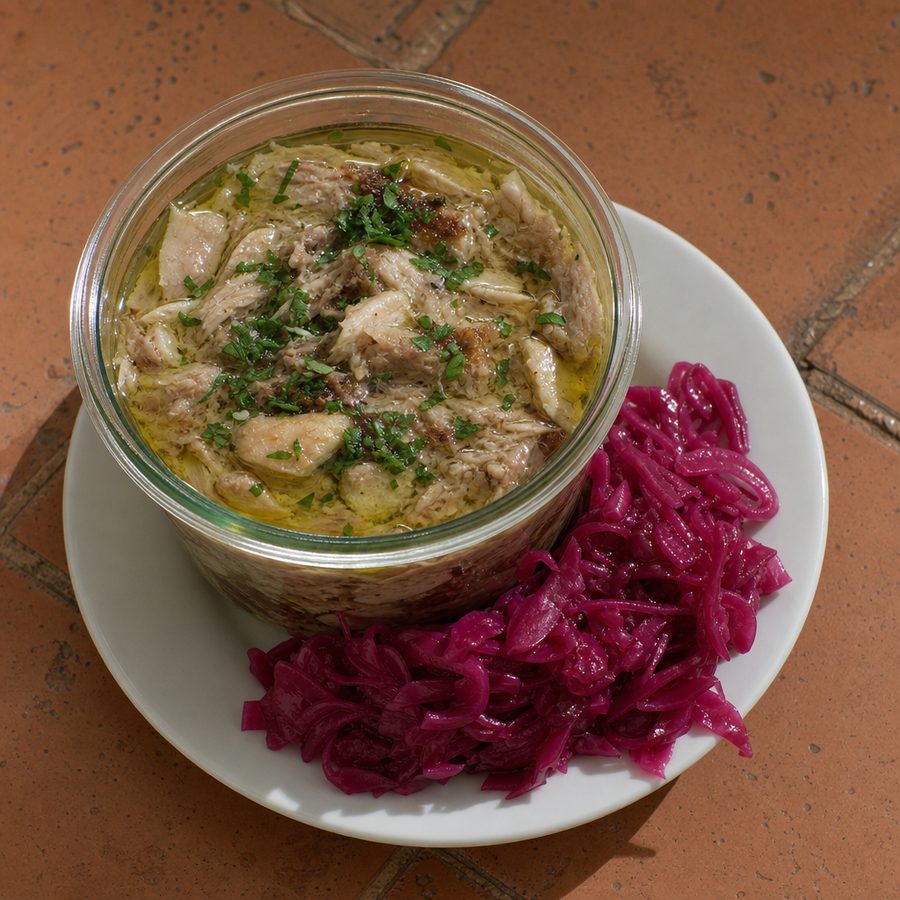
Rabbit legs braised slowly with onion and thyme, shredded into their own reduced juices and olive oil, then eaten cold or crisped in a pan with sharp pickled red cabbage.
Why You'll Love This Recipe
I know rabbit is the hardest sell here, so let me say the true thing first. Rabbit tastes mild. It is pale, fine-grained meat that pulls into soft threads, and if you served it to someone without telling them, most people would guess chicken thigh. You can buy it frozen at a good butcher or order it, and the hind legs are the cheapest part and the best one for this. It is a Sunday job that feeds the week. Two hours in a low oven while you do something else, then twenty minutes of picking and shredding, and you have four breakfasts sitting in a jar that you eat cold with a fork.
The thing that ruins rabbit is speed. It carries almost no fat inside the muscle, so a hot fast cook squeezes the water out and leaves you with dry strings, which is exactly where its bad reputation came from. Low and covered is the whole answer. The legs sit in broth at 300°F (150°C) with the lid on for about two hours, and what you are looking for is meat that falls off the bone when you push it with a spoon, not meat that merely gives. Then you shred it while it is still warm, moisten it with the reduced braising liquid and good olive oil, and press it down tight so no air sits on top.
Cold shredded meat for breakfast sounds odd until you have done it once. The kitchen smells like a roast chicken while it braises, not like anything wild, and the finished jar smells of thyme and lemon. Straight from the refrigerator the olive oil is cloudy and firm, so give the jar ten minutes on the counter, or press a portion into a hot dry skillet until the underside browns, which is my favorite way to eat it. Either way the pickled cabbage is what makes it a breakfast. Twenty minutes in cider vinegar turns raw red cabbage bright magenta and sharp, and that cold crunch against soft rich meat is the whole idea.
Ingredients
- 4 rabbit hind legs (about 2 1/2 lb total)
- 1 large onion, sliced thin
- 6 cloves garlic, smashed
- 2 cups chicken bone broth
- 6 tbsp olive oil, divided
- 6 sprigs fresh thyme
- 2 bay leaves
- 1 tbsp fresh lemon juice, plus the zest of 1 lemon
- 4 cups shredded red cabbage (about 10 oz)
- 1/4 cup apple cider vinegar
- 1 tsp honey
- 3 tbsp chopped fresh parsley
- 1 1/2 tsp fine sea salt, divided
Instructions
- Pickle the cabbage first: Toss the shredded red cabbage with 1/2 teaspoon of the salt in a bowl and squeeze it with your hands for a minute until it starts to give up water. Add the cider vinegar and the honey, toss again, and leave it at room temperature while everything else happens. It turns bright magenta in about twenty minutes.
- Brown the rabbit: Heat the oven to 300°F (150°C). Pat the legs very dry and season them with 3/4 teaspoon of the salt. Heat 2 tablespoons of the olive oil in a Dutch oven over medium-high and brown the legs in two batches, 3 to 4 minutes a side, until they are properly gold. Set them on a plate.
- Build the braise: Lower the heat to medium, add the onion, and cook 5 minutes until it softens and lifts the browned bits off the bottom. Add the garlic and cook 30 seconds more, then pour in the broth and scrape the pan clean. Add the thyme sprigs and bay leaves.
- Braise low and covered: Return the legs to the pot with any juices, cover tightly, and put it in the oven for 2 to 2 1/2 hours. It is done when a spoon pressed against the meat pushes it off the bone with no resistance at all. If it still holds on, give it another 20 minutes and check again.
- Pick and dress the meat: Lift the legs out and cool them about 20 minutes, until you can handle them. Pull the meat off with your fingers rather than a fork, working in good light, since rabbit bones are fine and easy to miss. Strain the braising liquid, simmer it hard down to about 1/2 cup, and pour it over the meat with the remaining 4 tablespoons of olive oil, the lemon juice and zest, and the remaining salt.
- Pack, chill, and serve: Press the meat firmly into a jar or small container, smooth the top, and pour any oil left in the bowl over the surface so it is sealed. Chill at least 4 hours or overnight. Serve about 3/4 cup per person with a heap of drained pickled cabbage and parsley scattered over the meat.
Variations
- Warm spice: Add a pinch of ground cloves and an extra bay leaf to the braise for a darker, more wintery jar.
- Rosemary and sage: Swap the thyme for a sprig of rosemary and a few sage leaves when you want the herbs louder against the pickle.
- Apple in the pickle: Shave half a tart apple into the cabbage as it pickles so there is something sweet against the vinegar.
- Duck fat finish: Use rendered duck fat in place of half the olive oil for a jar that sets firmer and tastes richer.
- Crisped and piled: Brown a portion in a dry skillet and pile the cold cabbage straight on top so it barely warms through.
Storage & Leftovers
Sealed under its film of oil, the jar keeps in the refrigerator for 5 days, and honestly it tastes better on day two than on day one, once the thyme and lemon have worked their way through the meat. The pickled cabbage keeps in its own jar for two weeks and gets sharper and softer as it sits.
Portions of the meat freeze well for 2 months, which is unusual for cooked meat. Shredded meat sitting in fat holds its texture through freezing far better than sliced meat does. Thaw overnight in the refrigerator and let it stand on the counter ten minutes before you eat it.
For the warm version, tip a portion into a hot dry skillet and press it flat for 2 to 3 minutes without stirring. Left alone, the bottom browns into something close to a crust, and you slide it onto the plate crisp side up with the cold cabbage beside it.
Notes & Tips
- Buy the hind legs: They are the meatiest part of the animal and the cheapest per pound, and they shred more evenly than the saddle does.
- Dry the meat before it hits the pan: Wet rabbit steams and stays pale, and the browning you skip at the start is flavor you cannot add back later.
- Keep the lid tight: A loose lid lets the steam escape and the liquid drop, and rabbit sitting in a dry pot is the one sure way to get stringy meat.
- Pick the bones in good light: Rabbit bones are thin and splinter easily. Fingers find them and a fork does not, so take the extra five minutes.
- Reduce the braising liquid properly: A watery finish makes a loose, bland jar. Boiled down to about half a cup, that liquid is what carries the whole braise into the meat.
- Squeeze the cabbage before it pickles: Working the salt in by hand breaks the cell walls, so the vinegar gets in fast and the shreds soften while keeping their crunch.
Nutrition & Mindful Eating
- The rabbit, the olive oil, and the pickled cabbage make the whole plate between them. The meat gives it substance, the oil carries the thyme and lemon through every thread, and the cabbage brings the sharpness that a rich cold meat wants beside it.
- Rabbit is pale, fine-grained meat that pulls into soft threads once it has braised, and it carries B12 and selenium along with a good amount of protein for its size.
- Red cabbage salted and left in cider vinegar goes bright magenta and stays crunchy, and it holds vitamin C and fiber. Cutting it fine and working the salt in by hand is what lets the vinegar reach the middle of every shred.
- Olive oil is doing real work here rather than sitting in the background. It carries the herbs into the meat, keeps the shreds soft through days in the refrigerator, and brings the monounsaturated fat that makes the jar taste rich on the tongue.
- Thyme, bay, garlic, and lemon go into a long slow braise where they have hours to work through the muscle, so the finished jar smells herbal and clean rather than heavy. Meat this dense holds you well into the afternoon, and the protein is doing most of that.
- As you eat, notice how soft the threads of meat have gone and how the cold sharp cabbage cuts straight through them, and let a breakfast you made on Sunday feel like a small kindness to yourself.
Frequently Asked Questions
Can I make this with chicken?
Yes, and it is the easiest way to try the method before you commit to rabbit. Use 8 bone-in, skin-on chicken thighs, braise them for about 75 minutes rather than two hours, and pull the skin off before you shred. The result is richer and a little less delicate.
Where do I even buy rabbit?
Most good butchers can order it and many keep it frozen, and farmers markets often have it in the fall. A whole rabbit runs about 2 1/2 to 3 pounds and works fine here, since the front legs and the saddle shred just as well as the hind legs once they have braised.
Mine came out dry and stringy. What went wrong?
It was pulled from the oven too early, or the oven ran hot. Rabbit that resists the spoon is undercooked rather than overcooked, and the fix is simply more time with the lid on. Dry shreds can also be rescued with an extra tablespoon or two of olive oil at the mixing stage.
Does this fit an AIP elimination phase?
It does. Rabbit, broth, onion, garlic, thyme, bay, lemon, cabbage, cider vinegar, honey, and olive oil are all on the list, and the pickle is a plain vinegar brine rather than a spiced one. Use a broth whose label you recognize, since some cartons carry pepper or yeast extract.