
Roasted Acorn Squash Breakfast Bowl with Skyr and Maple Walnuts
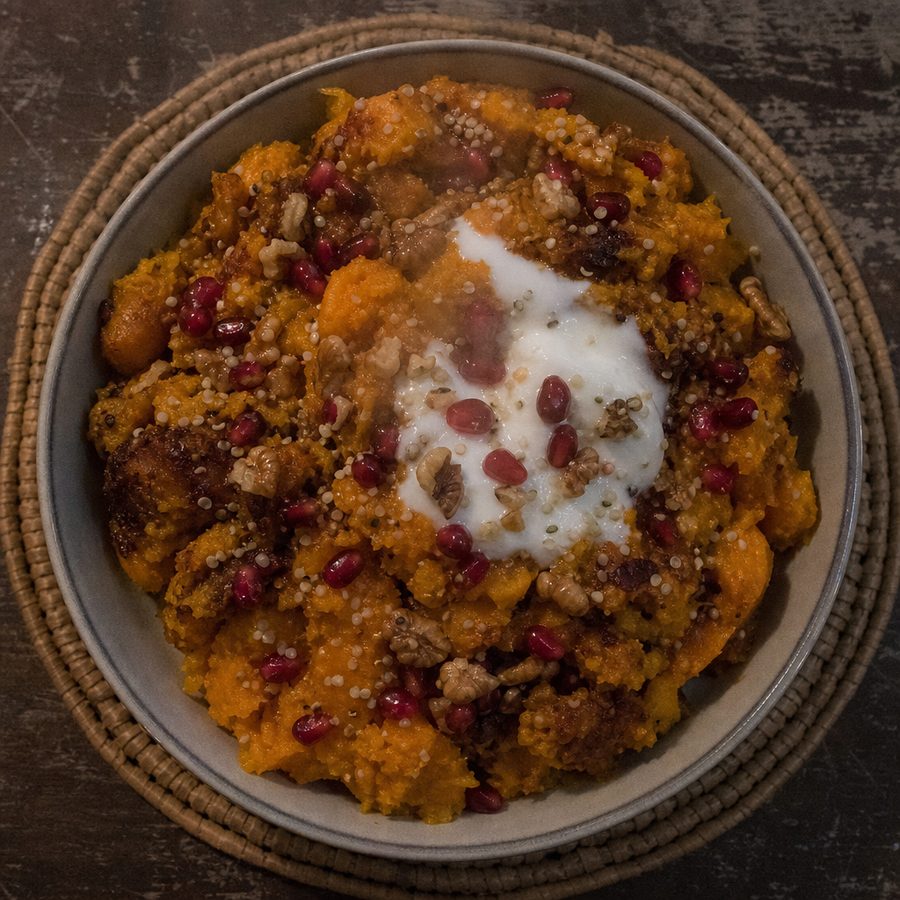
Acorn squash roasted until the cut faces caramelize, mashed warm with butter, cinnamon, and cloves, then topped with thick skyr, maple walnuts, hemp seeds, and pomegranate.
Why You'll Love This Recipe
This is the bowl I want in October, when the mornings turn and I have no interest in anything cold. Two small acorn squash roast while I am doing other things, and everything after that is mashing and topping. It is sweet the way a vegetable is sweet, which is to say gently, and the skyr over it keeps the whole thing from tipping into dessert. I roast the squash on a Sunday and build bowls through the week, so on a Tuesday morning this takes about four minutes. If you have only ever met acorn squash as a side dish at dinner, hot and spiced at breakfast is a different animal entirely.
Roasting is what makes this taste like anything at all. Cut side down on a buttered pan, the flesh touching the metal caramelizes into a brown, faintly sticky layer, and that layer is most of the flavor in the finished bowl. Squash that is steamed or microwaved is watery and tastes of very little, so give it the full forty minutes and let the edges go dark. Butter, cinnamon, and a pinch of ground cloves go into the flesh while it is hot enough to melt them together, and the salt is what keeps sweetness from being the only thing you taste.
The skyr is what turns a bowl of squash into breakfast. It is strained until it is dense, and it is tangy in a way that cuts the maple, and spooned onto hot squash it loosens at the edges and goes half melted, which I like better than either part on its own. The walnuts get a minute in a skillet with maple and salt until they turn glossy and smell toasted, and the pomegranate seeds go on last for a cold sharp pop. Every element in the bowl is a different temperature, and that is what keeps you interested down to the bottom.
Ingredients
- 2 small acorn squash (about 2 lb total), halved and seeded
- 2 1/2 cups plain skyr
- 1/2 cup walnut halves, roughly chopped
- 2 tbsp maple syrup, divided
- 2 tbsp butter, divided
- 1 1/4 tsp ground cinnamon
- 1/8 tsp ground cloves
- 3 tbsp hemp seeds
- 1/3 cup pomegranate seeds
- 1/2 tsp fine sea salt, divided
Instructions
- Roast the squash: Heat the oven to 400°F (200°C). Melt 1 tablespoon of the butter and brush it over the cut faces of the squash halves, then season them with 1/4 teaspoon of the salt. Set them cut side down on a sheet pan, since the steam that gets trapped under the cut face cooks the flesh while the exposed edge caramelizes against the metal, and roast 35 to 40 minutes, until a knife slides through the skin with no resistance and the cut faces have gone deep brown where they met the pan.
- Make the maple walnuts: While the squash roasts, warm the chopped walnuts in a dry skillet over medium heat for 2 minutes, until they smell toasted. Add 1 tablespoon of the maple syrup and a pinch of salt, stir for 45 seconds until the nuts are glossy and the pan is nearly dry, then tip them onto parchment to cool, because the coating sets hard as it cools and nuts left in the pan weld themselves to it.
- Scoop and mash: Let the squash sit until you can handle it, about 5 minutes, then scoop the flesh into a bowl and leave the skins behind, since acorn skin stays tough where delicata skin softens. Add the remaining butter, the cinnamon, the cloves, and the remaining salt, and mash with a fork until it is smooth but still has some texture.
- Adjust it: Taste and add the remaining maple syrup if your squash is on the bland side, which varies a great deal from one to the next. If the mash seems stiff, stir in a tablespoon or two of hot water until it drops softly from the spoon, because squash varies enormously in how much water it holds and no fixed measure would be right twice. Keep it warm.
- Spoon on the skyr: Divide the warm squash among four bowls. Add a large spoonful of skyr to each one off the heat, so it sits on the surface and softens at the edges rather than being stirred in, which is what keeps the two textures distinct.
- Finish the bowls: Scatter the maple walnuts, the hemp seeds, and the pomegranate seeds over the top. Serve right away, while the squash is still hot enough to melt the underside of the skyr.
Variations
- Delicata version: Roast delicata squash in its place, which takes about 25 minutes and has skin tender enough to mash right in with the flesh.
- Dairy-free: Use coconut oil in place of the butter and spoon thick coconut yogurt over the top.
- Different nuts: Pecans or walnut and pumpkin seed mixed together candy just as well in the maple pan.
- Berry version: Trade the pomegranate for raspberries or blueberries scattered over the skyr.
- Savory turn: Leave out the maple and the cinnamon, mash the squash with black pepper and thyme, and top it with feta and toasted pumpkin seeds.
Storage & Leftovers
The mashed squash keeps in a sealed container in the refrigerator for 4 days and is the whole reason to make this on a Sunday. Store the maple walnuts in a jar at room temperature, where they stay crisp for a week, and keep the pomegranate seeds in their own small container so they do not stain everything.
Reheat a portion of the squash in a small pan over medium-low for about 3 minutes, or in the microwave in one minute bursts, stirring between them. The skyr goes on after the squash is hot and never into the pan, since heating it directly makes it grainy and thin. Build the toppings fresh each morning.
Roasted squash freezes well for up to 3 months, either mashed in flat portions or in whole scooped halves. Thaw overnight in the refrigerator and expect a little water to separate out, which you can stir back in or pour off. The skyr and the pomegranate should never see the freezer.
Notes & Tips
- Cut side down, always: Face up, the squash bakes and stays pale. Face down, the flesh touching the hot pan caramelizes, and that browned layer is where the flavor lives.
- Halving a squash safely: Cut a thin slice off one side so the squash sits flat on the board and cannot roll, then bring the knife down through the stem end. A wobbling squash is how people cut themselves.
- Spice it while it is hot: Cinnamon and cloves stirred into hot flesh melt into it. Added once it has cooled, they sit on the surface and taste dusty.
- Do not cook the skyr: It goes grainy and splits over direct heat. Spoon it onto the hot squash at the table and let the warmth of the bowl soften it from underneath.
- Watch the walnuts: Maple in a hot pan goes from glossy to burnt in under a minute. Keep them moving and get them onto parchment while they still look wet.
- Taste before you sweeten: Squash varies enormously in sweetness from one to the next. Taste the mash first, then decide whether the second spoonful of maple is going in.
Nutrition & Mindful Eating
- Squash, skyr, and walnuts each bring something the others cannot. The squash brings the sweetness and the color, the skyr brings the protein and the tang, and the walnuts bring fat and crunch to a bowl that is otherwise entirely soft.
- Acorn squash grows sweeter and deeper the longer it roasts, and its orange flesh is where the beta carotene comes from, the same thing giving it that color. It also carries potassium and enough fiber to keep the sweetness gentle.
- Skyr is strained for a long stretch, which is why it is dense enough to sit on top of the squash rather than run off it, and why a modest spoonful carries so much protein. Its tang is the thing that keeps this bowl from eating like dessert.
- Walnuts turned in maple and salt for a minute go glossy and faintly bitter at the edges, and they bring the omega-3 fat walnuts are known for. Pomegranate seeds go over cold at the very end, and they are the sharpest texture in the bowl.
- Cinnamon and a pinch of cloves go into the squash while it is still hot, so the spice runs all the way through rather than sitting on the surface. Between the skyr, the walnuts, and the hemp seeds, a bowl this size stays with you well into the morning.
- As you eat, pay attention to the places where the cool skyr has gone half melted into the hot squash, and let your spoon slow down there rather than working straight through to the bottom of the bowl.
Frequently Asked Questions
Can I use a different squash?
Delicata roasts in about 25 minutes and has skin tender enough to eat, and kabocha is drier and sweeter and takes closer to 45. Both work here. Watch the portion with butternut, which sits well in smaller amounts, and roast whatever you choose until the cut faces are genuinely brown.
My squash came out watery. What went wrong?
Either it was crowded on the pan or it was covered with foil, and both trap steam. Give the halves space, leave the pan uncovered, and set them cut side down so the moisture escapes into the hot metal and the sugars caramelize. A watery mash can be saved by drying it in a pan for a few minutes.
Can I make the whole thing ahead?
The squash, yes, up to 4 days ahead, and the walnuts up to a week. I would not build the bowls in advance, because the skyr weeps into the squash overnight and the walnuts go soft. Assembly takes about two minutes once the squash is warm.
Does this fit a low-FODMAP breakfast?
It does, with an eye on the portion. Keep to about a cup of squash per bowl, which is what this recipe gives you. Skyr is strained for a long time, so what lactose it started with is largely gone, and the sweetness comes from maple and pomegranate rather than from honey, which a plan like this removes.