
Rolled Beef Roast Stuffed with Leeks and Bacon
A butterflied sirloin roast spread with soft leeks, bacon, and parsley, then rolled, tied, and roasted over shallots and parsnips until it slices into pink spirals.
Why You'll Love This Recipe
I make this when I want dinner to look like an occasion without actually being difficult, which in practice means a birthday, a first cold Friday, or the night somebody is coming who I want to feed properly. Almost all of the work is a sharp knife and a length of kitchen string, and none of it is fussy once you have done it once. The filling can be made the day before and kept in the refrigerator, and the roast itself sits in the oven for under an hour while the parsnips and shallots roast underneath it in the drippings. What comes to the table is a spiral, and people always look at a spiral.
Three details carry this. First, pound the butterflied roast to an even thickness, because a piece that is thick at one end will be raw there while the thin end is gray. Second, let the leek and bacon filling cool completely before it goes on the beef, since warm filling starts cooking the meat from the inside and makes the roll slump when you cut it. Third, tie it snugly every inch and a half. A loose roll unwinds in the pan and the filling ends up on the parsnips, which is not the end of the world but is not what you were after. Sear it hard, then let a moderate oven finish it gently.
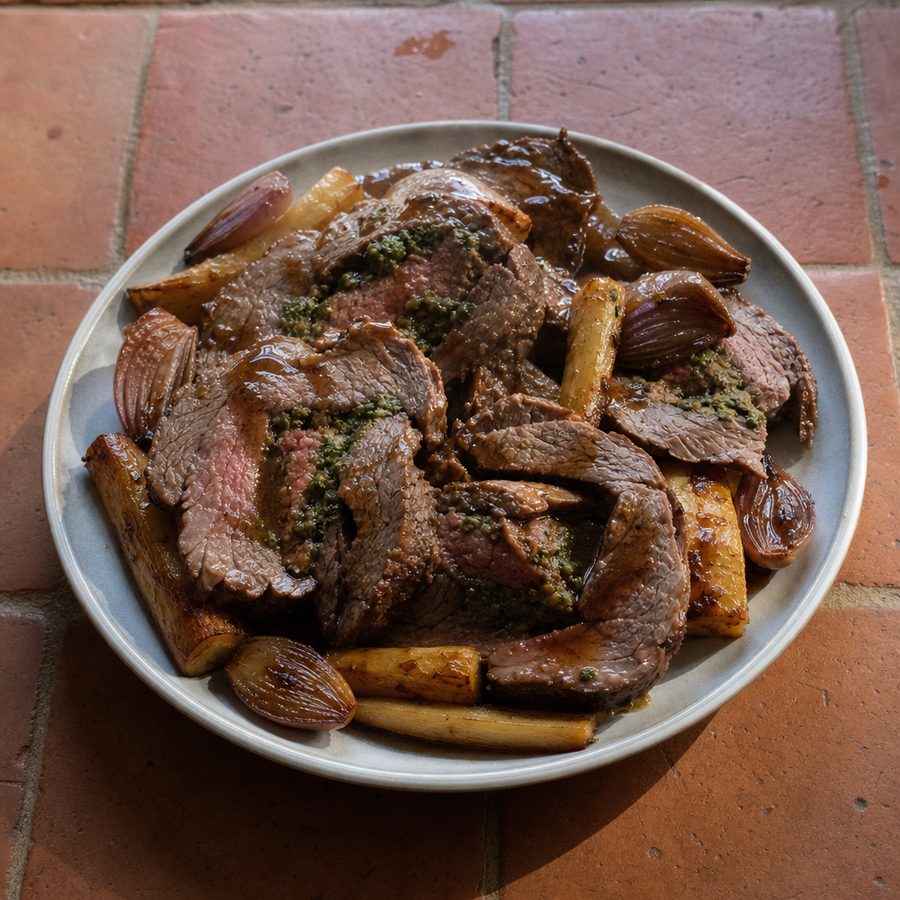
Cut it into thick slices and every one shows the same green and pink spiral, soft leeks running through firm beef with little dark flecks of bacon. Sirloin is close-grained and slices cleanly rather than shredding, so it eats like a proper roast, and pulling it at 130°F (54°C) keeps the center rosy and juicy. The parsnips underneath do something quietly good, taking on the fat and juices as they roast and turning sweet at the cut faces. A cup of broth swirled into the hot pan afterward, with lemon juice off the heat, becomes a thin sharp sauce that is all the plate needs.
Ingredients
- 2 1/2 lb boneless top sirloin roast, in one even piece
- 2 large leeks, white and pale green parts only, halved and thinly sliced
- 4 slices bacon, chopped small
- 1 lb parsnips, peeled and cut into 3-inch batons
- 6 shallots, peeled and halved through the root
- 4 cloves garlic, finely chopped
- 1/3 cup chopped fresh parsley
- 1 tbsp fresh thyme leaves
- 2 tbsp olive oil, divided
- 1 cup beef broth
- 1 tbsp fresh lemon juice
- 1 1/2 tsp fine sea salt, divided
Instructions
- Cook the filling: Heat a skillet over medium and cook the bacon for 5 minutes, until the fat has rendered and the pieces are just crisp. Add the leeks, garlic, and thyme with 1/4 teaspoon of the salt and cook for 8 to 10 minutes more, stirring often, until the leeks are completely soft and sweet. Take the pan off the heat, stir in the parsley, and spread the filling on a plate to cool to room temperature, since a warm filling rolled into raw beef starts cooking the inside of the roast before it ever sees the oven.
- Butterfly and pound the roast: Set the roast on a board with the grain running left to right. Slice it horizontally almost all the way through, stopping half an inch from the far edge, and open it like a book. Cover with a sheet of parchment and pound with a heavy pan or mallet until it is an even 3/4 inch thick all over, because a roll that is thicker at one end cooks to two different temperatures.
- Stuff, roll, and tie: Spread the cooled filling over the beef, leaving a 1-inch border on all sides. Roll it up snugly from the long edge nearest you, keeping the grain running the length of the roll, so that the slices you cut later run across the grain and eat tender, and tie it with kitchen string at 1 1/2 inch intervals. Season the outside all over with 1 teaspoon of the salt.
- Sear the roll: Heat the oven to 375°F (190°C). Warm 1 tablespoon of the olive oil in a large oven-safe skillet or roasting pan over medium-high heat and brown the roll on all four sides, about 8 minutes total, turning it with tongs as each face colors, since an oven at 375°F will cook the meat through but it will never give it a crust. Lift it onto a plate.
- Roast over the vegetables: Toss the parsnips and shallots with the remaining oil and salt and spread them in the pan. Set the roast on top and roast for 45 to 55 minutes, until a thermometer in the center of the meat reads 130°F (54°C) for medium-rare. Move the roast to a board, tent it loosely, and rest it for 15 minutes, because a rolled roast cut straight from the oven loses its juices and its spiral at the same moment, while the vegetables finish if they need a few more minutes.
- Make the pan sauce and slice: Set the pan over medium heat, pour in the broth, and scrape up everything stuck to the bottom. Simmer for 3 to 4 minutes until slightly reduced, then take it off the heat and stir in the lemon juice. Snip off the strings, cut the roast into 3/4 inch slices, and spoon the sauce over the slices and vegetables.
Variations
- Mushroom and leek: Cook 8 ounces of finely chopped mushrooms with the leeks until all their liquid has gone for a darker, earthier filling.
- Kale and lemon zest: Add two handfuls of finely chopped kale to the pan with the leeks and finish the filling with the zest of a lemon.
- Bacon-free: Leave the bacon out, cook the leeks in an extra tablespoon of olive oil, and add a tablespoon of balsamic vinegar for depth.
- Root swap: Use carrots or turnips in place of the parsnips when you want the vegetables underneath savory rather than sweet.
- Cold roast plate: Chill the roast completely, slice it thin, and serve it with a lemon and olive oil dressing for a cold plate the next day.
Storage & Leftovers
Sliced leftovers keep in a sealed container in the refrigerator for up to 3 days. Pour any remaining pan sauce over the slices before you close the lid, because roast beef dries from the cut faces inward and a little liquid around them keeps the edges soft.
Reheat covered in a low oven, around 300°F (150°C), for 10 minutes, or eat the slices cold, which is genuinely good with a little lemon squeezed over. Skip the microwave if you can, since it drives the juices out of a rare slice in seconds and turns the leeks in the spiral watery.
The roast freezes best whole and unsliced. Wrap a cooled half tightly and freeze for up to 2 months, then thaw overnight in the refrigerator and warm it covered before slicing. Roasted parsnips do not freeze well, so use those up first and roast a fresh tray if you want them again.
Notes & Tips
- Cool the filling first: Warm filling starts cooking the inside of the beef and makes the roll slump when it is cut. Spread it on a plate and give it 15 minutes.
- Wash the leeks well: Grit hides between the layers and cannot be picked out of a finished roast. Halve them lengthwise and fan the layers under cold running water.
- Pound to an even thickness: The pounding is not about tenderizing. It is about a flat sheet of beef that rolls evenly and cooks at the same rate end to end.
- Keep the grain running lengthwise: Roll so that the grain runs the length of the roll. That way each slice cuts across the grain and stays tender.
- Use a thermometer: Pull it at 130°F (54°C) for medium-rare. Carryover heat adds a few degrees during the rest, and a stuffed roast is too much work to guess at.
- Rest before you slice: Fifteen minutes lets the juices settle back through the meat. Cut it early and they run onto the board, taking the sauce with them.
Nutrition & Mindful Eating
- The beef, the leeks, and the roots under the pan are doing different jobs on this plate. The sirloin brings the substance, the leek and bacon filling brings salt and sweetness right through the middle of it, and the parsnips catch the drippings so nothing tastes plain.
- Sirloin is close-grained and firm, which is why it slices into clean spirals rather than pulling apart, and a roast this size carries the protein and the B12 that make dinner feel finished when you stand up from the table.
- Leeks are the reason the filling tastes sweet rather than sharp. Ten minutes over gentle heat softens them completely, and they carry the kind of fiber gut bacteria feed on, in a form that sits easily with people who find raw onion difficult.
- Parsnips roast in the fat that drips off the meat and turn deep gold at their cut faces, and behind that sweetness is a good amount of fiber, which is part of why a plate with roots on it holds you longer than one without.
- Bacon, thyme, and browned shallot are what you smell while it roasts, and the tablespoon of lemon juice stirred into the pan sauce off the heat is what keeps a rich roast tasting bright rather than heavy.
- As you eat, look at the spiral in the slice before you cut into it, notice how the sweet leeks land against the beef, and let the meal go slowly enough that you feel full before the plate is empty.
Frequently Asked Questions
What if my butcher will not butterfly the roast?
Do it yourself with a long thin knife, or ask for a flank steak instead, which comes flat and needs no butterflying at all. A flank rolls beautifully and cooks faster, around 35 minutes at the same temperature, so start checking the thermometer early.
My roll fell apart when I sliced it. What went wrong?
Usually one of two things. The ties were too far apart, so the layers loosened in the oven, or the roast was sliced before it rested and the filling had not set. Tie every inch and a half, rest the meat a full 15 minutes, and use a sharp serrated knife with a sawing motion rather than pressing down.
Can I prepare it in advance?
The filling can be cooked up to 2 days ahead, and the roast can be stuffed, rolled, and tied the morning of. Keep it wrapped in the refrigerator, then let it sit on the counter for 30 minutes before it goes into the pan so the center is not fridge-cold when it starts cooking.
Does this work for an AIP elimination phase?
Yes. There is no flour, breadcrumb, dairy, egg, or nightshade anywhere in it, and the filling is leeks, garlic, thyme, and parsley. Read the bacon label carefully, since cured meats often carry sugar, paprika, or celery powder blends, and choose one cured with salt alone.