
Salmon with Roasted Brussels Sprouts & Butternut Squash
A hands-off sheet-pan salmon with caramelized Brussels sprouts and roasted butternut squash for an easy AIP dinner.
Why You'll Love This Recipe
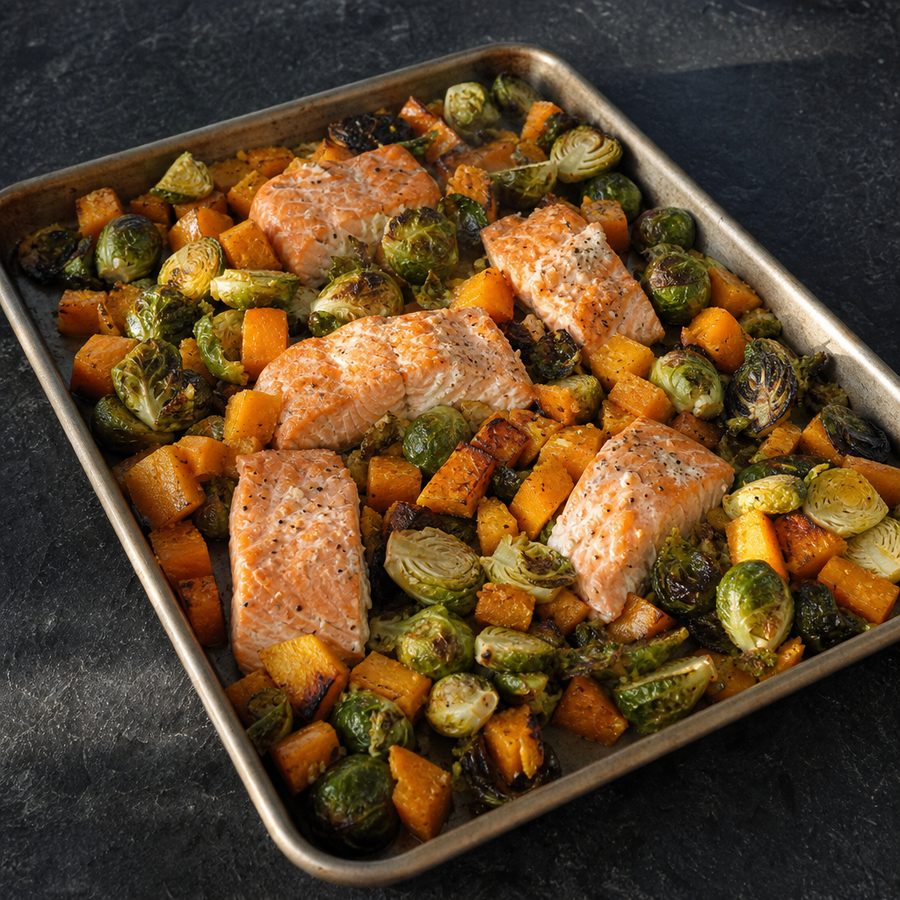
Salmon roasted with Brussels sprouts and butternut squash on a single pan, with the vegetables going in first so the fish is not sitting in a hot oven waiting for them. That order is the whole design. Squash and sprouts want twenty-five minutes to caramelize and salmon wants ten to twelve, so any sheet pan dinner that starts them together is choosing which of the two to ruin. Fifteen minutes for the vegetables on their own, then the fillets go into the middle, and both arrive at the same moment.
Put the Brussels sprouts cut side down, every one of them, and spend the extra minute it takes. That flat cut face against hot metal is where the browning happens, and browning is the entire difference between a sprout worth eating and one that gets pushed to the edge of the plate. Sprouts left on their round backs steam in their own moisture and come out pale and faintly sulfurous. It is the same reasoning behind leaving space around everything rather than filling the pan.
Salmon covers protein and fat while the squash and sprouts cover fiber, so nothing else is needed on the plate. The browned edges are worth as much as the ingredients themselves, since a sprout that has caught color on a hot pan tastes nutty and sweet where a steamed one tastes of almost nothing, and the same is true of the squash. That is the whole argument for the high oven and the single layer. If you want fish you can eat with your hands, there is our Blackened-Style Tilapia Collard Green Wraps.
Ingredients
- 4 salmon fillets (about 5 oz each)
- 1 lb Brussels sprouts, halved
- 1 small butternut squash, cubed
- 3 tbsp olive oil
- 3 cloves garlic, minced
- 1 tbsp lemon juice
- Salt to taste
Instructions
- Cut the vegetables to match each other: Heat the oven to 425°F (220°C). Halve the Brussels sprouts through the stem so each half holds together rather than falling into leaves, and cut the squash into one-inch cubes. What matters is that the two are close to the same size, because a pan of mixed cuts hands you burnt squash and half-raw sprouts at the same moment. Peeled and cubed squash from the store is a fair shortcut, but look through it and cut down any pieces much bigger than the rest.
- Oil, salt, and space, then fifteen minutes alone: Toss the sprouts and squash with two tablespoons of the olive oil, the garlic, and salt, then spread them over a sheet pan in one layer, sprouts cut side down, with room around everything. Two pans beat one crowded pan every time, because vegetables packed tight release steam that has nowhere to escape to and they braise rather than roast. Roast for fifteen minutes and resist stirring them, since the undersides need uninterrupted contact with the metal to brown.
- Clear the middle and dry the fillets: Pull the pan out and push the vegetables to the edges to clear four spaces in the center, where the heat is most even. Pat the salmon dry, set the fillets skin side down in the gaps, brush them with the last tablespoon of oil, and season with salt. Dry fish browns and wet fish steams, and the whole difference is one paper towel. If a fillet has a thin tail end, fold it back under itself so the piece cooks as one thickness.
- Ten to twelve minutes, and check the thickest part: Roast for another ten to twelve minutes, until the salmon flakes under gentle pressure at its thickest point and the flesh has turned opaque. The USDA figure for fish is 145°F, while plenty of people pull salmon nearer 125 to 130°F for a fillet still slightly translucent in the middle, so cook to whichever you prefer. Either way take it out about five degrees short, because it keeps cooking on a hot pan. Squeeze the lemon over the whole tray as it comes out.
- Give it two minutes, then taste a sprout: Let the pan sit for two minutes, then taste one of the Brussels sprouts. Roasted vegetables almost always want more salt than they were given at the start, because they lose a great deal of water in the oven and everything except the seasoning concentrates along with it. A pinch scattered over the pan now does more than twice as much would have done at the beginning, and it is the step that most often separates a sheet pan dinner people go back to from one they do not.
Variations
- Add more vegetables: red onion and carrot roast on the squash's schedule. Add them at the beginning, well before the salmon goes on.
- Make it warmer: toss the vegetables with ground ginger and a little turmeric before they go in, so the warmth roasts into them rather than landing on the fish.
- Add something sweet and sharp: a drizzle of balsamic over the sprouts in the last few minutes, or a handful of dried cranberries stirred in at the end, plays against the squash.
- Change the fish: arctic char and steelhead trout roast in the same window, and thick cod fillets work if you add them a couple of minutes later.
- Finish with herbs: chopped dill or parsley scattered over everything as it comes out of the oven lifts the whole pan.
Storage & Leftovers
Refrigerate leftovers in an airtight container and eat the salmon within three days. It holds up better than white fish does, but the oils that make it worth eating also pick up a strong smell in the refrigerator past that point, particularly sealed under a lid. Keep the fish and the vegetables in separate containers where you can, since the squash keeps giving off moisture and the salmon sits in it.
Reheat at 350°F (175°C) for eight to ten minutes, loosely covered, so the fish does not dry out while the vegetables come back up to temperature. Salmon is one of the few things that reheats better low than hot: high heat squeezes the fat out and leaves it dry and strong tasting. If you want the edges back on the sprouts, give the vegetables a minute under the broiler once the fish is warm.
Cooked salmon freezes acceptably for a month, although it comes back noticeably drier and is better flaked into a salad or a grain bowl than served as a fillet again. Roasted butternut squash freezes well and roasted Brussels sprouts do not, thawing limp and watery. If you are cooking for the freezer on purpose, roast an extra tray of squash rather than doubling the whole pan.
Notes & Tips
- Do not overcook the salmon: pull it the moment it flakes and still looks just opaque in the center. A minute too long dries it out.
- Stagger the timing: start the squash and sprouts alone and add the salmon partway through. The fish needs far less time than the vegetables do.
- Cut the squash small: one inch cubes finish in the time given, and anything much larger will still be firm when the salmon is ready.
- Sprouts cut side down: laying the halves face down on the pan is what gives you the browned, caramelized surface rather than a steamed one.
- Use one big pan or two: everything needs to sit in a single layer, so reach for a second sheet rather than piling it all onto one.
- Flexible swap: no garlic? You can leave it out, or use a pinch of garlic-free all-purpose seasoning.
Nutrition & Mindful Eating
- Salmon, sprouts and squash share one pan and finish together. The fish brings its rich silky flesh, the squash brings sweetness, and the sprouts bring the browned slightly bitter edge that keeps the plate in balance.
- Salmon is the reason this pan is worth heating. It roasts into large soft flakes, the fat running through it keeping the fillet moist, and that same fat is where the omega-3s and the vitamin D come from.
- Butternut squash comes off the tray closer to a dessert than a side, collapsing sweet and silky where the cubes touched the metal. The color it turns is beta-carotene, and the oil around it is what carries that in, with fiber and potassium alongside.
- Brussels sprouts, halved and laid cut side down, blister on that face while the loose outer leaves go crisp as paper, and dry heat holds onto more of their vitamin C than a pot of water would.
- Lemon and garlic are the finish. The garlic toasts in the oil and turns sweet, and a squeeze of lemon over the hot fish cuts its richness and pulls the sweet squash and the browned sprouts onto the same plate.
- As you eat, watch how easily the salmon separates under the fork and how different the crisp sprouts feel next to the soft squash, and let the meal set the pace rather than your schedule.
Frequently Asked Questions
Is salmon AIP-compliant?
Wild or farmed salmon is fully AIP-friendly and a great source of anti-inflammatory omega-3 fats.
Can I use frozen salmon?
Yes, just thaw it fully and pat it dry so it roasts rather than steams.
How do I know the salmon is done?
It's ready when it flakes easily with a fork and looks just opaque in the middle. It's better to pull it a touch early than to overcook it.
How long does it keep?
Three days for the salmon and four for the vegetables, and both keep better in separate containers. Reheat at 350°F (175°C) for eight to ten minutes, covered, which is gentler on the fish than a hot oven. The vegetables can take a minute under the broiler afterward if you want their edges back.