
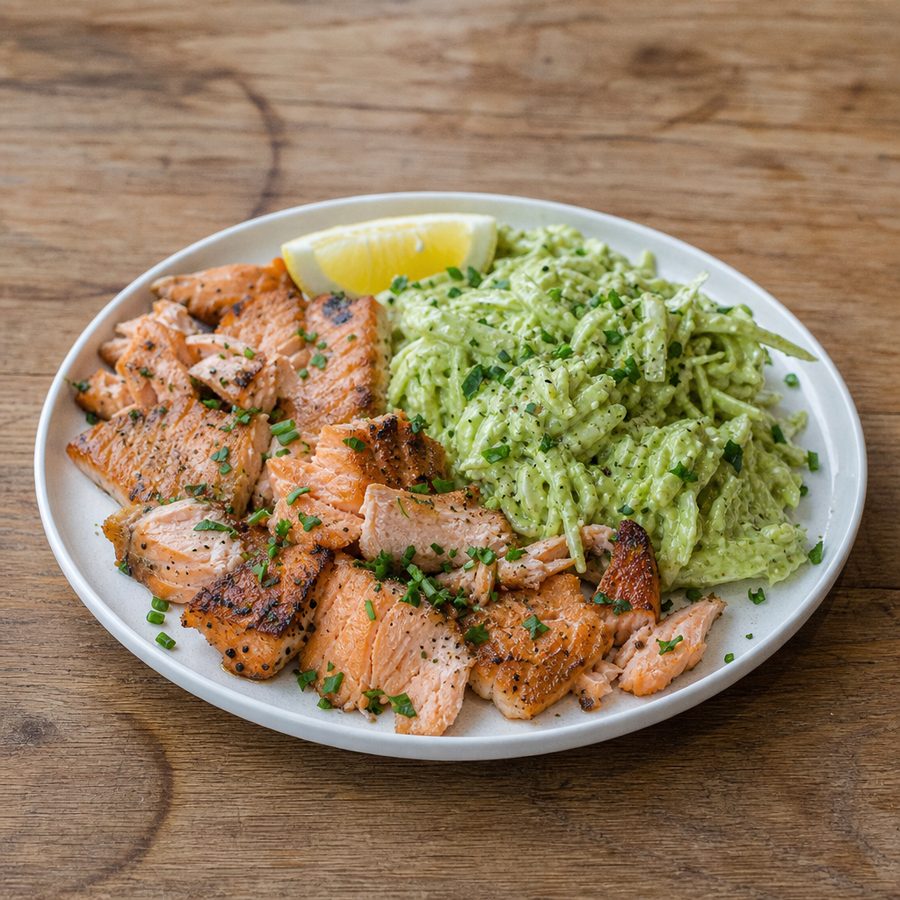
Salmon and Celeriac Remoulade Breakfast Plate
Roasted salmon over a cold celeriac remoulade bound with mashed avocado, lemon, and cider vinegar, with chives and parsley through it for a savory morning plate.
Why You'll Love This Recipe
Mornings on an elimination phase get repetitive fast, and the thing people miss most is not a particular food but the feeling of having eaten something composed. This is that plate. It is cold and creamy on one side, warm and rich on the other, and it takes about half an hour start to finish. I make it on a Saturday when I want to sit down with a fork and a knife rather than drink breakfast standing up, and I make a double batch of the remoulade so that Monday morning is nothing more than roasting a piece of fish and spooning the rest onto the plate beside it.
Classic remoulade is celery root in a mustard mayonnaise, and both of those are off the table here, so the sauce is built on a very ripe avocado instead. Mashed hard with lemon juice, cider vinegar, and olive oil, it goes glossy and thick and coats the shreds the way the original does. The acid is not optional. It keeps the avocado green, it keeps the celeriac from browning at the cut edges, and it is what stops something this rich from tasting flat. Give the dressed celeriac ten minutes to sit before you serve it and the shreds soften just enough to stop crunching at you.
Salmon roasts while the remoulade rests, which is the whole reason this works on a weekday. A hot oven and ten minutes gets you fish that flakes in wide pieces with a still-glossy center, and the fat in it is what carries the meal for hours. Warm fish against a cold, sharp, herby slaw is one of those contrasts that makes a simple plate taste considered, and the chives and parsley go on at the end so they stay green and grassy rather than turning dull and sad in the bowl.
Ingredients
- 4 skin-on salmon fillets (about 1 1/3 lb total)
- 1 small celeriac (about 14 oz), peeled and coarsely shredded
- 1 large ripe avocado
- 2 tbsp fresh lemon juice, divided
- 1 tbsp apple cider vinegar
- 2 tbsp olive oil, divided
- 3 tbsp finely chopped fresh chives
- 2 tbsp chopped fresh flat-leaf parsley
- 1 tsp fine sea salt, divided
Instructions
- Heat the oven and prep the celeriac: Heat the oven to 425°F (220°C) and line a sheet pan with parchment. Peel the celeriac with a knife, since the skin is too knobbly for a peeler, then shred it on the large holes of a box grater or with the shredding disc of a food processor. Toss it immediately with 1 tablespoon of the lemon juice so it does not brown.
- Make the remoulade dressing: Scoop the avocado into a bowl and mash it hard with a fork until it is smooth rather than lumpy. Work in the cider vinegar, the remaining lemon juice, 1 tablespoon of the olive oil, and half the salt. It should look like a thick pale green dressing and taste sharp on its own.
- Dress and rest the celeriac: Fold the dressing through the shredded celeriac until every strand is coated, then stir in the chives and parsley. Let it sit at room temperature for at least 10 minutes while the fish cooks, which softens the shreds and lets the acid work through them.
- Roast the salmon: Pat the fillets dry, rub them with the remaining olive oil, and season with the rest of the salt. Set them skin side down on the sheet pan and roast for 10 to 12 minutes, until the flesh turns opaque at the edges and separates into wide flakes when you press the thickest part with a fork, about 130°F (54°C) for a glossy center. That is short of the FDA figure of 145°F (63°C) for seafood, which is the number to use instead if you want the fillet opaque the whole way through.
- Build the plates: Spoon a generous mound of the remoulade onto each plate and set a fillet beside it while the fish is still warm. Taste the remoulade once more for acid, add a squeeze of lemon if it needs waking up, and serve straight away.
Variations
- Apple and celeriac: Shred half a tart apple in with the celeriac for a sweeter remoulade that still stays savory against the fish.
- Herb swap: Trade the parsley for chopped fresh dill or tarragon, both of which sit naturally with salmon and give the plate a more classically French edge.
- Peppery greens: Pile a handful of watercress or arugula under the remoulade so there is something bitter cutting through the avocado.
- Trout instead: Swap the salmon for trout fillets and drop the roasting time to about 8 minutes, since the fillets are thinner.
- Fennel and lemon: Shave a small bulb of fennel into the celeriac for anise sweetness and a crunchier plate that eats well on a warm morning.
Storage & Leftovers
The remoulade keeps in a sealed container in the fridge for two days. Press a piece of parchment right onto the surface before you put the lid on, since it is the air rather than the fridge that dulls the color of the avocado. The lemon and vinegar already in it do most of the protecting.
Cooked salmon holds for three days and is better cold than reheated. If you want it warm, use a covered skillet over low heat for two or three minutes rather than the microwave, which drives the fat out and leaves the fish chalky and smelling like the whole kitchen.
Neither part freezes. Celeriac turns limp and weeps once it has thawed, and avocado goes gray and watery, so treat this as a fresh plate and shred only as much celeriac as you plan to dress.
Notes & Tips
- Shred, do not chop: Long shreds are what make this eat like a remoulade. Cubes turn it into a salad and the dressing slides off them instead of clinging.
- Acid first, always: The lemon goes onto the celeriac the moment it is shredded. Two minutes of sitting bare is enough to give you gray edges you cannot undo.
- Buy the avocado ahead: This lives or dies on a properly ripe avocado. One that yields to gentle pressure at the stem end mashes smooth in under a minute.
- Dry the fish: Wet salmon steams and turns pale rather than roasting. Ten seconds with a paper towel gives you edges that firm up and color slightly.
- Watch the thin end: Fillets taper, so the tail cooks faster than the middle. Tuck the thin end under itself before roasting and the whole piece finishes at the same time.
- Season the slaw twice: Salt once in the dressing, then taste after it has rested. Celeriac absorbs seasoning as it softens and often wants a second small pinch.
Nutrition & Mindful Eating
- Salmon, avocado, and raw celeriac make an unusually complete plate. The fish brings the protein and the richness, the avocado turns into the sauce, and the shredded root keeps the whole thing crisp and fresh so nothing about it sits heavy.
- Salmon carries the long chain omega-3 fats, EPA and DHA, which are the forms your body uses directly, and they are part of why a piece of fish this rich holds you well past the middle of the morning.
- Celeriac shredded raw tastes like celery crossed with a nut, faintly sweet and faintly peppery, and the fiber that gives it that crunch is also what feeds the bacteria living in your gut.
- Avocado does the job of a sauce here because of its fat, and that same fat helps you absorb the fat-soluble vitamins sitting in the celeriac and the herbs beside it.
- Chives, parsley, lemon, and cider vinegar are what keep this bright. The acid sharpens everything it touches, which means the plate tastes finished with a light hand on the salt.
- As you eat, notice the swap between cool sharp remoulade and warm soft salmon, and let that contrast slow your fork down enough to tell when you have had enough.
Frequently Asked Questions
Can I use smoked salmon and skip the oven?
Yes, and it makes this a five minute breakfast. Drape a few slices over the remoulade cold and add an extra squeeze of lemon, since smoked fish is saltier than roasted. If you go that route, hold back the salt in the dressing and season at the table instead.
My celeriac browned before I dressed it. Is it ruined?
Not at all, it just looks tired. Celeriac oxidizes within minutes of being cut, which is why the lemon goes on the shreds before anything else happens. Toss the browned shreds with a little extra lemon juice and the color evens out under the green dressing anyway.
What if my avocado is not ripe enough to mash?
Then the dressing will be lumpy and the whole plate suffers. A firm avocado can be blitzed smooth in a small food processor with the lemon and vinegar, which is the rescue I use most often. Otherwise buy them a few days ahead and let them soften on the counter.
Does this work for an AIP elimination phase?
It does. There is no mustard, no mayonnaise, and no dairy in the dressing, and the seasoning is lemon, cider vinegar, chives, parsley, and salt. Everything on the plate is fish, root vegetable, fruit, and herbs, which is the shape an elimination breakfast wants to be.