
Salmon in Parchment with Bok Choy, Sesame, and Lime
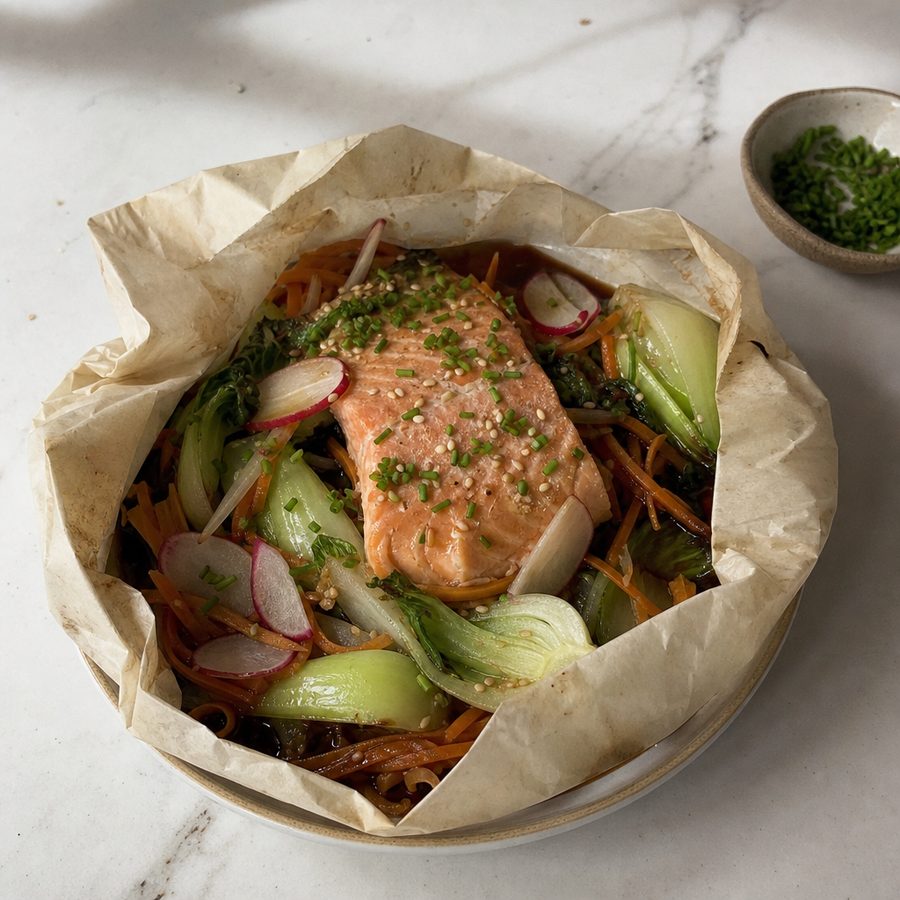
Salmon fillets sealed in parchment over baby bok choy, carrot, and radish with tamari, sesame, and lime, steamed in their own juices and opened at the table.
Why You'll Love This Recipe
Parchment is the method I reach for when I want dinner to be genuinely easy and still worth sitting down for. Four packets go together in fifteen minutes, bake for another fifteen, and land on the plate still puffed and sealed, and each person cuts their own open. The steam that comes out smells of sesame, lime, and hot greens, and it is the best part of the meal. There is one pan to wash and no splattered stovetop, which is why this ends up on a Wednesday more often than a Saturday. It also travels well to someone else's oven if you are cooking at a friend's place.
Nothing browns inside a packet, so the flavor has to be built into the liquid before it is sealed. Tamari, lime juice and zest, toasted sesame oil, garlic-infused olive oil, a little maple syrup, and a pinch of cayenne get whisked together and divided between the four packets, where they turn into a small pool of sauce as the vegetables release their water. The carrots and radishes go on the bottom cut thin so they cook in the same time as the fish, the bok choy sits on top of them, and the salmon rides above everything so it steams rather than boils.
Salmon is forgiving in parchment in a way it is not in a hot pan, because the packet holds it in gentle wet heat and the window between done and overdone stretches out to a few minutes rather than a few seconds. Pull the packets at fifteen minutes and the center will be just barely opaque, which is where salmon tastes best. What you get on the plate is a fillet in a shallow pool of dark, sharp sauce with bok choy that still has some structure at the stem. Chives and toasted sesame seeds go on after the paper is open.
Ingredients
- 4 salmon fillets, about 6 oz each, skin removed
- 1 lb baby bok choy (about 6 small heads), halved lengthwise and rinsed well
- 2 medium carrots, cut into thin matchsticks
- 6 radishes, trimmed and sliced 1/8 inch thick
- 2 tbsp certified gluten-free tamari
- 2 tbsp garlic-infused olive oil
- 1 tbsp toasted sesame oil
- 2 tbsp fresh lime juice, plus the zest of 1 lime
- 2 tsp maple syrup
- 1/4 tsp cayenne
- 1 tbsp sesame seeds, toasted
- 1/4 cup chopped fresh chives
- 3/4 tsp fine sea salt
- 1/2 tsp black pepper
Instructions
- Heat the oven and cut the paper: Heat the oven to 400°F (200°C). Cut four 15-inch squares of parchment paper and fold each one in half to crease the center, then open it flat again. Working on the crease gives you a hinge to fold against later, which is what keeps the packet sealed.
- Mix the sauce: Whisk the tamari, the lime juice and zest, the toasted sesame oil, the garlic-infused olive oil, the maple syrup, the cayenne, and the black pepper in a small bowl until the oils stop separating. Give it another stir right before you spoon it out, since it will split again as it sits.
- Build the packets: Divide the carrot matchsticks and the radish slices between the four sheets, piling them just to one side of the crease. Set 3 bok choy halves on each pile, cut side up. Pat the salmon dry, season it with the salt, and lay a fillet on top of the vegetables in each packet.
- Seal them: Spoon the sauce over the fish and vegetables, dividing it evenly. Fold the empty half of the parchment over the top, then work around the open edge making short, overlapping folds, pressing each crease flat, until the packet is sealed all the way around. Leave a little air inside so the steam has room.
- Bake: Set the packets on a rimmed sheet pan and bake for 14 to 16 minutes. They will puff up as the steam builds, which is the sign you sealed them properly. A 1-inch fillet is done at 15 minutes and will be barely opaque in the middle, which is where salmon tastes best.
- Open and finish: Slide each packet onto a plate and let them sit for 2 minutes. Cut an X in the top of each one and fold the paper back, standing clear of the first rush of steam. Scatter the chives and the toasted sesame seeds over the open packets and serve them in the paper, with the sauce pooled underneath.
Variations
- Sharper with ginger: Add a tablespoon of grated fresh ginger to the sauce for a sharper, warmer packet.
- Cod or halibut: Swap in a firm white fish of the same weight and cut the bake to 12 to 13 minutes, since a white fish dries out sooner in the steam.
- Chili crisp finish: Raise the cayenne to half a teaspoon and add a pinch of smoked paprika for a packet with real heat behind the lime.
- Over rice: Serve each packet tipped over a scoop of brown rice so the sauce has something to soak into.
- Grilled packets: Wrap the parchment in foil and cook the packets on a covered grill over medium heat for 14 to 16 minutes.
Storage & Leftovers
Cooked packets keep 3 days in the refrigerator, and the easiest thing is to leave dinner in the paper and refrigerate it sealed. The vegetables sit in the sauce overnight and taste more strongly of sesame and lime the next day than they did coming out of the oven.
Reheat in a covered skillet over low heat with a spoonful of water for 4 to 5 minutes, or eat it cold, which is genuinely good. A microwave overcooks salmon in about forty seconds and turns the surface of the fillet chalky, so the stovetop is worth the extra pan.
You can build the packets up to a day ahead and refrigerate them unbaked on a sheet pan, which makes this a good dinner to assemble in the morning. Add 2 minutes to the bake time if they go into the oven cold. Baked packets do not freeze well, since bok choy collapses on thawing.
Notes & Tips
- Cut the vegetables thin: Fifteen minutes of steam softens a matchstick and barely touches a chunk. The carrots and radishes have to be sliced thin to finish with the fish.
- Wash the bok choy properly: Grit hides where the stems meet at the base. Halve the heads first, then fan the layers under cold running water, since you cannot fix it once the packet is sealed.
- Why the infused oil works: Garlic flavor dissolves into oil while the FODMAPs in garlic stay behind in the water, so an infused oil gives you the taste without the part that sets off symptoms. It is the one place this way of eating gets something for nothing.
- Fold, do not twist: Short overlapping folds pressed flat make a seal that holds. A twisted corner opens in the oven, the steam escapes, and the fish bakes dry.
- Stand back when you open it: The steam that comes out is hotter than the oven air and it will catch the back of your hand. Cut an X and let it vent for a second before folding the paper back.
- Feeding people who are not on the plan: Whisk a grated garlic clove and a sliced scallion into a spoonful of the sauce and pour it into their packet before sealing. The packets cook side by side and nobody has to eat two dinners.
Nutrition & Mindful Eating
- Salmon, bok choy, and the sharp sauce work as one thing here. The fish brings the richness, the greens stay crisp enough to push back against it, and the lime and tamari keep every bite from going soft and one-note.
- Salmon is marbled with fat all the way through the fillet, which is why it stays moist in a sealed packet and where its omega-3 fats and vitamin D come from.
- Bok choy gives you two vegetables in one head, a stem that stays juicy and squeaks against the teeth and a leaf that goes silky in the steam, and it carries calcium and vitamin K along with that.
- Carrots and radishes sliced thin sweeten as they steam, and the beta-carotene that gives the carrots their color comes across better in this dish for having a little oil sitting in the packet with them.
- Toasted sesame, in the oil and the seeds both, is what makes this smell the way it does when the paper opens, and the seeds bring a small amount of crunch to a plate that is otherwise entirely tender.
- As you eat, let the steam off the open paper reach you before the first bite, notice the difference between the stem and the leaf of the same piece of bok choy, and slow down enough to chase the sauce at the bottom.
Frequently Asked Questions
Can I use foil rather than parchment?
You can, and it seals more easily, though it does not puff the same way and the fish steams a little harder. Do not use foil if you are marinating for long stretches in this much lime, since acid sitting against aluminum picks up a metallic taste. Parchment is worth buying for this.
How do I know it is done without opening it?
Go by time and thickness. A 1-inch fillet takes 15 minutes at 400°F (200°C), a thinner tail piece takes 12, and a thick center cut takes 17. If you need certainty, push an instant-read thermometer straight through the paper into the fish and look for 125°F (52°C) to 130°F (54°C), which is medium-rare. The FDA figure for seafood is 145°F (63°C) if you would rather have it cooked through.
What else can I put in the packet?
Anything that cooks in fifteen minutes and is cut thin. Zucchini half-moons, napa cabbage ribbons, thin green beans, and bell pepper strips all work. Avoid dense roots unless you slice them almost transparent, since a raw chunk of parsnip in the middle of a finished packet is a disappointment.
Does this fit a low-FODMAP dinner?
It does. The sauce is built on tamari, lime, toasted sesame, and a little maple rather than on onion or garlic, and garlic-infused olive oil brings that aroma in without the part that troubles you. Bok choy, carrot, and radish all sit comfortably at this portion, and certified gluten-free tamari keeps wheat out of the sauce.