
Sardines with Silky Skillet Eggplant, Olives, and Basil
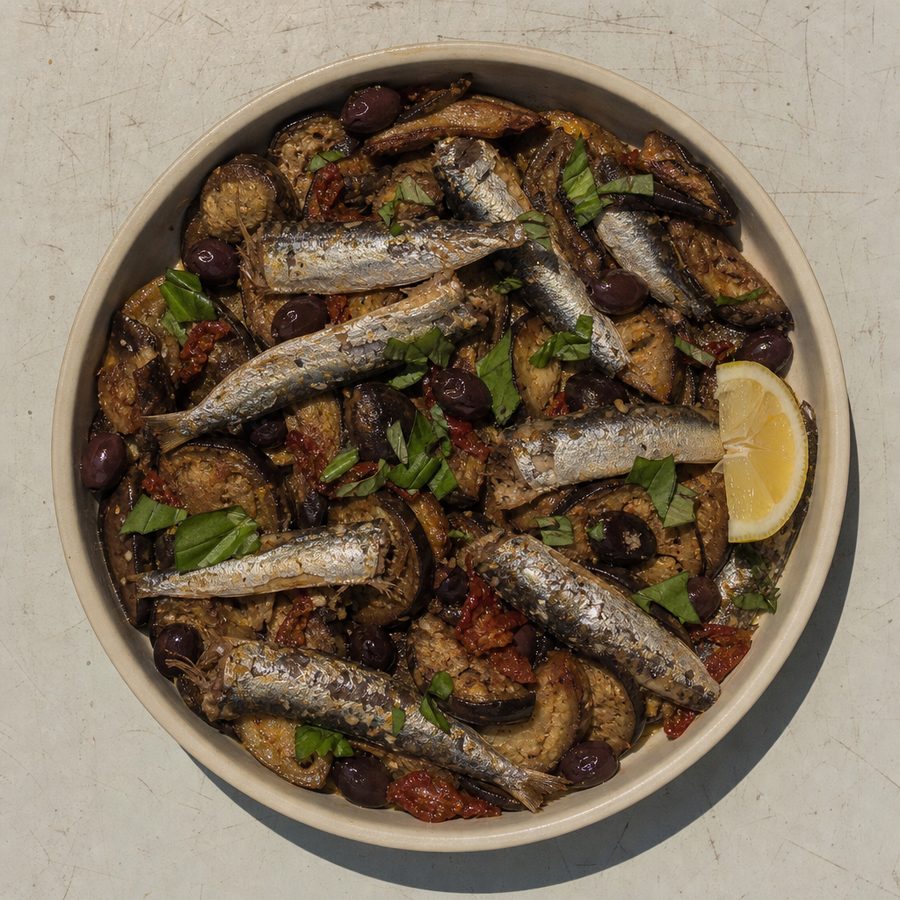
Eggplant salted, then fried slowly until it collapses, glazed with sun-dried tomato, olives, and balsamic, with whole sardines laid over the top and warmed off the heat.
Why You'll Love This Recipe
Half the world eats fish in the morning and most of the rest of us have decided that is strange, which is a shame, because a tin of sardines is the fastest protein in any kitchen. There is nothing to thaw and nothing to time. All the work in this plate belongs to the eggplant, and even that is twenty minutes of mostly standing nearby. I make the eggplant on a Sunday and keep it in a jar, and then breakfast on Tuesday is a spoonful of it warmed in a pan with a tin opened over the top. If sardines are new to you, this is a friendly place to start, because the eggplant is sweet and the olives are salty and the fish sits in good company.
Eggplant has a reputation for turning greasy, and it comes down to two things people do to it. The first is skipping the salt. Fifteen minutes under salt collapses the sponge structure so it takes up far less oil in the pan, and the water that beads out gets patted away. The second is adding more oil halfway through frying. Eggplant drinks whatever you give it in the first minute and then gives most of it back as it softens, so the pan that looks dry at minute three will look slick again at minute eight. Give it three tablespoons, spread the pieces out, and wait.
The last few minutes are what make it taste like more than fried vegetables. Sun-dried tomatoes sliced thin go in with the olives and dried oregano, then a tablespoon of balsamic hits the hot pan and reduces to a glaze in under a minute, so the eggplant ends up sweet, salty, and faintly sharp all at once. The sardines go on whole and off the heat, covered for two minutes so they warm through without breaking apart, and lemon juice, torn basil, and a good grind of pepper land at the table. Whole fillets look like dinner. Mashed ones look like something you gave up on.
Ingredients
- 4 cans (3.75 oz each) sardines in olive oil, drained
- 1 medium eggplant (about 1 lb), cut into 1/2-inch half-moons
- 3 tbsp garlic-infused olive oil, divided
- 1/3 cup oil-packed sun-dried tomatoes, drained and sliced thin
- 1/3 cup pitted kalamata olives, torn in half
- 1 tbsp balsamic vinegar
- 2 tbsp fresh lemon juice
- 1/2 cup fresh basil leaves, torn at the last minute
- 1 tsp dried oregano
- 1/4 tsp cayenne
- 1 tsp fine sea salt, divided
- 1 tsp freshly ground black pepper
Instructions
- Salt the eggplant: Cut the eggplant into 1/2-inch half-moons, spread them on a clean towel, and sprinkle with 1/2 teaspoon of the salt. Leave them 15 minutes, until beads of water sit on the cut faces, then press another towel over the top and pat them properly dry. This is the step that keeps them from drinking the whole pan.
- Fry the first batch: Heat 2 tablespoons of the garlic-infused olive oil in a large skillet over medium-high until it shimmers. Lay in half the eggplant in a single layer and cook 4 minutes without moving it, until the undersides are deep gold, then turn each piece and give it 3 minutes more. Move it to a plate.
- Fry the second batch and bring them back together: Add 1/2 tablespoon more oil, cook the rest of the eggplant the same way, and return the first batch to the pan. Lower the heat to medium and cook 2 minutes more, pressing gently with a spatula, until the pieces slump and look glossy rather than spongy. Resist adding oil while they fry, since they release what they took in.
- Glaze the pan: Stir in the sun-dried tomatoes, the olives, the oregano, the cayenne, and half the black pepper, and cook 1 minute until everything smells warm. Pour in the balsamic vinegar and toss for 30 to 45 seconds, until it has thickened around the eggplant and there is no thin liquid left in the pan.
- Lay the sardines over and warm them: Take the pan off the heat. Drain the sardines and lay them whole across the eggplant, spooning a little of the pan oil over each one. Cover the pan and leave it 2 minutes. The residual heat is enough to take the chill off the fish, and it means you never have to turn them, which is what breaks them.
- Finish and plate: Add the lemon juice, the remaining 1/2 tablespoon of garlic-infused olive oil, the rest of the black pepper, and the remaining salt only if it needs it, since the olives and the tins bring their own. Divide between four plates and tear the basil over each one at the last moment.
Variations
- Tomato-packed tins: Use sardines packed in tomato sauce and spoon the sauce over the eggplant as well, skipping the balsamic.
- With feta: Crumble 3 oz of feta over the hot eggplant just before the sardines go on so it softens without melting.
- Over a grain: Spoon it over 3 cups of warm millet or quinoa for a plate that carries you further into the morning.
- Roasted rather than fried: Toss the salted eggplant with the oil and roast at 425°F (220°C) for 25 minutes, turning once, then finish the glazing step in a skillet.
- Mint and chili: Swap the basil for torn mint and add sliced jalapeno with the olives for a sharper, hotter plate.
Storage & Leftovers
The eggplant is the part worth storing, and it is better on day two than on day one. Sealed in the refrigerator it keeps 4 days, and the flavors of the olive, tomato, and balsamic keep working into it while it sits. Store it on its own and open a fresh tin of sardines each morning rather than keeping the whole plate assembled.
Warm the eggplant in a skillet over medium for 3 to 4 minutes, or eat it cold, which is genuinely good and closer to how it would be served in Sicily. Sardines that were already warmed once will break up if you heat them again, so use fresh ones from the tin and let the hot eggplant do the work under them.
An opened tin of sardines keeps in the refrigerator 2 days if you move the fish and its oil into a small covered dish. Do not leave them in the metal tin. The eggplant does not freeze, since it turns watery and loses the texture the whole recipe is built around, so make what you will eat within the week.
Notes & Tips
- Salt the eggplant and dry it properly: Fifteen minutes under salt breaks down the sponge and pulls water to the surface, and a firm pat with a towel takes it away. Eggplant that goes into the pan damp steams first and browns never.
- Do not add oil once the frying starts: The pan will look dry at minute three. It is not. Eggplant takes up oil fast and releases most of it back as the flesh collapses, so anything extra you add is simply in the finished dish.
- Why garlic-infused olive oil works: Garlic flavor is fat soluble and the fructans that trouble a sensitive gut are water soluble, so oil steeped with garlic picks up the taste while the difficult part stays behind in the bottle. Some goes in at the start to fry with and a little at the end for the smell.
- Warm the fish, do not cook it: The sardines are already cooked in the tin. Two minutes under a lid off the heat is all they need, and it means they never get turned with a spatula, which is what breaks whole fillets into paste.
- Slice the sun-dried tomatoes thin: Whole halves are chewy and land in one bite. Sliced into slivers they distribute through the eggplant and give it a sweet, concentrated backbone in every forkful.
- Taste before the last salt: Between the olives, the tins, and the salting of the eggplant, this plate arrives most of the way seasoned. Taste it at the end and add the remaining salt only if it actually wants it.
Nutrition & Mindful Eating
- Sardines, eggplant, and olives set the character of this plate between them. The fish is rich and full flavored, the eggplant is sweet and soft enough to take a fork with no resistance, and the olives cut through both with salt and a little brine.
- Sardines are small fish eaten whole, soft bones included, and that is where the calcium comes from. They also carry the long chain omega-3 fats and vitamin D, which is a lot for something that arrives on the plate straight from a tin.
- Eggplant is mostly air and water until it meets a hot pan, and then it collapses into something almost creamy. It brings fiber along with the polyphenols that give the skin its deep purple, so leaving the peel on is worth doing for more than the color.
- Sun-dried tomatoes and kalamata olives are the concentrated flavors here. The tomatoes bring a sweet, savory intensity along with lycopene, and the olives bring the monounsaturated fat that keeps this plate satisfying rather than sharp.
- Dried oregano goes into the hot pan where its oils wake up, balsamic reduces to a glaze in under a minute, and lemon juice and torn basil land cold at the very end, which is what stops something this rich from tasting the same all the way through.
- As you eat, notice how completely the eggplant has given way under the fork and how the lemon and basil arrive after the salt does, and let a breakfast this savory be a reason to sit down properly.
Frequently Asked Questions
Which tins should I buy?
Look for sardines packed in olive oil with the bones left in, since the bones are soft enough to eat and are where the calcium comes from. Water-packed tins work and taste milder. Skinless and boneless fillets are fine too, though they are more delicate and want to go on the plate even more gently.
My eggplant came out greasy and spongy. What went wrong?
Almost certainly no salting, or oil added partway through. Salt first and pat dry, get the pan properly hot before anything goes in, and then hold your nerve. Eggplant looks like it is starving for oil at minute three and releases what it absorbed by minute eight, so adding more only lands in the finished dish.
Can I make this ahead for weekday mornings?
That is how I use it. Cook the eggplant through the glazing step on a Sunday, cool it, and refrigerate for up to 4 days. Each morning, warm a portion in a small skillet for 3 minutes, lay a fresh tin of sardines over it off the heat, and add the lemon and basil then. Breakfast takes five minutes.
Does this fit a low-FODMAP breakfast?
It does. Sardines and eggplant both sit comfortably here, the eggplant works out to about a cup per plate once it has cooked down, and the savory backbone is olives, sun-dried tomato, oregano, and garlic-infused olive oil rather than garlic cloves or onion, so nothing gets stripped out of the recipe.