
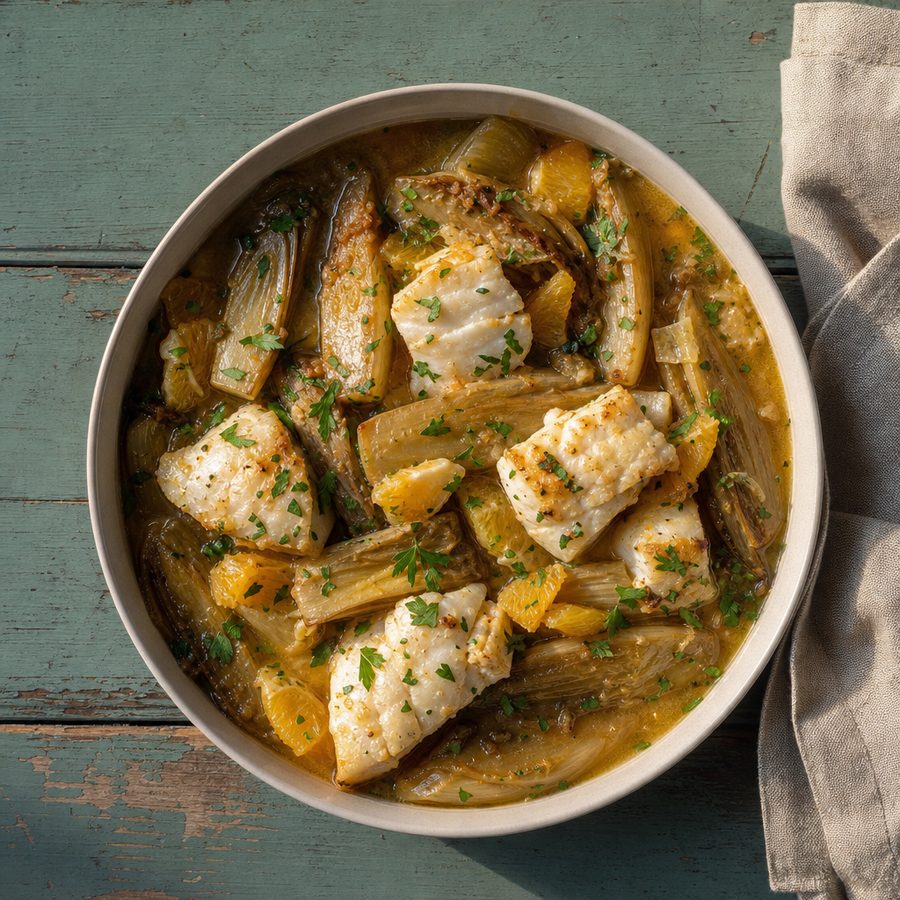
Seared Cod over Braised Endive with Orange and Coriander
Endive halves browned and braised in orange juice and broth with cracked coriander and thyme, with thick cod fillets laid on top to finish in the steam.
Why You'll Love This Recipe
Endive is the vegetable I buy when I want something that behaves. The heads are dense, they keep for two weeks, they need no washing, and halving them lengthwise gives you two flat faces that brown as reliably as a scallop. What surprises people is how completely the bitterness goes away. Browning and then twelve minutes in a little liquid turns those tight pale leaves sweet and silky, and what is left of the bitter edge is exactly enough to keep the plate from being bland. It is also fast, which is the reason it ends up on a Wednesday.
Cod is the right fish here because it is mild and thick and it wants gentle heat. Laying the fillets on top of the braise rather than searing them separately means they cook in the steam coming off the orange and broth, which keeps them from tightening and drying at the edges. When it is right, the flesh separates into big opaque flakes under light pressure and still looks slightly wet at the center of the seam. Cracked coriander seed is the flavor that ties the fish to the fruit, since it is faintly citrusy on its own and sits comfortably between the two.
This is a plate I make in the dark half of the year, when good oranges show up and I have run out of enthusiasm for roasted vegetables. It takes half an hour, it uses one pan, and it looks composed enough to put in front of company without any arranging. I do not serve anything underneath it, because the braising liquid reduces to about half a cup of intensely orange-scented broth and it deserves to be eaten with a spoon. If you want something alongside, a handful of watercress dressed with lemon is all it needs.
Ingredients
- 1 1/2 lbs thick cod fillet, cut into 4 pieces
- 4 heads Belgian endive, halved lengthwise through the root
- 2 oranges, one juiced and one cut into segments
- 2 shallots, thinly sliced
- 2 tsp coriander seed, cracked under the flat of a knife
- 3/4 cup vegetable broth
- 2 tbsp olive oil
- 4 sprigs fresh thyme
- 1/3 cup flat leaf parsley leaves, torn
- 1/2 tsp ground black pepper
- generous 1/2 tsp fine sea salt
Instructions
- Prepare the endive and orange: Halve each head of endive lengthwise straight through the root so the leaves stay attached. Juice one orange, and cut the peel and pith off the other with a knife before slicing between the membranes to release the segments. Crack the coriander seed by pressing down on it with the flat of a heavy knife.
- Brown the endive: Heat the olive oil in a twelve-inch skillet over medium-high until it shimmers. Lay the endive halves in cut side down and leave them entirely alone for four to five minutes. Resist checking. They should come up deep bronze across the whole cut face and smell nutty. Turn them cut side up.
- Start the braise: Scatter the shallots and cracked coriander into the gaps between the endive halves, tuck in the thyme sprigs, and season with half the salt and the black pepper. Pour in the orange juice and the broth. Bring it to a simmer, cover, and cook for eight minutes, until a knife slides into the thickest part of an endive with almost no resistance.
- Add the cod: Pat the cod dry, season it with the remaining salt, and lay the fillets on top of the endive rather than down in the liquid. Cover again and cook six to eight minutes depending on thickness. The fish is ready when it turns from translucent to opaque and separates into thick flakes under gentle pressure from a fork.
- Reduce and finish: Lift the cod and endive onto warm plates. Take the lid off, turn the heat to high, and let the liquid bubble for one to two minutes until it has reduced enough to coat a spoon. Spoon it over everything, scatter the orange segments and torn parsley across the top, and serve straight away.
Variations
- Fennel in place of endive: Halved and sliced fennel bulbs brown and braise the same way and want an extra three or four minutes under the lid.
- Olive and caper finish: Scatter a handful of chopped kalamata olives over the top with the parsley for a saltier, more southern version.
- Blood orange: In late winter, blood orange juice turns the braising liquid a deep sunset color and brings a faint raspberry note with it.
- Add toasted almonds: A third of a cup of sliced toasted almonds over the finished plate gives the whole thing some crunch.
- Warmer spicing: Add a small piece of cinnamon stick and two crushed cloves along with the coriander for something closer to a tagine.
Storage & Leftovers
Cod is best eaten the day it is cooked, but this keeps two days in a sealed container in the refrigerator and the endive is arguably better on day two, since the braising liquid has had time to work all the way into the leaves.
Reheat gently, covered, in a low oven or a covered skillet over low heat with a spoonful of water, five or six minutes. Anything faster will tighten the fish and turn the flakes rubbery. The microwave is not a good idea for a fillet this delicate.
The leftovers make an unexpectedly good cold plate. Flake the fish over the sliced endive, add the orange segments, spoon the jellied braising liquid over the top, and eat it at room temperature with a little more olive oil. Do not freeze it, since both the fish and the endive turn to water.
Notes & Tips
- Cut through the root: The root holds the leaves together. Cut through it lengthwise and each half stays intact, which is what lets the face brown evenly.
- Four minutes, no peeking: Every time you lift an endive half to check on it you break the contact that is doing the browning. Set a timer and leave it alone.
- Lay the cod on top, not in: Fish sitting down in simmering liquid poaches and goes soft. Sitting above it, in the steam, it firms up and keeps its flakes distinct.
- Crack the coriander, do not grind it: Whole seeds cracked under a knife give you occasional bursts of citrus and pine. Ground coriander disappears into the liquid and just tastes vaguely dusty.
- Segment the orange over a bowl: Whatever juice runs out while you cut between the membranes goes straight into the braise. Do it over the measuring cup you juiced into.
- Reduce after everything comes out: The liquid will be thin when the fish is done. Two minutes at a hard boil with the plates already dressed is what turns it into a sauce.
Nutrition & Mindful Eating
- Cod, endive, and orange are the three things on this plate and each one is doing something the others cannot. The fish brings almost all of the protein, the endive brings bulk and a bitter edge, and the orange brings the acid and sweetness that make a mild white fish worth eating.
- Cod is a firm, close-flaked white fish with a great deal of protein for how light it eats, and it carries iodine, selenium, and vitamin B12 in quantity. Cooked in steam rather than dry heat, it stays moist enough that you notice the texture as much as the flavor.
- Endive is a chicory grown in the dark, which is why the leaves stay pale, and browning turns its bitterness into something close to caramel. It brings folate and a fiber called inulin, the kind that feeds the bacteria living in your gut.
- Orange arrives twice, as juice cooked down into the braise and as cold segments dropped on at the end, and the second of those is where most of the vitamin C survives. The membranes you cut away are the bitter part, which is why segmenting is worth the extra two minutes.
- Cracked coriander seed, thyme, and softened shallots are what make the braising liquid taste like more than orange juice. Coriander is faintly citrusy and floral on its own, and cracking rather than grinding it means you meet it in bursts rather than as a background hum.
- As you eat, take a spoonful of the reduced broth on its own before you start on the fish, and let that first taste of orange and coriander set how quickly you work through the rest.
Frequently Asked Questions
My endive is still bitter. What went wrong?
It usually means the cut faces did not brown enough. Four full minutes without moving them is the minimum, and the surface should be genuinely bronze rather than pale gold. Older heads with green-tipped outer leaves are also more bitter to begin with, so choose heads that are tight, pale, and heavy.
What other fish works here?
Anything thick and mild. Halibut, hake, and pollock all behave the same way. Thin fillets like sole or tilapia will overcook before the braise finishes, so if that is what you have, cook the endive fully, then add the fish for the last three minutes only.
How do I know when cod is done without cutting into it?
Press the thickest part gently with the back of a fork. When it gives and the flesh begins to separate along its natural seams, it is ready. If you want certainty, an instant-read thermometer should show 130°F to 135°F (54 to 57°C), and it will climb a few more degrees off the heat. That is short of the 145°F (63°C) the FDA gives for seafood, so cook it further if that is the number you follow, and expect a tighter flake.
Can I use bottled orange juice?
You can, though it is sweeter and flatter than juice from a fresh orange, so add a squeeze of lemon at the end to compensate. You would still need a whole orange for the segments, which is the part of the dish people actually notice, so it is not much of a saving.