
Seared Scallops with Braised Fennel and Orange
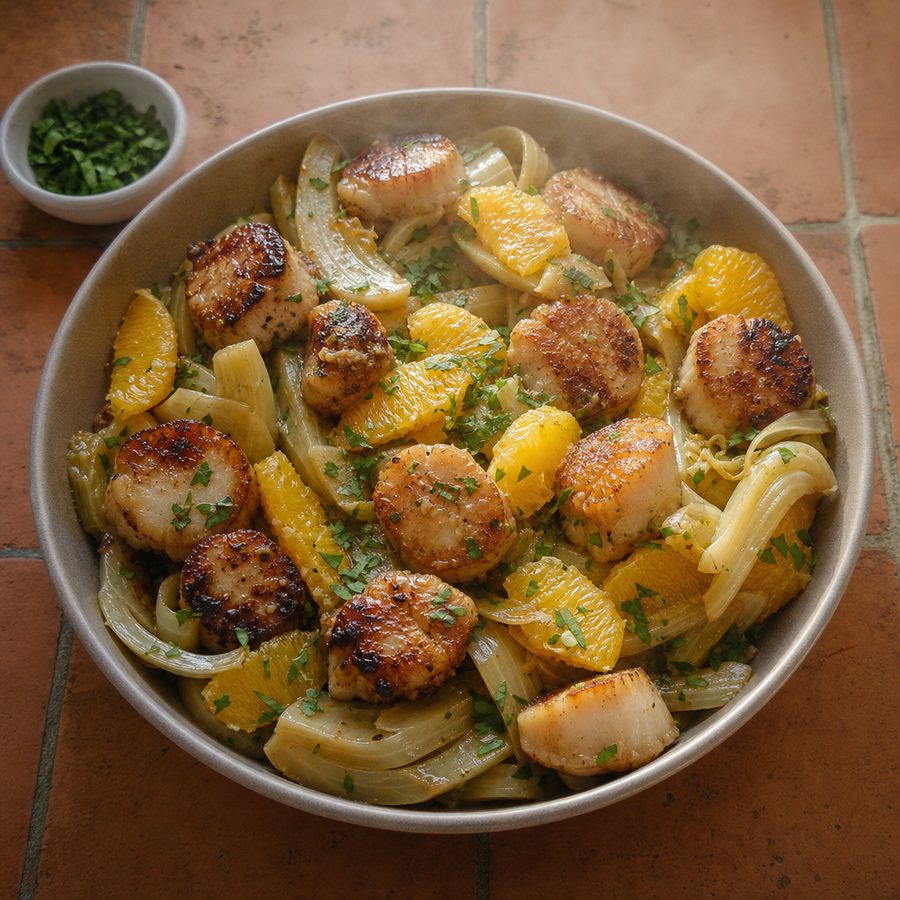
Sea scallops seared to a deep crust over fennel braised soft in orange juice and broth, with cool orange segments and parsley spooned over at the table.
Why You'll Love This Recipe
A slow Saturday, or a morning when the plate should look like it came from a restaurant and took forty minutes at most. Scallops feel extravagant and cook faster than eggs, which is a useful thing to know. I make it when I have people staying and want the first meal of the day to be memorable, and I make it for myself when the sweet, soft breakfasts of an elimination phase have started to wear thin and I want something with a crust on it.
The fennel does the slow part while you do nothing. Sliced thick and braised in orange juice and a little broth, it goes from crunchy and sharply anise-flavored to silky and mild in about fifteen minutes, and it drinks up the orange as it goes. The scallops are the opposite kind of cooking entirely: bone dry, very hot pan, ninety seconds a side, and out. What you are after is a deep brown crust on two faces with a center that is still faintly translucent, because a scallop cooked all the way through has already gone rubbery.
Scallops carry their own salt, which is why there is none added anywhere in this recipe, and the sweetness of the shellfish against the anise of the fennel is the reason this pairing keeps showing up on menus. The orange segments go over cold at the end and burst against the warm fennel, which is the moment the plate goes from good to worth making again. It is a light breakfast in feel and a substantial one in fact, and it leaves you clear-headed rather than full. Four or five scallops look modest sitting there on the fennel, and then you finish the bowl and find you have stopped thinking about food altogether.
Ingredients
- 1 lb large dry sea scallops (about 16), side muscle removed
- 2 medium fennel bulbs (about 1 lb), cored and sliced 1/4 inch thick, fronds reserved
- 2 oranges, 1 juiced and 1 cut into segments
- 1 large shallot, thinly sliced
- 3 tbsp olive oil, divided
- 1/2 cup chicken broth
- 3 tbsp chopped fresh parsley
Instructions
- Prep the fennel and orange: Trim the stalks from the fennel, saving a few fronds for the top. Halve each bulb, cut out the hard core, since it stays woody through a braise, and slice the halves a quarter inch thick. Juice one orange. Cut the peel and pith off the second with a knife and slice between the membranes to free the segments.
- Braise the fennel: Heat two tablespoons of the olive oil in a wide skillet over medium heat. Cook the shallot for two minutes, add the fennel, and let it color lightly for four minutes. Pour in the orange juice and the broth, bring it to a simmer, and cover, because fennel needs liquid and a lid to go silky rather than frying dry, then cook for twelve to fifteen minutes, until a knife slides through the slices without resistance.
- Reduce and set aside: Take the lid off and raise the heat for two or three minutes, until the liquid has reduced to a glossy few spoonfuls around the fennel. Slide it onto a plate or into a low oven to keep warm, and wipe the pan out, since scallops need a clean, dry, ferociously hot surface and anything left behind will steam them.
- Dry and sear the scallops: Pull off the small tough side muscle if it is still attached and pat the scallops completely dry on both flat faces. Heat the last tablespoon of oil in the pan over high until it just begins to smoke. Lay the scallops in with space between them and do not move them for ninety seconds, because a crowded pan drops the temperature and a scallop that is turned early leaves its crust on the metal.
- Turn and finish: When the underside is deep golden brown and releases easily, turn each scallop and cook for sixty to ninety seconds more. They are ready when the sides feel springy and the center is just barely translucent, about 125°F. Set them over the fennel, scatter the orange segments, parsley, and reserved fronds on top, and serve at once.
Variations
- Grapefruit and mint: Swap the orange for pink grapefruit and the parsley for mint if you want a sharper, more bitter edge against the sweet shellfish.
- Braised in coconut: Use coconut milk in place of the broth for a rounder, creamier fennel that suits a cold morning.
- Add greens: Wilt a few handfuls of watercress or arugula into the fennel just before serving so there is something peppery under the scallops.
- Bacon underneath: Render two slices of chopped bacon before the shallot and braise the fennel in the fat for a smokier, heartier plate.
- Root vegetables too: Add sliced parsnip or celeriac to the braise alongside the fennel when you want the meal to carry further into the day.
Storage & Leftovers
Braised fennel keeps beautifully for three days in a sealed container and is arguably better on day two, once the orange has worked all the way through it. I often braise a double batch on purpose and use the second half under fish at dinner later in the week.
Scallops are a different matter. They do not reheat, and a leftover scallop warmed in a pan goes tight and squeaky in under a minute. If you have a few left, slice them cold over the fennel with extra orange and eat them that way rather than trying to bring them back.
Do not freeze cooked scallops. Raw ones freeze well if you buy more than you need, so keep them in the freezer, thaw overnight in the refrigerator, and dry them thoroughly before searing. A previously frozen scallop needs even more drying than a fresh one.
Notes & Tips
- Dry, dry, then dry again: A wet scallop steams and turns gray. Pat both flat faces, let them sit uncovered on a paper towel for ten minutes, and pat them once more before they go in.
- Use a pan that holds heat: Cast iron or heavy stainless stays hot when cold shellfish hits it. A thin nonstick pan drops in temperature and you will never get a crust.
- Give them room: Crowded scallops release moisture and boil each other. Sear in two batches if your pan is not wide enough to leave a finger of space between them.
- Core the fennel: The wedge at the base of each half is tough and stays that way through the braise. Cut it out and the rest of the bulb goes silky.
- Keep the fronds: The feathery tops taste like a milder version of the bulb and cost nothing. Save a handful and scatter them over the finished plate.
- Do not chase the second side: Ninety seconds on the first face and about a minute on the second is the whole cook. If you are waiting for the center to look opaque, you have already gone too far.
Nutrition & Mindful Eating
- Scallops, braised fennel, and orange give you three quite different things on one plate: sweet firm shellfish, a soft aromatic vegetable, and cold bursts of fruit. Each one keeps the other two from becoming monotonous.
- Scallops are dense with protein for their size, and they bring selenium, B12, and a good amount of magnesium along with that sweet firm bite. It is why four or five of them add up to a meal.
- Fennel braised slowly loses the sharp anise flavor it has raw and turns sweet and silky, and it brings fiber and potassium along with it. Long, gentle cooking is also what makes it easy on a sensitive stomach.
- Orange goes in twice on purpose. The juice cooks down into the fennel and sweetens the braise, and the cold segments burst against the warm vegetable, carrying vitamin C that would fade if it were cooked.
- The crust on a seared scallop is the whole reason for the dry pan and the high heat. That deep brown surface is where the toasted, almost caramelized flavor comes from, and it is what makes the sweet center taste sweeter still.
- As you eat, notice how briefly a scallop was in the pan and how much flavor it picked up there, and let a plate this quick to make still be one you sit down for.
Frequently Asked Questions
What are dry scallops, and does it matter?
Dry scallops are sold without a phosphate soak, which means they have not taken on extra water. They brown properly, taste sweeter, and are worth asking for by name. Treated scallops look bright white and sit in milky liquid, and they will steam in the pan no matter how hot it is.
Why is there no salt in the recipe?
Scallops come out of the sea salty and hold that seasoning through cooking, so I let them carry the plate. Taste at the end, and if the fennel needs lifting, use a squeeze of the orange rather than reaching for the salt cellar first.
Can I use shrimp instead?
Yes. Large raw shrimp sear the same way in about the same time, two minutes on the first side and one on the second, and they suit the fennel and orange just as well. Already cooked shrimp can simply be warmed through in the fennel for a minute.
Does this fit an AIP elimination phase?
It does. Shellfish, fennel, orange, shallot, parsley, olive oil, and broth are all compliant. Check your broth, since many carry pepper or a spice blend, and use one with a short ingredient list or homemade stock.